Hangul has a well-earned reputation. It was designed to be learnable, the shapes follow a logic, and you can genuinely understand the whole system in an afternoon. Which is exactly why so many people are surprised a month later, still staring at a three-syllable word on a shop sign and assembling it letter by letter like a crossword clue.
Understanding the alphabet and reading Korean are two different skills, and only the second one gets you anywhere. The good news is that the gap closes faster than you would expect, as long as your practice is built out of real words with sound attached rather than a chart of letters you quiz yourself on.
The short version: put Korean words and short phrases on your cards, never single letters, and always with audio. Read each one out loud before you flip it. Fifteen minutes a day for two weeks will get you decoding, which no amount of staring at a consonant chart will.
What it looks like when it works
Plenty of people can point at ㄱ and say "that is g or k" and still freeze on an unfamiliar word. That is not a talent problem, it is a training problem: they trained letter identification, and then expected reading to appear on its own.
What you are actually aiming for is less dramatic than fluency and much more specific. You see a syllable block and your mouth starts moving without a long pause first. You can sound out a word you have never met smoothly enough that when the audio plays, the two roughly match. And you stop making those random vowel substitutions, because your ear has finally learned that ㅓ and ㅏ are two different categories rather than one vague sound with two spellings.
That last part is worth dwelling on. Most early reading errors are not visual, they are auditory. You guess a vowel wrong on the page because you never learned to hear the difference, and your eyes are covering for an ear that was never trained.
How to build the cards so they teach reading
One card, one Korean word or a very short phrase, in Hangul, with audio. That is the whole design. If a card has a single letter on it, you are studying a chart, and charts do not transfer.
A clean format that holds up over hundreds of cards:
- Front: the Korean word in Hangul, and nothing else competing for your eyes.
- Back: the meaning in your own language, plus audio for the Korean.
- Optionally on the back, one short note where it genuinely helps, something like "final consonant" or "tense consonant". One note, not a paragraph.
And a warning that will save you several weeks: romanization is a useful crutch for about three days, after which it quietly becomes the thing you actually read. The Hangul sits on the card and your eyes skip past it to the familiar Latin letters underneath. If you include romanization at all, make it visually secondary, and drop it as soon as you can stand to.
An order that keeps the letters from blurring
The system is logical, but your brain still wants a sensible sequence. The principle is simple: reduce confusion early, then introduce contrast deliberately once you can handle it.
Vowel contrasts first, inside words
Beginners rarely forget vowels. They mix them. So the early cards should make the differences obvious and let the audio keep you honest. The three pairs worth attacking first are ㅏ against ㅓ, ㅗ against ㅜ, and ㅡ against ㅣ, because those are the ones that collapse into mush if left alone.
Choose short, frequent words you can pronounce clearly. A reasonable starter set:
- 나 (I, informal) and 너 (you, informal)
- 오늘 (today)
- 지금 (now)
- 우유 (milk)
- 이 (this)
- 은 (topic particle)
You are not learning grammar here, and it does not matter that 은 is a particle rather than a word you would say alone. You are training your eyes and ears to stop flattening distinct vowels into one muddy sound.
Consonant families, but always through words
Korean consonants come in sets that are nearly impossible to separate by looking. They separate by listening, repeatedly, in context.
- ㄱ, ㅋ, ㄲ
- ㄷ, ㅌ, ㄸ
- ㅂ, ㅍ, ㅃ
- ㅈ, ㅊ, ㅉ
- ㅅ, ㅆ
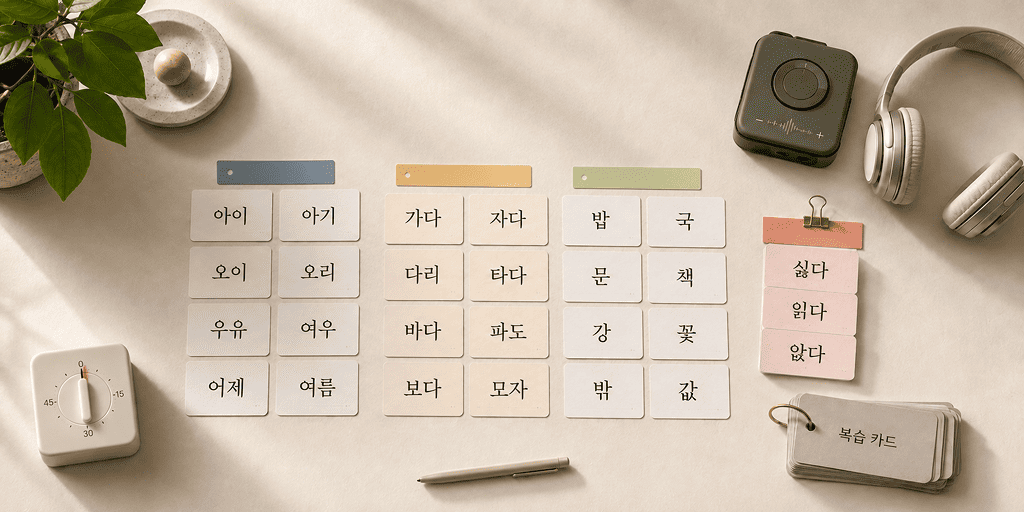
You do not need a phonetics lecture about aspiration and tension. You need enough repeated exposure in real words that your ear starts expecting the difference before you consciously notice it. Words like 가다 (to go) next to 카메라 (camera), or 바다 (sea) next to 파도 (wave), or 자다 (to sleep) next to 차 (tea, and also car), do more for you than any explanation. If one of those words feels too hard to say, swap it out. The pairing method matters, the specific list does not.
Batchim early, but gently
Batchim, the final consonant at the bottom of a syllable block, is where confident beginners suddenly start reading as though they are defusing something. Everything was going well, and now there is a consonant with no vowel after it and the rules have opinions.
Do not sit down to learn all the batchim rules. Build familiarity with sound first, starting with the endings that are easiest to hear and repeat: ㄴ, ㅁ, ㅇ. Words to start from:
- 문 (door)
- 눈 (snow, and eye)
- 밤 (night, and chestnut)
- 공 (ball)
- 사람 (person)
- 한국 (Korea)
At this stage your only job is to notice that the ending is short and clipped rather than released the way an English final consonant often is. The rules about what happens when batchim meets the next syllable can wait until you have met them a few dozen times in words.
The daily loop, and the one rule that makes it work
Here is the loop. It is deliberately boring, because boring is what becomes automatic.
Every time a card comes up, read the Hangul out loud before you flip it. Out loud, not in your head, and before, not after. Then flip, listen to the audio, and say it once more. If you were wrong, repeat the correct version twice and move on without lecturing yourself about it. That is the entire method, and the "before you flip" part is the part people skip, which is also the part that turns reading into a reflex rather than a translation exercise.
Alongside that, keep a small trouble set. Almost all of your early progress comes from fixing a handful of repeating mistakes, not from piling on new words. Usually it is a couple of ㅓ and ㅏ words, one or two ㅗ and ㅜ words, a tense consonant you keep reading as plain, and one batchim ending you keep dropping. Five or six cards, reviewed daily, will clear more confusion than fifty new ones. This is also exactly what spaced repetition is for: a card you keep getting wrong comes back soon, and one you have solid stops crowding the queue.
The four mistakes almost everyone makes
"I recognize Hangul, but I read slowly"
This is recognition without decoding practice. You can identify the pieces, but assembling them is still conscious work, and conscious work is slow.
Shrink your words for a week. More one and two-syllable cards, fewer long ones, and deliberately fast reviews of the cards you already find easy. Speed on easy material is what builds the smoothness you are missing; grinding through hard words just reinforces the pause.
Guessing vowels
If you regularly guess between ㅓ and ㅏ, or ㅗ and ㅜ, your eyes are trying to do a job your ear has not learned yet. No amount of looking will fix it.
Review vowel-contrast pairs often, and listen and repeat every single time, including on the cards you are sure you know. Those are precisely the ones where a wrong pronunciation quietly sets. That is the whole argument for learning vocabulary with audio rather than from text alone.
Treating ㄹ as one English sound
Korean ㄹ does not map cleanly onto an English r or an English l, and it behaves differently depending on where it sits in the word. Learners who try to pin it to one English letter end up with a sound that is wrong in both directions.
The practical approach is to stop labeling it and let the audio lead. Collect several words with ㄹ in different positions, like 나라 (country), 우리 (we, our), and 사람 (person), and simply repeat after the recording until your version stops sounding foreign to you.
Batchim panic
People go one of two ways here: they over-pronounce the final consonant into a full extra syllable, or they erase it entirely.
Work in small batches that share an ending, so your mouth learns one shape at a time: 문 and 눈 for ㄴ, 밤 and 사람 for ㅁ, 공 and 방 (room) for ㅇ. Say the word at a natural speed first, then check it against the audio. Slow, careful pronunciation is a trap here, because the ending only sounds right at normal speed.
A realistic ten days
This is designed to be survivable rather than heroic. Fifteen minutes, most days.
For the first three days, build clean decoding and nothing else. A small starter set of short words with unambiguous vowels, reviewed daily with the say-it-first rule, and modest additions so you are not drowning by Thursday. The goal of this stretch is confidence on easy material, not coverage.
Days four to six, add contrast on purpose. Word pairs that target whichever vowel confusion is actually yours, plus a few words that bring in the consonant families. Your trouble set exists by now, so hit it every day. This is the part where reading starts to feel less like decoding.
Days seven to ten, bring in batchim steadily. A small set with ㄴ, ㅁ and ㅇ endings, reviews kept short but consistent, and a handful of ordinary everyday words so you start noticing that you can read things that were not on a card. That noticing is the point of the whole exercise.
Drills for today
Pick one and do it now, rather than reading three more articles about Hangul.
- Add fifteen short Korean words with audio and review them once, say-it-first.
- Build five vowel-contrast pairs and go through them twice.
- Add ten batchim words with ㄴ, ㅁ and ㅇ endings and focus only on the clipped ending.
- Run a three-minute speed round on your easiest cards to train smoothness.
When to stop learning Hangul and start reading Korean
Earlier than you think. People stay in alphabet mode for months because it feels safer, and the practice stops paying off long before they leave.
A good marker: you can sound out a new two-syllable word without freezing, your pronunciation lands close enough to the audio after one check, and you can keep moving through a line of text without turning each word into a separate puzzle. That is enough. The remaining accuracy comes from reading, not from more alphabet work.
From there, keep adding common words and short phrases and let the routine do the work. Hangul stops being a subject and becomes the thing you read other subjects in.
Doing this in My Lingua Cards
My Lingua Cards is built around exactly the card format described here: each card is a word or phrase rather than a letter, it arrives with audio, and spaced repetition decides when you see it again, so the words you keep missing come back while the solid ones get out of the way. That removes the part of this plan people usually abandon, which is the scheduling.
It also trains both directions, and for Korean that matters more than usual. Recognizing 사람 on a page is one skill; producing it when you want to say "person" is another, and only the second one shows up in conversation. If you want the mechanics of that, we wrote about remembering words in both directions. Start with a small set of the short words from this article, run it daily, and add more as reading stops feeling like work.
.png)