You can spend an hour learning new words and still come up blank the moment you need one. That is not a character flaw, and it is almost never about talent. It is about method.
Strip away the branding and vocabulary learning comes down to two questions: how often do you meet the word again, and how hard do you have to work to pull it out of your head. Every method below is really a different answer to those two questions, which is why some of them hold up for months and others evaporate by Friday.
How I judge a vocabulary method
Short answer: spaced repetition is usually the best base for remembering vocabulary, because it controls both the timing of review and the act of recall. Cramming, lists, mnemonics, context and immersion all have their uses, and all of them work better sitting on top of a spaced repetition habit than on their own.
To keep this honest, the criteria have to match real life rather than the feeling of being productive.
- long-term memory: do you still know the word in a month;
- time to result: how many minutes it takes to make one word stick;
- reliability: does it work on an ordinary tired day, not only on your most motivated one;
- transfer to speech: does the word turn up when you are talking.
Keep those four in mind as we go. A method that feels excellent today and fails in two weeks is a motivational poster, not a system.
Spaced repetition
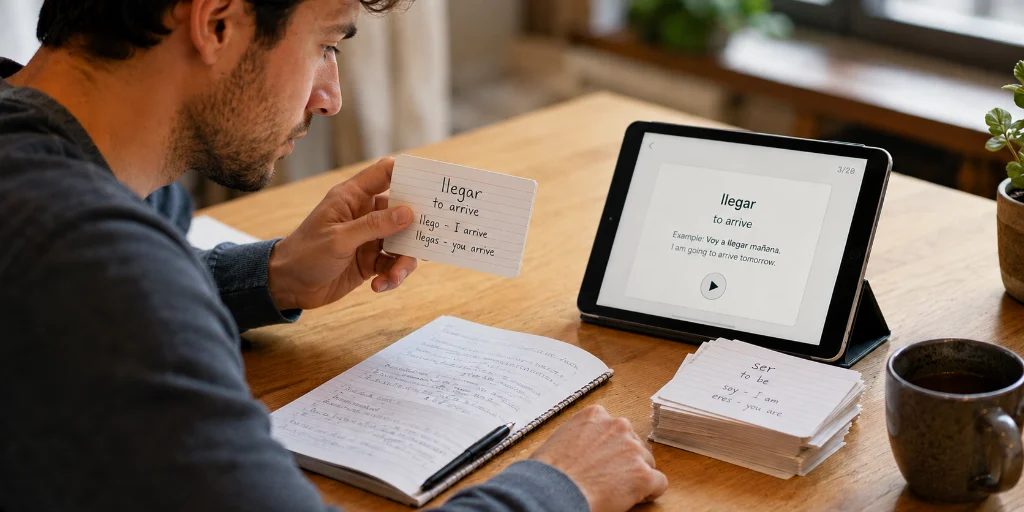
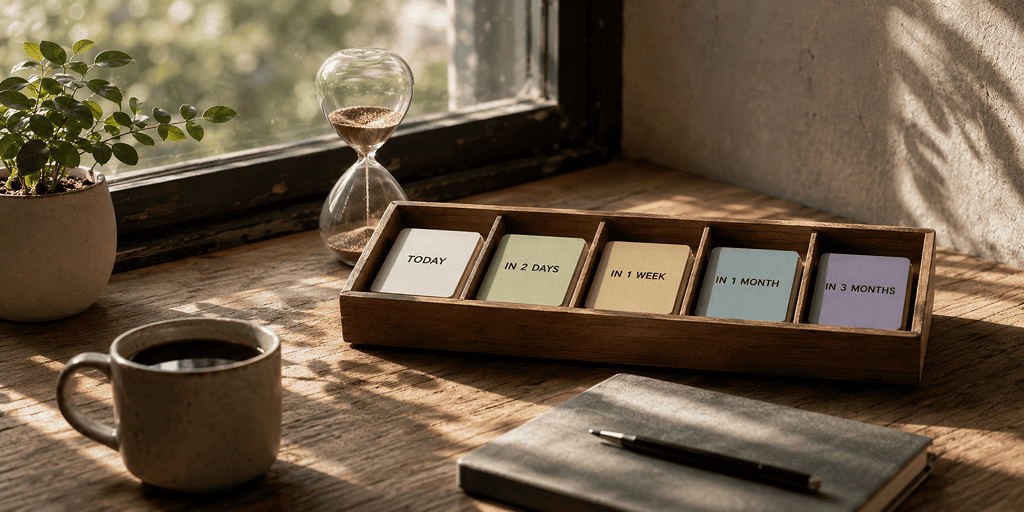
The idea is plain: you come back to a word shortly before you would have forgotten it, and the gaps grow each time you get it right. In practice that means cards, where you try to answer first and check afterwards.
Why it usually wins
Two things do most of the work. Spreading practice over time builds sturdier memory than packing the same minutes into one sitting. And trying to retrieve an answer teaches you more than reading that answer again. Spaced repetition forces both: the word comes back later, and it comes back as a question.
That is also why it holds up at scale. You can carry a few thousand words without deciding anything, because the schedule decides what today is made of. Nothing else on this list gives you that.
Where it fails, and what fixes it
Spaced repetition breaks in three predictable ways. You skip days until the queue looks like a punishment. Your cards are vague, so every review repeats the same confusion. Or you only ever see the word in the language you are learning, so you build recognition and call it knowledge.
The fixes are unglamorous. Keep sessions short and frequent, because consistency beats heroic weekends. Put a clear meaning and one natural example on each card instead of three meanings and five translations. And practice in both directions, so you can produce the word and not only understand it.
Cramming
Cramming is hitting the same words many times in a short window. It feels powerful because you get fluent fast: by the twentieth repetition the word slides off the tongue. Then it disappears, and the disappearance is not bad luck. Familiarity feels exactly like knowledge from the inside, which is what makes cramming so convincing and so temporary.
It still has honest uses. A warm-up before a lesson or a conversation, on words you already half know, is a good use of ten minutes. Emergency vocabulary for a single day is fine too. Just do not mistake either for building a vocabulary you can lean on next month: long-term memory is low, transfer to speech is lower, and the apparent speed is borrowed against the future.
Word lists
Word, translation, word, translation, repeat. Lists are tidy, comforting, and easy to do when you are tired, which is exactly why so many people never leave them.
The problem is that re-reading trains recognition. You get very good at noticing a word that is sitting in front of you, while speaking asks for the opposite: producing the word when it is nowhere in sight. You can rescue a list by covering the translation and answering before you peek, then coming back to it days later rather than only in the same sitting. At that point you have reinvented flashcards and spacing, which is a compliment to the method rather than a new one.
Mnemonics
Mnemonics are hooks: a vivid image, a silly story, a sound-alike link. For a stubborn word that refuses to enter your head politely, a good hook can do in one minute what five reviews could not.
They go wrong in two ways. Sometimes you remember the story and not the word. Sometimes the association is so heavy that it slows you down in speech, because the route to the word runs through a small cartoon. So treat mnemonics as a booster on the few words that need one, keep them short, and let ordinary review take over once the word starts coming on its own.
Context
Context means learning the word with its neighbors: not word equals translation, but the word inside a sentence people would actually say. This is where vocabulary starts to sound like language instead of like a dictionary being read aloud.
It pays off in transfer. You pick up which words travel together, you get a ready-made chunk you can reuse, and you avoid the technically correct sentence that no native speaker would produce. The trap is the same one lists have: if you only read examples, you are back to recognition. Use the context inside recall, so you are remembering a short phrase rather than reading it, and say it out loud once even if quietly.
Immersion
Immersion is volume. Words show up again and again inside real language, in the middle of things you actually want to read or watch. For anything you already half know, it is the best reinforcement there is, and it is the only method here that teaches tone and rhythm.
For brand-new vocabulary it is slow, because it controls neither of the two things that matter. You cannot arrange to meet a word again at the right moment, and you can consume for hours without ever being asked a question. A word can pass you ten times and still sit in the "I recognize it" drawer. So immersion is a background habit that makes frequent words automatic, not a plan for the words you want to use next week.
So why does spaced repetition win
Not because it is clever. Because it is the only one of these that reliably produces both mechanisms at once: the word comes back later, and you have to retrieve it. Immersion gives you contact without retrieval. Cramming gives you retrieval without spacing. Lists and context and mnemonics each solve a piece of the problem and leave the timing to you, and timing is precisely the thing people are worst at.
If you want the mechanism itself rather than the comparison, I wrote about how spaced repetition works separately.
The mistake behind most "it didn't work for me"
Spaced repetition is not immune to bad input. Most stories about it failing are, on inspection, stories about cards that teach nothing: one card carrying three meanings, an example sentence so long you never finish reading it, rare words that appear nowhere else in your life, or a single direction of practice that keeps the word passive.
A good card answers one clear question, and you can tell it is good by how little you hesitate. If you pause because you are not sure what is being asked, fix the card. Willpower is not the missing ingredient.
A plan that uses all of them
You do not have to pick one method and denounce the rest. You need a hierarchy. Spaced repetition is the spine: a short daily habit, intervals doing the scheduling, recall as the default rather than a bonus. Context rides on top of it, because phrases transfer to speech better than isolated words. Mnemonics come out only for the words that keep slipping. Immersion runs in the background and quietly turns your reviewed words into words you no longer think about.
That order matters more than the pieces. Most people do it backwards, treat input as the plan, and then wonder why the words never arrive on time.
What to do today
Fifteen minutes is enough to feel the difference, and you do not need a new app to try it.
- pick ten words you actually want to use this month, not ten impressive ones;
- write one short phrase for each that you could realistically say out loud;
- test yourself both ways, from the language you are learning and back into it;
- tomorrow, test again before you look at today's notes.
If you only keep one step, keep the testing. It is the one your future self will notice. A repeatable version of this is the fifteen-minute routine I use with cards.
Making the spacing somebody else's job
My Lingua Cards exists so you do not have to be the scheduler. Cards carry audio, examples and short explanations, and the app decides which words need attention today, so a session is whatever the schedule hands you rather than a decision you make while tired.
It also runs both directions. Words start in the direction that builds understanding, and the reverse direction arrives as they get more familiar, which is how a word moves from something you recognize to something you can say. You can start with one month free and 300 cards, and continue with a subscription if you want to go past the first three hundred words.