AI is brilliant at one thing: it answers. Instantly, patiently, and without looking at you as though you just said something unhinged in a language you have studied for four months.
So yes, AI can make language learning faster. But there is a trap that catches a lot of smart people. They start relying on AI to hold the language for them. They get great texts, great corrections, great example sentences, and then they open their mouth in a real conversation and discover the words are still not there.
That is not because AI is bad. It is because AI does not store vocabulary inside your head. You do, and a word only comes out in conversation after you have pulled it out of memory repeatedly over time. So the useful question is not whether to use AI, but which job to give it.
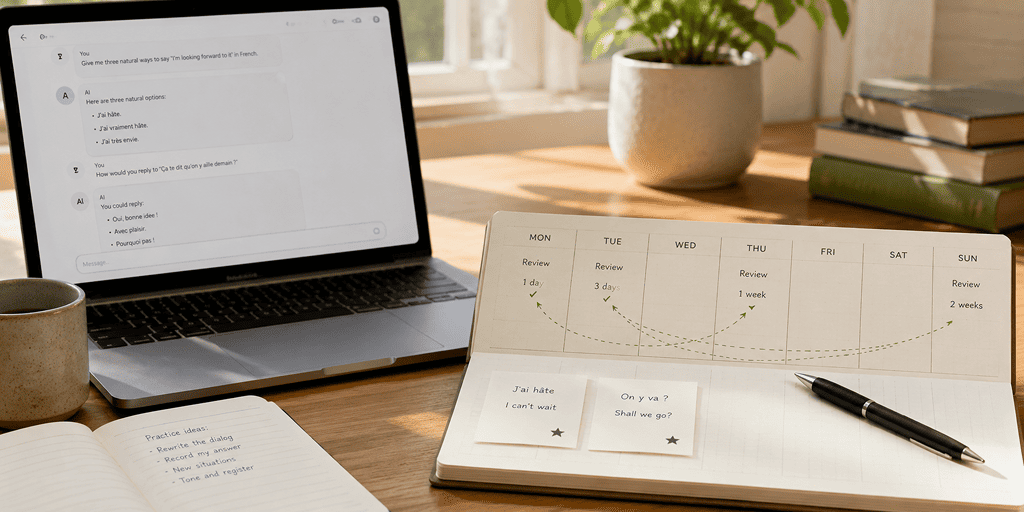
Short version: use AI to produce practice material and to fix what you write and say. Use spaced repetition to memorize the words that come out of it. Use reverse practice to move those words from recognized to said. Keep the three jobs separate and each tool does what it is good at.
What AI is genuinely good for
AI shines whenever the task is flexible and a bit creative. It will generate as many example sentences as you want, in the register you want. It will take your stiff sentence and show you how a person would actually say it. It will explain a mistake in plain words instead of grammar terminology.
It is also a very good sparring partner. It will play the receptionist, the colleague, the pharmacist or the customer support agent you are dreading, and it never gets tired of the fifth attempt. And because feedback arrives in seconds, you stop repeating the same error for months without noticing.
If you have ever wanted a private tutor who never sighs, never runs out of time and never judges, this is the closest thing available.
What AI cannot do for you
AI is not your memory. It can repeat a word back to you, remind you of a phrase, even remember what you said earlier in the chat. None of that creates the automatic recall you need when you are the one talking.
Speaking is retrieval at speed. That ability only appears when you retrieve the same words again later, then later again, with growing gaps between attempts. It is a property of your memory, not of the conversation partner, and no amount of excellent output from the other side builds it.
Skip that part and you end up with a folder of beautifully corrected text and the same freeze mid-sentence. This is the same reason vocabulary deserves to be treated as its own project rather than a side effect of grammar or chat.
A simple split that keeps you honest
The mental model that works is to give each tool one role and refuse to let them blur:
- AI generates practice and improves your output;
- spaced repetition memorizes the vocabulary;
- two-way practice moves words from recognizing them to producing them.
Once those roles are separate, you stop expecting magic from the wrong tool, and you stop blaming yourself when an AI session felt productive and changed nothing a week later.
The passive trap: reading AI output feels like learning
This is the most common AI study session. You ask for a dialogue. You read it. You understand it. You think, nice, I am improving.
You are improving a little, but mostly you are building passive recognition, which is exactly the problem with word lists. Recognition feels fluent because everything on the screen makes sense. Recall is the skill speaking needs, and reading a dialogue does not exercise it at all.
If you want AI to help you speak, active recall has to appear somewhere in the process. Either you produce the language, or you save what matters and produce it later. Reading alone is entertainment with a vocabulary flavor.
Use AI to get better example sentences
Example sentences turn a word into something usable, and AI produces them fast. The trick is asking for the right kind:
- short sentences you could realistically say;
- one clear meaning per sentence;
- natural word combinations rather than dictionary style;
- a mix of statements, questions and negatives.
A prompt that works in most languages: "Give me eight short, natural example sentences using 'to book a table'. Keep them everyday and varied. After each sentence, give a simple translation."
Then do the one thing that makes it count: pick the two best sentences and turn them into flashcards. Reading eight examples is fine. Recalling two of them across a week is what changes how you speak.
Use AI to fix your sentences, and keep the fix
Corrections are only worth something if you do not lose them. A correction loop that actually pays looks like this:
- you write your sentence;
- AI corrects it and explains the change;
- you rewrite the corrected version once from memory, without looking;
- you save the corrected phrase as a card.
The last step is where almost everyone stops too early. They read the correction, agree with it, and move on, and next week they make the identical mistake because nothing was stored. AI gives you the feedback. Cards make the feedback stick.
Use AI as a speaking trainer with controlled roleplays
Roleplay is one of the best uses of AI, because it creates the pressure to respond without the embarrassment of a real audience. Choose situations you actually face: ordering food, booking a hotel, small talk with colleagues, explaining a problem to customer support, asking for directions, talking about your work.
Then constrain it, so it becomes training rather than entertainment:
- ask it to keep replies short;
- ask it to use vocabulary at your level;
- ask it to repeat new words naturally a few times;
- ask it to correct you gently and briefly.
When the roleplay ends, do a quick harvest: collect the words and phrases you wanted to say but could not, and turn them into cards. Those gaps are the most valuable output of the entire session.
Find your missing words, one topic at a time
A far more productive request than "teach me fifty words" is "show me what I keep missing". Write a short paragraph about your day, ask AI for a more natural version, compare the two, and pick a handful of phrases you genuinely want to use. Those phrases are gold, because they come from your real life, and you will meet them again, which is exactly what makes words stick.
AI also makes it tempting to jump around: travel today, politics tomorrow, niche slang after that. It is fun, and it scatters your vocabulary. Pick one topic for a week, such as your job, health appointments, cooking and shopping, or your hobbies, and ask for dialogues, questions and mini-stories around that one topic. The same core words come back naturally, which makes them far easier to memorize and activate.
Why you still need spaced repetition with AI
Because your brain forgets on a schedule whether you approve of it or not. Spaced repetition brings words back just as they are about to fade, so you have to retrieve them again, and that act of retrieval is what strengthens memory. If you want the underlying logic, we cover it in how spaced repetition works.
AI can produce endless content, but it will not schedule the right repeats for your memory. For words to stop vanishing you need repeated recall, gaps between those recalls, and consistency across days. That boring foundation is what makes everything else on this page work.
The direction AI will not fix by itself
If you mostly read and listen, you train one direction: from the target language to your own. That builds comprehension. Speaking needs the opposite direction, from your own language to the target language, and that one grows only when you practice it on purpose.
You can do roleplays with AI for weeks and quietly avoid that direction, because AI is always ready to rescue you with a suggestion. It is helpful, and it also removes precisely the effort of recall that would have built the skill.
Reverse flashcards solve this neatly: they show you the meaning and make you produce the word. That is the exact muscle a real conversation uses, and it is the core of turning passive vocabulary into active vocabulary.
An AI and flashcards routine that fits real life
This is the routine worth recommending to a friend, because nothing about it is dramatic:
- do your daily card reviews first;
- spend five to ten minutes in an AI chat or writing exercise on one topic;
- collect five to ten useful words or phrases from that session;
- add them as cards with audio and at least one example sentence;
- do a quick reverse pass on the cards that are ready for it.
That is all. AI does what it is best at, spaced repetition does what it is best at, and neither is asked to do the other's job.
Common mistakes when studying with AI
These show up constantly, and each one feels like a reasonable choice at the time:
- treating AI like a lesson you read rather than practice you do, so everything stays passive;
- collecting far too much, because AI can produce a hundred useful phrases in seconds and your memory cannot absorb a hundred in a day;
- asking for rare words you will never use, which never stick because life never brings them back;
- letting AI carry the conversation by suggesting your replies, which feels fluent and trains no recall at all;
- not keeping the good corrections, which amounts to renting progress instead of owning it.
If you only fix one of these, fix the last. A correction that is not turned into a card is gone within a week.
What to do today
If you want a quick win, do this once and you will feel the difference:
- pick one real situation you will face this month;
- run a short AI roleplay for that situation;
- write down the five moments where you hesitated;
- turn those missing words and phrases into cards, each with one example sentence;
- review them over the next week until they come out without thinking.
You will still make mistakes. You will just make different ones, which is the entire point of practice.
Putting it into practice with My Lingua Cards
My Lingua Cards takes care of the memorize-it-properly part: vocabulary cards with examples and audio, spaced repetition that schedules the reviews for you, and two-way practice that moves words from recognition to recall.
Use AI to generate dialogues and corrections, then add the words you want to keep to your personal list in the app, which adds the translation, and let the learning session bring them back on schedule. There is one month free and 300 cards to try it without pressure, and a subscription when the routine starts feeling natural.


.png)