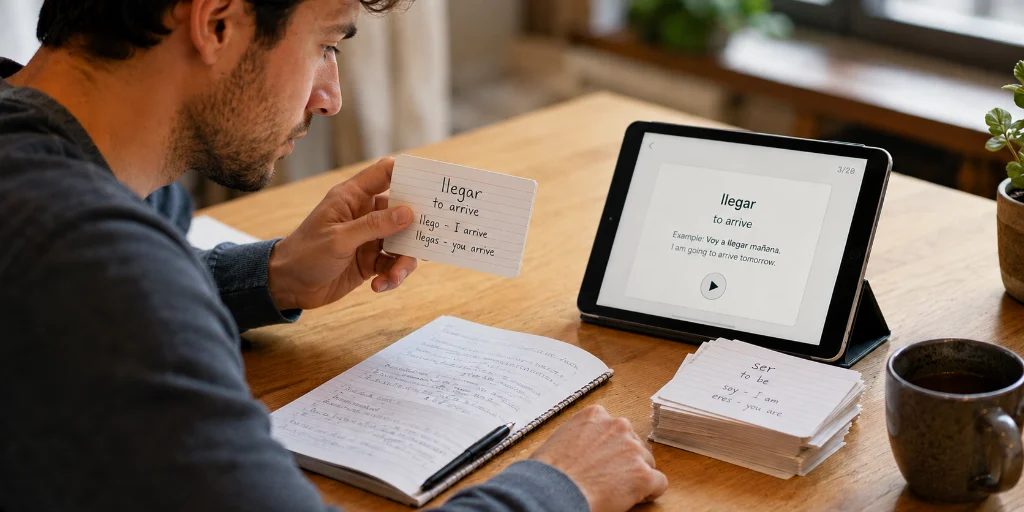
There is a particular kind of frustration that comes after six months of steady app use. Your streak is long, your lesson map is mostly gold, and then a colleague asks you something simple in the language you have been studying, and nothing comes out. You knew that word. You saw it maybe forty times. It is just not available when you need it.
That gap is not a discipline problem, and it is usually not your memory either. It is a mismatch between what you wanted and what the tool was built to give you. So before comparing prices and feature lists, it helps to notice that language apps split into two fairly different species.
Short version: if you want a guided course that teaches you a language from scratch, Duolingo, Babbel or Busuu are reasonable places to be. If your actual problem is that words slip away and refuse to come out when you speak, you want a vocabulary trainer, and that is what My Lingua Cards was built to be.
Two kinds of app, two kinds of result
The first species is the course. It hands you a path: unit one, unit two, a grammar note, a dialogue, a badge. Vocabulary shows up inside that path as material you pass through. The app decides the order, and progress means moving forward on the map. This is genuinely valuable when you are starting from nothing and have no idea what to study first, because the hardest part of week one is not memory, it is deciding.
The second species is the trainer. It assumes you already know your goal and cares about one thing: getting specific words into your head and keeping them there. There is no map. There is a queue for today, built from what your memory is about to lose. Progress means a word moved from shaky to reliable, which is less photogenic than a golden unit but much closer to being able to speak.
Neither species is better in the abstract. The error is using a course when your complaint is recall, or reaching for a bare flashcard engine when what you really need is someone to tell you where to begin. My Lingua Cards is firmly in the second category, and it is honest about that.
What My Lingua Cards actually is
It is a browser service built around vocabulary cards with audio and spaced repetition. You pick a language, you get ready-made sets of words and phrases, and you train them in short daily sessions. Nothing to install, nothing to assemble.
The part that matters is what sits on a single card. A card is not a word with a translation glued to the back. Depending on the entry, it can carry:
- the word or phrase, its transcription, and a short explanation that lands the meaning in one read;
- a longer explanation for when the short one is not enough;
- example sentences, plus a memory hint where one genuinely helps;
- an image for visual context and several audio clips: the word itself, the explanations, the examples.
Then there is the daily queue. The system decides what you see today, mixing reviews that have come due with new words when you have room for them. You are not planning a study session every morning, which is the quiet reason people keep going past week three.
The feature that changes the outcome: practice in both directions
Most people do not have a learning problem. They have a direction problem.
Seeing a word and understanding it is one skill. Starting from the meaning in your own head and producing the foreign word is a different one, and only the second is what happens when you speak. If every review you have ever done showed you the foreign word first, you have trained recognition for months and recall barely at all. That is the whole mechanism behind turning passive vocabulary into active vocabulary, and it explains why people with large reading vocabularies still stall mid-sentence.
My Lingua Cards trains both. Forward, target language to yours, builds fast comprehension. Reverse, your language to the target, builds the say-it skill. The reverse direction unlocks after you have handled a card correctly a few times going forward, which keeps it from being pure guesswork, and then the card comes back in reverse mode repeatedly until producing it stops feeling like work.
It is a small mechanical difference and it changes everything downstream. Recognition is the first step. Recall is the step that makes you speak.
Spaced repetition without the admin work
Spaced repetition is not magic, it is scheduling. Every time you review a word, the next review gets a date. Early ones come back within days, later ones stretch to weeks, and once a word has survived enough successful returns it stops crowding your queue. If you want the underlying logic, we wrote it up in how spaced repetition works.
The practical question is who keeps that schedule. You can absolutely run it yourself, and some people enjoy it. Most people discover that the schedule is exactly the part they abandon first, usually in a busy week, and by the time they come back the backlog is embarrassing enough to be avoided entirely.
My Lingua Cards runs it and shows you one thing: your queue for today. That is not a small convenience. A modest system you follow for ten minutes a day beats a beautifully tuned one you open twice a month, every single time.
What the alternatives are good at, and where vocabulary leaks
None of these apps are bad. They were built for different jobs, and most disappointment comes from asking them for a job they never claimed.
Duolingo
Nothing else gets a beginner to open an app for ninety days straight. The friction to start is nearly zero and the habit mechanics work. If your honest problem is that you never stick with anything, this is a reasonable first stop.
The leak is that you follow the app's storyline rather than your own vocabulary priorities, and much of the practice is choosing from options on screen. Choosing is recognition. Finishing the exercise becomes the goal, and recall quietly stays where it started. My Lingua Cards is narrower and more demanding: vocabulary is the product, and reverse practice is a required stage rather than a bonus.
Memrise
Its strength is exposure to how people actually talk. Real phrasing, real speed, plenty of familiarity with natural expressions. That is worth a lot for listening and for not sounding like a textbook.
The leak is familiarity masquerading as knowledge. You get very good at spotting the right answer, which feels like progress right up to the moment you have to produce the word from nothing. My Lingua Cards pushes past the point where you recognize a word and into the point where you can say it.
Anki
The spaced repetition engine is excellent and the flexibility is real. If you want to build a system precisely to your own specification, it will let you.
The leak is not the software, it is the time. You can build something great in Anki. You can also spend three weeks choosing a card template, cleaning imported decks, arguing with yourself about interval settings, and reading forum threads about the correct way to handle leeches. My Lingua Cards trades that flexibility for a workflow that is already assembled: cards arrive complete with audio, examples and context, and the progression is part of the product rather than something you configure.
Quizlet
It is fast to start and easy to make or find a set. For cramming a specific list before a specific Thursday, it does the job.
The leak is that flashcards stay a format rather than becoming a method. Without a review schedule pushing words back at you at the right moment, a set you finished in March is simply gone by June, and the loss is invisible while it happens. In My Lingua Cards the scheduling is the default, not an option you remember to turn on.
Babbel and Busuu
Both are solid guided courses with proper dialogues and grammar explained by people who can explain grammar. From zero, with a structure you can trust, they are a sensible investment.
The leak is the shape of the thing: a course ends. Vocabulary becomes material you covered rather than a set you maintain, and long-term retention is not really what a curriculum is optimizing for. A trainer works more like a gym membership than a course, which is less satisfying and more useful at month eighteen.
What actually moves the needle
Strip away the feature lists and only a few things change results.
The first is card depth. A bare word with a translation teaches you a label. The same word with its sound, an example sentence and an image gives your memory several ways back to it, which is why you stop saying "I know it but I can't find it." It also stops you learning the word with a private mispronunciation you will have to unlearn later.
The second is direction, which we covered above and which is the single biggest predictor of whether your vocabulary shows up in speech. The mechanics of training both sides are in remembering words in both directions.
The third is what happens on a bad day. Most people are not doing ninety-minute study blocks; they are doing eleven minutes on a train. A tool that hands you a ready queue survives that reality. A tool that requires a decision before you can start does not.
Matching the tool to what you actually need
The goal changes the emphasis more than it changes the method. Someone who has just moved country does not need poetry, they need about four hundred words for housing, paperwork, pharmacies and appointments, available under stress, which means reverse practice from day one. Someone preparing for work meetings needs a narrower set of field terms but the same production skill, plus a maintenance habit so the vocabulary does not evaporate when the project ends.
Exam candidates have a timing problem rather than a content problem: vocabulary crammed in a week is largely gone in a month, so daily spacing beats weekend panic even when the total hours are identical. Travelers need fast survival recall and enough audio exposure to catch words spoken at real speed. And anyone maintaining a level they already reached needs the least glamorous thing on this list: a small daily queue that keeps old words alive without turning into a project.
All of those are the same workflow with a different word list, which is precisely why a vocabulary-first tool stays useful after your goal changes.
How to choose in about two minutes
My Lingua Cards is probably right for you if:
- you want words that come out when you speak, not just words you recognize;
- your real study time is ten or fifteen minutes a day, not an evening;
- you would rather train than build and maintain a card system yourself.
Something else is probably right for you if:
- you are starting from zero and want grammar explained in a structured course;
- your main obstacle is motivation, and a streak with cheerful noises genuinely keeps you going;
- you enjoy configuring your own system and want total control over every setting.
Those are not mutually exclusive, incidentally. Plenty of people run a course for structure and a trainer for the words, and that combination is more sensible than trying to make one app do both.
A ten-minute test you can run today
You do not have to take any of this on faith. Pick ten words you sort of know and never use. For each one, write the situation where you would actually say it. Then say it out loud in a full sentence, which will feel ridiculous and is the entire point.
Now do it in both directions. Foreign word to meaning, which will be easy. Then meaning to foreign word, with nothing on screen to help you. Notice how different those two feel. Tomorrow, repeat the same ten and watch how fast the second direction improves.
That gap you just felt is the thing most apps do not train, and closing it is most of what separates understanding a language from speaking it.
Where to start
If the diagnosis fits, My Lingua Cards keeps the workflow simple: cards that arrive complete with audio, examples and visual context, spaced repetition that builds your queue for you, and two-way practice that moves words from recognized to available. There is a free period to try it on, which is long enough to find out whether ten minutes a day actually sticks for you. That is the only question worth answering.