French silent letters are the reason you can know a word perfectly on the page and miss it entirely in a podcast. You learn beaucoup, someone says it at normal speed, and your brain reports back: sorry, never met this person.
The fix is not a hundred rules. It is learning each new word as sound first, meaning second, spelling third. That order is the whole article.
The real problem is not silent letters, it is silent habits
Most of us learned our first foreign language by reading, so we built a reflex: see letters, guess a sound, move on. In French that reflex quietly manufactures a pronunciation that exists only inside your head, and then three annoying things follow.
- you do not recognize the word when you hear it, because your version sounds different;
- you say it as written, and people understand you after a beat of visible effort;
- you start doubting whether you know the word at all, when in fact you know it as spelling and not as sound.
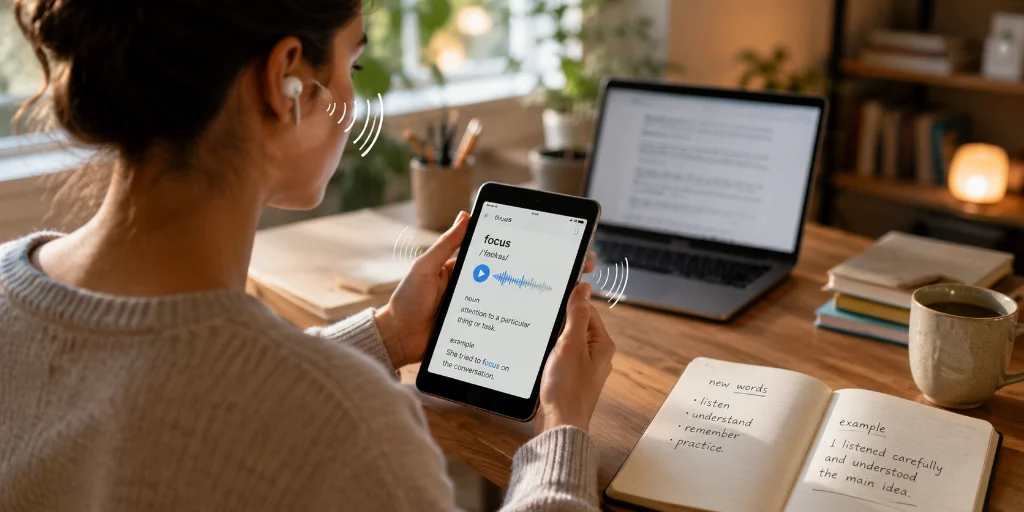
Audio fixes this at the root. Attach the right sound from the first contact and silent letters stop being a threat and start being patterns.
What "silent" actually means in French
Silent in French usually means silent sometimes. A letter can be reliably silent in a given position, mostly at the end of a word. It can be silent alone and pronounced in liaison, when the next word begins with a vowel sound. It can be silent in one word and audible in a relative of that word. Or it can be part of a spelling that signals a sound rather than being spoken itself, which is what happens with nasal vowels.
So the goal is not memorizing the exceptions. The goal is a solid sound-memory for each word, and then patterns that explain what you are hearing.
The silent-ending trap
French likes to end words with consonants that never arrive in speech. Lean on spelling and you will overpronounce them, which means storing a wrong audio file under the right meaning.
Final -s, -t, -d, -x, -p and -g are usually silent, with a decent number of exceptions. The verb ending -ent is silent in many forms, which trips up learners who expect a syllable. Plural markers behave the same way: the -s and -x you see are mostly invisible to the ear, and the article in front is what tells you the number.
A practical rule while you are learning: treat the last consonant of a new French word as suspicious until you have heard it.
The word-family trick
French spelling preserves history and family links, which is why a letter can be silent in one form and audible in another. That looks like chaos if you meet words one at a time, and like a system if you meet them in families.
Learn the word with audio, then let its relatives arrive. The silent consonant that seemed pointless often turns out to be the one you hear in the adjective or the feminine form, and at that moment spelling stops fighting you.
Liaison: the silent letter that wakes up
Liaison is a normally silent final consonant getting pronounced because the next word starts with a vowel sound. It is a large part of why French sounds like it is sliding.
For vocabulary, the consequence is simple: you have to recognize a word both with and without the bridge, or you will miss it in real speech. The dictionary form is one shape, connected speech adds a consonant, and both are ordinary French. You do not need to master every rule to benefit; you need enough real audio that a new variant does not register as a new word.
The h that is not a sound and still causes trouble
French h is generally silent, so pronunciation is not the problem. Behavior is. Some words act as if they begin with a vowel sound, which allows liaison and elision; others act as if something is blocking that, the so-called aspirated h, even though nothing is actually pronounced.
Which is another argument for learning words inside short phrases rather than as lonely dictionary entries. The phrase carries the behavior; the entry does not.
The e that disappears
The French e is often reduced or dropped in ordinary speech, especially in frequent words and endings. This is a direct cause of the classic complaint: I can read French, I just cannot understand it.
If your vocabulary came from text, you expect every vowel to show up. Real French does not cooperate, and the sooner your ear accepts that rhythm, the sooner listening starts feeling manageable. Audio from the first day is what makes learning words with audio less optional in French than in most languages.
Nasal vowels: letters that change a sound instead of being said
Certain letter combinations produce nasal vowels. The letters are not pronounced one by one; they signal a single sound.
Try to say them letter by letter and you will keep inserting consonants that are not there. Learn them by ear and the spelling becomes a label for a sound you already own.
The mistakes that cost the most
Four patterns account for most of the trouble, and none of them require overthinking to fix.
Leaving pronunciation for later
Later becomes never, or becomes expensive, because by then you are unlearning a habit rather than learning a word. Listen first and repeat once; ten seconds is enough to prevent a wrong version from forming.
Letting reading set the default
If you read a word ten times before hearing it once, the read version is the one that sticks. Flip the ratio: hear it, then read it, then hear it again with the spelling in front of you.
Learning the word but not its behavior in a sentence
Connected French moves: liaison appears, vowels drop, rhythm compresses. One short example sentence with audio teaches all three at once.
Knowing only the clean version
You recognize the careful dictionary pronunciation and lose the fast one. That needs repeated contact over time rather than one heroic session, which is exactly what spaced repetition is for.
An audio-first routine for French words
Small enough to do daily, strong enough to change how French sounds to you in a few weeks.
First contact is audio only
Before you look at the spelling, play the word, say it out loud, and copy the rhythm rather than just the vowels. If it feels silly, that is your mouth learning French.
Add meaning, then return to the sound
Once you know what it means, listen again, say it again, and only then look at how it is written. That order stops spelling from hijacking the memory.
Learn one short example sentence
Pick a sentence you can imagine actually saying, listen to the whole thing, repeat it, and notice what disappears or connects. This is where liaison stops being theory.
Let the schedule bring the sound back
French pronunciation is not learn-once. Cards that return before the sound fades keep pronunciation attached to meaning, and the reverse direction, from your language into French, is what turns recognition into speech. That second half is covered in remembering words in both directions.
What to practice today
Take eight to twelve new words and give them fifteen minutes.
- listen to each word before reading it, repeat it twice, then check the spelling;
- add one short example sentence with audio for each word;
- do an eyes-closed round: play the audio and recall the meaning;
- do a meaning-first round: see the meaning and say the French word out loud;
- finish by replaying the three trickiest words slowly, then at natural speed.
Do that a few times a week and something satisfying happens: French starts arriving as words you know instead of continuous mystery noise.
How My Lingua Cards fits this
If you want the audio to stay attached to the vocabulary without managing it yourself, build your French words as cards in My Lingua Cards: audio on the word, audio on the example, short explanations, and spaced repetition deciding what today contains.
You practice from French into your language while the word is settling, and the reverse direction opens as it gets familiar, so the word moves from recognized to sayable. You can start with one month free and 300 cards, which is plenty of room for a first batch of silent-letter troublemakers.
.png)