Most of us have been there. You read something funny, shocking or dramatic in a foreign language and think, "I will never forget that word." Three days later it is gone. Meanwhile a dull word you drilled because you had to is still there.
That gap is the whole idea behind intention to remember. Memory does not keep what felt intense. It keeps what you clearly marked as important and then actually practiced.
The good news is that you do not have to wait for motivation, drama or a "wow" moment to learn. You can build a routine that works on an ordinary Tuesday.
The trap: "If it feels strong, I will remember it"
Emotion makes a moment feel memorable. The problem is that "feels memorable" and "can be recalled later" are not the same thing. In language learning the trap looks like this:
- you collect exciting slang and dramatic phrases, then cannot find them when you speak;
- you recognize a word when you see it, but cannot produce it when you need it;
- you binge content, feel inspired, and lose most of the vocabulary because you never practiced pulling it out of memory.
Emotion works like a spotlight. It lights up a moment, but it does not file anything away. If you want words to stay, you need the filing system.
What intention to remember actually does
Think of it as a mental highlighter with a plan attached. When you explicitly decide "I am going to remember this", you tend to do several useful things without noticing:
- you pay closer attention in that moment;
- you push aside distractions and competing thoughts;
- you repeat the item in your head;
- you treat it as important, so you process it more deeply.
Emotion can grab your attention, but it does not guarantee any of the rest. For vocabulary, that deliberate processing matters a lot, because words are easy to mix up: near-synonyms, similar spellings, similar sounds and interference from your own language are everywhere.
What the remember-or-forget experiments show
Memory researchers have a classic setup called directed forgetting. People see words one at a time, and after each word they get a cue: remember this one, or forget this one. Later they are tested on all the words.
The pattern is robust: words tagged "remember" are recalled better than words tagged "forget", even though everyone saw both kinds for the same amount of time. The only difference was the decision about what to keep.
A language learner lives in this experiment every day. You meet far more words than you can keep, and the ones you deliberately choose and practice are the ones that win.
Familiarity is not memory
Here is a familiar mini-drama. You see a word in context and it feels known. You think, "I have got this one." Then someone asks you to use it in a sentence, and your brain shows a loading screen.
That happens because familiarity is a weak signal. It only says "I have seen this before". Usable memory says "I can bring this back when I need it", and the only way to build it is practice that forces retrieval.
This matters most for speaking. Recognition is enough to follow a film. Speaking without freezing needs recall, and recall is the expensive part.
How to turn intention into a routine
"Intention" sounds abstract until you attach behavior to it. These steps do that without turning your life into a productivity documentary.
Choose fewer words, and choose them on purpose
If you try to keep everything, you keep nothing. Make a small, clear selection:
- pick five to fifteen words or phrases for the day;
- choose items you expect to use this week;
- prefer short phrases to isolated words when you can, because structure helps them stick.
"Everything is important" means nothing is. If you are unsure how big the daily set should be, see how many new words per day you actually need.
Mark them with a short ritual
Before you start, look at your small list and say, out loud if you can: "These are today's remember words." It feels a little silly, and it is exactly the kind of explicit tag the experiments use.
Then start practicing immediately. The ritual only works if something follows it.
Recall instead of rereading
Rereading trains recognition. You want recall, so reverse the order:
- Look at the meaning.
- Pause.
- Say the word in the language you are learning.
- Then check.
That pause is the whole point. The effort of searching for the word is what makes it easier to find next time.
Space the repetitions
One intense session feels productive because short-term gains come fast. But a word you only met once, however deliberately, still fades if nothing brings it back.
Spacing simply means meeting the same items again later, when they are slightly harder to recall. Without it, your memory treats the words as something needed only today. The forgetting curve article explains why the timing matters.
Practice both directions
Going from the foreign word to its meaning strengthens recognition. Going from the meaning to the foreign word trains the recall you use when you speak, and that second direction is where speaking confidence comes from.
Even two minutes in the harder direction each day makes a difference. Here is why two-way flashcards work better than one-way review.
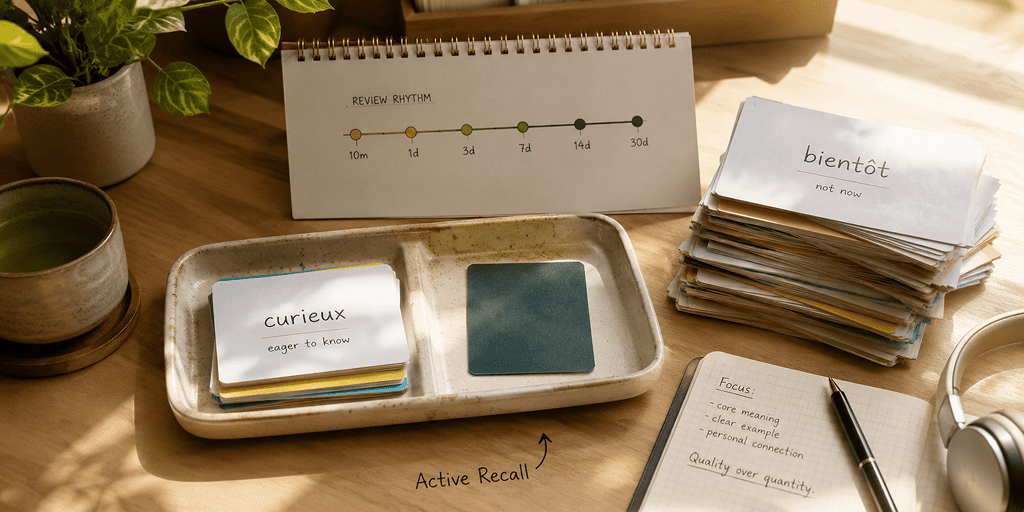
A "not now" drill against overload
You can borrow the remember-or-forget logic at home. It is surprisingly good at taming a long list. Take twenty new items and split them:
- mark ten as "remember";
- mark ten as "not now".
Study only the "remember" items today. "Not now" does not mean never, it means you are not spending today's memory budget on them. This helps in two ways:
- similar words interfere with each other less;
- you stop feeling guilty about everything you have not learned yet.
Your memory likes clear boundaries, and so does your motivation.
Where emotion does help
Emotion is not useless. It is a multiplier, not a strategy. If a word is funny, rude, scary or dramatic, give it one vivid example sentence, personal or absurd, and then do the unglamorous part anyway:
- recall the word from its meaning;
- recall it inside your sentence;
- recall it again tomorrow.
A strong first impression can make the start easier. Recall and spacing are what make the word last. Emotional words can also be misremembered with great confidence, a slightly wrong phrasing or the wrong synonym, which is one more reason to check yourself rather than trust the feeling.
Common mistakes when studying with intention
These four undo the whole approach, and each has a simple fix:
- Setting the intention, then studying passively. Saying "I will remember this" and then scrolling is hope, not intention. Follow the decision with recall.
- Too many items at once. Nobody stays committed to sixty words. Cap the list so you can finish it even on a bad day.
- Only practicing the comfortable direction. The meaning-to-word direction is harder, which is exactly why it helps. Give it at least a couple of minutes.
- Using excitement to decide what matters. A vocabulary built on drama is short on everyday words. Choose by usefulness, then add emotion through examples if you like.
A 15-minute plan for today
If you want something concrete, do this once and notice the difference:
- Pick ten words or phrases you actually want this week and name them your remember words (2 minutes).
- Listen to each word, check the meaning and say it aloud (5 minutes).
- Look at each meaning, pause, produce the word and check yourself (5 minutes).
- Do a quick round in the other direction and note the words you missed, because they are tomorrow's priority (3 minutes).
Keep it light. Consistency beats intensity.
Keeping the habit without relying on willpower
The point of intention is not to become a monk of focus. It is to take the randomness out of what you remember. Two rules help:
- make the start automatic: the same time, the same place, the same tiny ritual;
- keep the list small enough to finish even on a bad day.
If you can finish, you will come back tomorrow. If you cannot, you will start avoiding it. Motivation comes and goes, repetition is what memory responds to.
Putting it into practice with My Lingua Cards
My Lingua Cards takes care of the parts that are hard to keep up by hand. Each card has the word with its audio, translation, a description and an example sentence, and the learning session mixes new words with familiar ones that are due, so spaced repetition brings each word back as it starts to fade. Reverse practice runs as a separate session from the translation to the word, so you train recall and not just recognition.
If you want a word to be one of your remember words, add it to your personal list in the app, which adds the translation, and it joins your practice. You can try it with one month free and 300 cards, and see how quickly deliberate recall starts to feel natural.