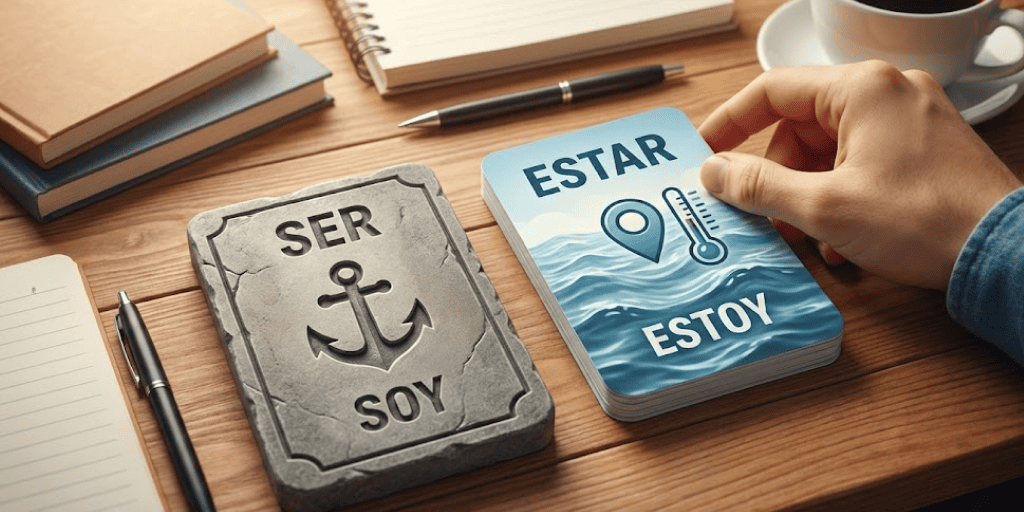
If you are learning Spanish, ser vs estar was probably the first thing that made you ask why on earth there are two verbs for “to be”. Every textbook promises to explain the difference, and you still hesitate mid-sentence.
So let us skip the theory and build a reflex instead: a small flashcard set, a few contrast pairs and fifteen minutes a day.
Why ser vs estar feels confusing
The problem is not you. It is the way these verbs are usually taught: long lists of rules, exceptions and tables that evaporate the moment you open your mouth.
In practice you need two ideas and six situations. Ser is mostly about what something is. Estar is mostly about how or where something is. Everything else is detail you will absorb from real sentences.
Three everyday uses of ser
Identity and profession: soy profesora, él es médico, somos amigos. Roles that feel like part of who someone is.
Description that belongs to the thing: el café es caliente, la casa es grande. Typical or defining qualities, not just this second.
Facts, dates and where events happen: hoy es lunes, la fiesta es en mi casa, Madrid es la capital de España.
Three everyday uses of estar
Feelings and temporary states: estoy cansado, ella está contenta, estamos nerviosos. Mood, health, tiredness.
Position and location: estoy en casa, el libro está en la mesa, estamos en el trabajo. Where people and things are right now.
Results after a change: la puerta está abierta, el café está frío, la calle está vacía.
Are there nuances and exceptions? Plenty. But if your cards drill these six situations over and over, your instinct improves long before you finish reading about the exceptions.
Why flashcards suit this problem
Ser and estar are not knowledge, they are speed. While you are talking, there is no time to scan a table in your head; you need the right verb to arrive on its own.
Cards give you three things a grammar chapter cannot. They repeat the same patterns until your brain stops deliberating. They can put two nearly identical sentences side by side, so you learn the feel instead of the label. And they can train understanding and speaking separately, which is where most people get stuck.
You do not need hundreds of them either. A compact set that keeps coming back in a smart order beats a huge deck you never finish.
Step 1: build a small core set
Aim for twenty to thirty cards you can truly master, not a hundred you half remember. Each card carries one clean pattern on the front, a short Spanish sentence where the verb is doing visible work: soy médico, estoy cansado, la fiesta es en mi casa. On the back goes the translation in your language, a one-line reason such as “identity or profession, so ser”, and nothing else. Long explanations on a card are explanations you will skip.
Group the cards by the six situations rather than alphabetically, so every batch you review has one clear job.
The card types worth having
- feelings with estar: estoy cansado, estoy enfermo, estamos contentos;
- professions and identity with ser: soy estudiante, ella es ingeniera, somos amigos;
- locations with estar: estoy en casa, el libro está en la mesa;
- events with ser: la reunión es en la oficina, el examen es por la mañana;
- description against current state: el café es caliente next to el café está frío.
That already covers most of what an ordinary day asks of you. In My Lingua Cards you can lean on the ready-made Spanish sets for the vocabulary and add your own ser and estar sentences with an explanation in your language and audio for the example.
Step 2: add the contrast pairs
The real progress on ser and estar comes from pairs where only the verb changes and the meaning moves with it.
El libro es aburrido means the book is boring, full stop. Estoy aburrido means you are bored right now. Ella es lista means she is clever, ella está lista means she is ready. El vino es bueno is a judgement about the wine, el vino está bueno is what you say after the first sip.
Make each pair either two cards with their own short notes, or one card with both sentences on the front and the contrast on the back. What matters is meeting those twins often enough that you start hearing the difference instead of reasoning it out.
Step 3: work in both directions
Most learners stop at recognition. They understand estoy cansado instantly and still freeze when they want to say “I am tired”.
So run the set both ways. From Spanish into your language, which checks that you read the verb correctly in context. And from your language into Spanish, where you have to produce the sentence yourself, out loud if you can. The second direction is slower and less pleasant, and it is the one that changes how you speak. That gap between passive and active knowledge is exactly what the reverse cards close.
My Lingua Cards shows the same card in the main direction first and brings the reverse version in later, once the sentence is familiar. With paper cards, flip the deck after a few days and go again.
A fifteen-minute daily routine
You do not need a study block for this. A short fifteen-minute routine done most days will do more than an occasional long session.
Spend the first five minutes on recognition: go through the cards from Spanish into your language, decide fast, and mark anything you hesitated on. Give the next five minutes to the contrast pairs; read both sentences aloud and say, in your own words, what changed. Use the last five minutes for production: look at the sentence in your language and say the Spanish version yourself, then repeat the correct one a couple of times whenever you pick the wrong verb.
Reading the examples out loud matters more than it sounds. The rhythm of estoy cansado is part of what makes the right verb feel right, which is also why learning with audio pays off here.
The mistakes worth a card of their own
A few traps catch almost everyone, and each one deserves its own card.
Using ser for feelings. Beginners say soy cansado, which sounds like a personality trait. Make a card that says plainly: soy cansado is wrong, use estoy cansado.
Forgetting that location takes estar. Estamos en casa, el supermercado está cerca. A one-word reminder on the back, “where”, is enough.
Mixing identity with a temporary role. Es profesor is what he is; está de profesor hoy is what he is doing today. Keep them as a pair.
And the slogan trap: “ser is permanent, estar is temporary”. It works until la fiesta es en mi casa, and then it does not. Fill the deck with sentences you would actually say and let usage teach you what sounds natural.
Whenever you catch yourself asking “ser or estar here?”, write the sentence down and turn it into a card that evening. Those are the best cards in any deck, because they came from your own hesitation.
What to do today
If you want this handled this week rather than some day, four steps are enough.
- write one or two sentences for each of the six situations, in your own words;
- turn them into twenty to thirty cards and add three contrast pairs;
- set the deck up so it runs in both directions, or plan to flip it in a few days;
- do the fifteen minutes daily for a week and keep the sentences you keep missing.
A week of that will not make you perfect. It will make you notice that you answered without thinking, which is the whole point.
Keep going
If you like drilling small, well-chosen card sets instead of rereading rules, My Lingua Cards is built for this. You get ready-made Spanish sets with example sentences and audio, you can add your own ser and estar cards from lessons or real conversations, and spaced repetition decides when each card comes back, so nobody has to plan the reviews.
Start on the free period, run the short routine for a week, and add the next grammar point that keeps tripping you up once you see that the method holds.

.png)