Learning vocabulary by topic sounds sensible from the first minute. You group words by theme, stay organized and watch the lists grow. It feels tidy and responsible.
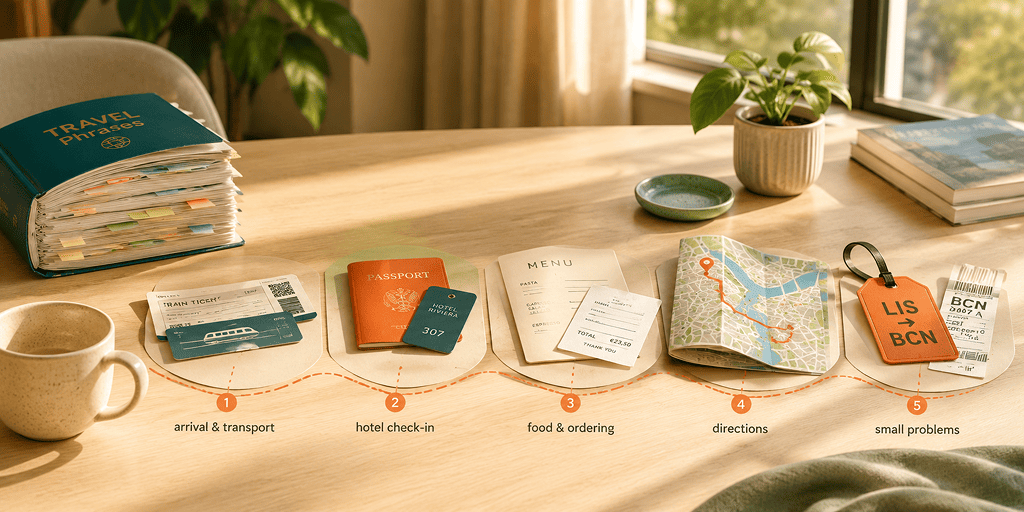
Then you open a set called "Travel" and find passport, suitcase, boarding gate, customs, hostel, sunscreen and "itinerary", a word you have seen maybe once. A week later half of it is gone, and the half that stayed is rarely the half you needed at the hotel desk.
That does not make topic-based learning a bad idea. It usually means the set was built the wrong way. Useful word sets are grouped by use, not just by subject: they cover one real situation with words and phrases that naturally appear together, which is exactly why they are easier to remember and more likely to come back when you need them.
Why big themes usually fail
The most common mistake is picking a topic that is far too wide. "Travel" is not one situation. It is ten situations wearing one coat.
Inside that single label you may be mixing moments that have almost nothing in common:
- checking in for a flight and getting through security;
- finding your hotel and asking for directions on the way;
- ordering food at a station cafe;
- writing to your host because your train is late.
Memory works better when words are tied to one clear scene. A set that reads like a page from an old textbook gives the brain nothing to hold on to, so you may recognize a few words on sight and still fail to use them in real life.
Narrow sets fix this. Instead of "Food", try ordering lunch at a cafe. Instead of "Work", try giving a short update in a meeting. Instead of "Travel", try checking into a hotel. The topic stays the same, but now the words have a job.
What makes a word set actually useful
A useful set can answer one plain question: where will I use this? If the answer is vague, the set is weak. If the answer is a specific moment in your week, the set already has a purpose, and that purpose is what makes the words stick.
One set, one situation
A small set for one real moment beats a huge set for a fuzzy topic. Introducing yourself and making small talk, ordering coffee and asking for a change, joining an online call, buying something at a pharmacy: each of these is a scene you can picture.
Words from the same scene support each other. When one of them comes to mind, the others have a good chance of following.
Not only nouns
This is where many topic lists quietly stop being useful. People build a hotel set out of hotel, room, key, bed, towel and floor, and then discover that nobody speaks in nouns. Real sentences need verbs, a few common adjectives and ready-made phrases. For the same hotel, a set that works looks more like this:
- the essentials: room, key, reservation;
- the actions: check in, check out;
- a couple of describing words: available, late;
- phrases you can say straight away: "I have a reservation", "something is not working", "could you help me?".
That starts to sound like a conversation instead of a storage label.
Small enough to finish
Big sets look impressive, small sets get learned. A compact set is easier to review, easier to hear with audio, easier to meet in example sentences and much easier to practice in both directions. If you collect eighty words in one sitting, you will probably spend the next few days pretending you still know them. Ten to fifteen items leave room for the part that matters: coming back to them often enough that they stay.
Close to your current week
The best set is rarely the most "important" one in general. It is the one you are likely to need soon. If a trip is coming, transport and hotel language beat office vocabulary. If you write to clients in English, short work messages matter more than furniture. If you freeze when someone asks a simple question, a set of basic answers will do more for you than any "advanced" topic.
How to build a strong word set
If you want topic-based learning to work, do not start with the name of a topic. Start with a moment.
Start with a situation, not a category
Before you add a single word, ask yourself a few honest questions:
- what do I want to understand better;
- what do I want to be able to say;
- in which situation do I freeze or reach for my phone;
- which conversation keeps repeating in my life?
Answers like "I cannot explain what I do for work", "I get lost ordering food" or "I lose the thread in work calls" are much better starting points than "which theme should I study now?". Each of them can become a practical set.
Build around a core
Do not add words just because they feel related. Start with five to seven central words or phrases, then add only what truly belongs to the same scene. For an online meeting the core might be join the call, mute, unmute, share your screen, discuss and deadline. After that, follow up, reschedule, bad connection and available fit naturally.
If "conference hall" sneaks in because it belongs to work in general, the set starts drifting. A good set stays honest about its one situation.
Prefer phrases to lonely words
Single words are useful, but phrases are often easier to use. You can know "delay" and still get stuck, while "sorry for the delay" or "the flight is delayed" come out whole. The same goes for "schedule" next to "what time works for you?" and "let's move it to tomorrow". People speak in chunks, not in dictionary entries, and the more your set reflects that, the sooner it becomes usable. Travel is a good place to see this in action, as we show in how to learn travel vocabulary without memorizing a phrasebook.
Signs your set is too weak
Sometimes a set looks organized and still does not work. The warning signs are usually easy to spot:
- too many rare words you are unlikely to meet;
- lots of nouns and almost no verbs or phrases;
- several different situations mixed together;
- no single real-life scene where most of the words belong.
There is also a quick test. Imagine one short conversation from the situation the set is meant for. Could most of these words appear in it together? If not, the set is too broad or too random, and it is worth splitting it.
What to study first
If you are not sure where to begin, choose situations that come back often and stay simple: talking about yourself, daily routines, asking and answering short questions, ordering food or coffee, getting around town, your work or studies, and common requests or problems. If you are starting a language from scratch, how to start when you do not know which words to learn first goes deeper into this choice.
These sets are not good because they are "beginner topics". They are good because the situations repeat, and every repeat is another chance for the words to settle in memory.
What to do today
Do not build five sets tonight and feel proud for twelve minutes. Build one useful set and make it work:
- Pick one situation you are likely to face in the next week or two.
- Write down five to seven key words or phrases for it.
- Add a few verbs and short expressions you would really say.
- Remove anything rare, vague or only loosely connected.
- Keep the set small enough that reviewing it takes minutes, not an evening.
"Introducing yourself in a simple conversation", "ordering at a cafe" or "joining an online meeting" are all good first sets. One is enough to start.
Why this works better over time
When sets are narrow, practical and reviewed regularly, they stop feeling like study material and start feeling like language you own. You meet the same words in examples, you hear them, you review them before they fade. If you also practice from your own language to the new one, they move from "I know this when I see it" to "I can say this when I need it". That second step is covered in how to remember words in both directions.
That is the difference between collecting vocabulary and building it. One looks productive. The other helps you speak.
Putting your word sets to work in My Lingua Cards
A useful set still needs repetition, context and practice, or it becomes one more nice list. In My Lingua Cards the word set library groups ready-made themed sets, and you can study them and organize your own. When you sign up you choose up to five starting themes, and the app prepares personal starter sets for them. Each card shows the word with its transcription and audio, the translation, a description, an example sentence and an image, and the learning session brings words back for review over time.
If your situation needs words that are not in a set yet, add them to your personal list, one per line, and the app adds the translation. Reverse practice, from the translation to the word, runs as a separate session and helps themed vocabulary move from recognition to recall. You can start with one month free and 300 cards, and build your first small set around a moment that is coming up this week.