
The first German words worth learning are the ones you will need in your first week: a handful of polite phrases, a dozen or so everyday verbs in the form you will say them in, the question words, the nouns of a normal day with their article and plural, the small words that hold a sentence together, and the numbers you pay with. Learn every noun as der, die or das plus the word, every word with its sound, and every word inside a short sentence. About 150 words chosen this way get you through a bakery, a train station and a first conversation with a neighbor.
This article gives you those first words, grouped by what they do for you, and then the part most lists skip: how to keep German words in memory when the article, the plural, the case ending and the sound all seem to want separate attention.
Why German words feel heavier than they are
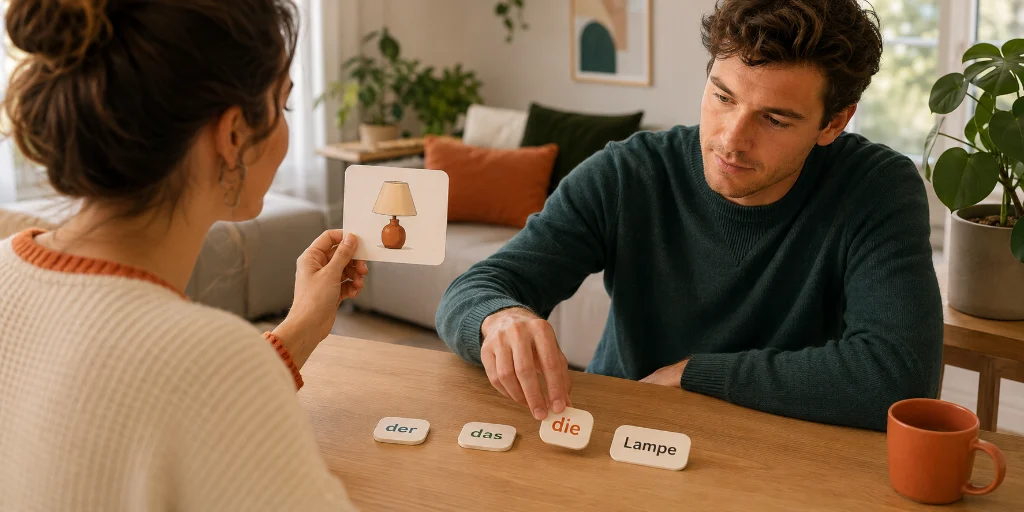
A German word carries more information than a word in English or Spanish, and the extra information is not optional. Tisch (table) is not a complete word; der Tisch is. Save the bare noun and you will spend months choosing between der, die and das in front of people. The plural is a second piece: der Zug (train) becomes die Züge, das Haus becomes die Häuser, and no rule you can learn in week one predicts both.
Then the article changes shape inside a sentence. You learned der Bus, but you ride mit dem Bus, and you wait auf den Bus. Beginners read about cases, feel lost, and conclude that German is hard. It is not hard; it is unforgiving if you learn words in isolation. A word that lives in a sentence from the start arrives with its case already attached.
Sound is the last layer. ich and Buch both have ch, and they do not sound alike. schon (already) and schön (beautiful) are different words. A learner who reads words silently invents a pronunciation and then fails to recognize the real one in speech.
A German noun is three things: the article, the word and the plural. A German word of any kind is two things: the spelling and the sound. Learn the whole item, in a sentence, or you learn half of it twice.
The first German words, by what they do for you
Treat these lists as a starting pool, not a syllabus. Someone moving to Berlin next month starts with the phrases and the nouns of daily errands; someone learning for a partner's family might start with the verbs.
Polite phrases you say whole
Learn these whole; do not analyze them yet.
- Hallo / Guten Tag – hello / good day
- Danke / Bitte – thank you / please, you are welcome
- Entschuldigung – excuse me, sorry
- Ja / Nein – yes / no
- Ich verstehe nicht. – I do not understand.
- Wie bitte? – Pardon?
- Ich hätte gern... – I would like... (how you order)
- Tschüss – bye
Everyday verbs in the form you will say
German verbs change their ending for each person, and the dictionary form (gehen, haben) is not what comes out of your mouth. Learn each verb as its ich form first, because "I" is the person you will talk about most in the first weeks, and add the dictionary form next to it so you recognize it later.
- ich bin (sein) – I am; ich habe (haben) – I have
- ich gehe (gehen) – I go; ich komme (kommen) – I come
- ich esse (essen) – I eat; ich trinke (trinken) – I drink
- ich möchte (möchten) – I would like
- ich kann (können) – I can; ich muss (müssen) – I have to
- ich brauche (brauchen) – I need
- ich verstehe (verstehen) – I understand; ich weiß (wissen) – I know
Three of these do most of the work: ich möchte, ich brauche and ich habe. With them and a noun you can ask for almost anything in a shop or an office without a single grammar rule.
Question words
- Was? – what (Was ist das? – What is that?)
- Wo? – where (Wo ist der Bahnhof? – Where is the station?)
- Wann? – when
- Wer? – who
- Wie? – how (Wie viel kostet das? – How much does that cost?)
- Warum? – why
Nouns of a normal day, with article and plural
- der Mann, die Männer – man; die Frau, die Frauen – woman; das Kind, die Kinder – child
- das Wasser – water; das Brot, die Brote – bread; der Kaffee – coffee
- das Haus, die Häuser – house; die Wohnung, die Wohnungen – apartment
- die Arbeit – work; die Schule, die Schulen – school
- der Zug, die Züge – train; der Bus, die Busse – bus; der Bahnhof, die Bahnhöfe – station
- das Geld – money; die Zeit – time; der Termin, die Termine – appointment
- die Straße, die Straßen – street; der Supermarkt, die Supermärkte – supermarket
You will notice patterns later: nouns ending in -ung are feminine, nouns ending in -chen are neuter. Notice them and keep learning the article anyway; the patterns cover some nouns, the card covers all of them.
Small words that hold a sentence together
- und – and; aber – but; oder – or
- nicht – not; kein – no, not a (Ich habe kein Geld. – I have no money.)
- auch – also; sehr – very; noch – still, another
- hier – here; heute – today; morgen – tomorrow; jetzt – now
- mit – with; für – for; zu – to; in – in
Numbers: learn the reversal early
One to twelve are single words: eins, zwei, drei, vier, fünf, sechs, sieben, acht, neun, zehn, elf, zwölf. From 13 to 19 you say the small number first: dreizehn, vierzehn. The tens are zwanzig, dreißig, vierzig and here is the part that trips everyone: 21 is einundzwanzig, "one and twenty". The reversal does not go away, so practice reading prices out loud from the first week: 4,50 Euro is vier Euro fünfzig.
How to remember German words once you have them
A list is the easy part. The four habits below are what separate people who still know these words in March from people who recognized them for a week.
1. Never save a noun without its article and plural
The memory target is der Termin, die Termine, never Termin. If the article is not on the card, you will practice the noun fifty times and the gender zero times. If you add your own words, type the article into the word itself. The full method, including what to do when a rule and your memory disagree, is in How to Remember German Noun Gender with Flashcards.
2. Learn the sound before you trust the spelling
Every card needs audio, and you need to say the word out loud before you check it. The two ch sounds, the rounded ü and ö, the r that is nothing like the English one, and the final consonants that lose their voice (Tag, Hund, lieb): none of them come from reading. The reasons go beyond German; we lay them out in Why You Should Learn Vocabulary with Audio, Not Just Text.
3. Put each word into a short sentence, and let the case come with it
German lets you build a complete, polite sentence from very little. Let the sentences do your grammar for you.
- Ich hätte gern einen Kaffee. – I would like a coffee.
- Wo ist der Bahnhof? – Where is the station?
- Ich fahre mit dem Bus. – I go by bus.
- Ich habe morgen einen Termin. – I have an appointment tomorrow.
- Das ist für die Arbeit. – That is for work.
You do not need to know what "accusative" means to say einen Kaffee; you need to have said it twenty times. When the grammar lesson comes, it will explain something you already do. A word that lives in a sentence also arrives with a slot: mit brings dem along, ich hätte gern brings a thing to order.
4. Practice from your language into German, not only the other way
Seeing die Wohnung and remembering "apartment" is recognition. Wanting to say "apartment" and producing die Wohnung, with the right article and without a pause, is recall, and recall is what you use when you speak. Give the second direction its own short practice from the first week, with the German hidden and only the meaning in front of you. If the article comes out late or wrong, that is not a failure of the method; that is the method showing you what to fix.
How to do this in My Lingua Cards
If you would rather not build the cards yourself, My Lingua Cards prepares them. Choose German as your learning language and your native language, pick a level (A1 if you are starting from zero), up to three goals and one to five starting themes. The app then prepares a starter dictionary of 300 German words for that level and those themes, sorts them into one starter set per theme, and activates the first 10 so you can start learning on the cards right away.
Each card shows the word with its transcription, audio, the translation, a short description, an example sentence and an image. On a German noun card, the article and the plural stand right under the word, so what you see every time is der Termin, die Termine, not just Termin. The example sentence adds the case: you meet mit dem Bus and einen Termin as they are used, not as a table. The learning session mixes new words with words that are due for review, so you do not decide what to study first. Reverse practice runs as a separate session, from the translation to the German word, and that is where the fourth habit lives.
Words from this article that are not in your starter set, or words you pick up from a form or a menu, go into Learning now: type them one per line, article included, or paste a short text, and the app adds the translation. Free access gives you one month and 300 cards, enough to find out whether this way of learning German works for you. Start on the German page.
Mistakes that undo a good start
- Downloading a 1,000-word list on day one. It turns learning into a backlog. Fifteen words a week that you can hear, say and recall with their article are worth more than a thousand you have seen once.
- Learning nouns without der, die, das. You will have to learn them again, and the second time is harder because the bare noun is already in your head.
- Postponing cases until "the grammar is ready". Your example sentences are your case practice. Say mit dem Bus now; understand why in month two.
- Reading instead of listening. If you have never heard schön, you will say schon and tell people something is "already" when you mean it is beautiful.
What the first two weeks can look like
Ten to fifteen minutes a day is enough. The sequence matters more than the minutes.
In the first week, take the polite phrases, the question words and six or seven verbs in their ich form: ich bin, ich habe, ich möchte, ich brauche, ich gehe, ich verstehe. Add ten nouns with their articles and plurals. Review them every day, out loud, and say each word before you flip the card. By the weekend you should be able to order a coffee, ask where something is and say that you do not understand, slowly, but without searching for the word.
In the second week, bring in the small connecting words and start the short sentences, five or six of them, built from words you already know. Add the numbers to twenty and practice three or four prices out loud. Start the reverse direction on the words from week one; they are familiar enough now that recalling them with the article is a fair test rather than a guess.
After that, add words by situation rather than by frequency rank: the words of your commute, your supermarket, your first appointment at an office. If the pace feels heavy, How to Learn Your First 200 Words in a New Language Without Burning Out shows how to slow down without stopping.
What to do today
Pick ten words from the lists above: three nouns with their articles, three verbs in the ich form, two question words and two of the small connecting words. Learn them with audio, saying each one before you check it, then write two sentences with them. That is a real first day of German. If you want the cards, the audio and the schedule ready for you, start with the German learning page and let the first 10 words come to you.
.png)