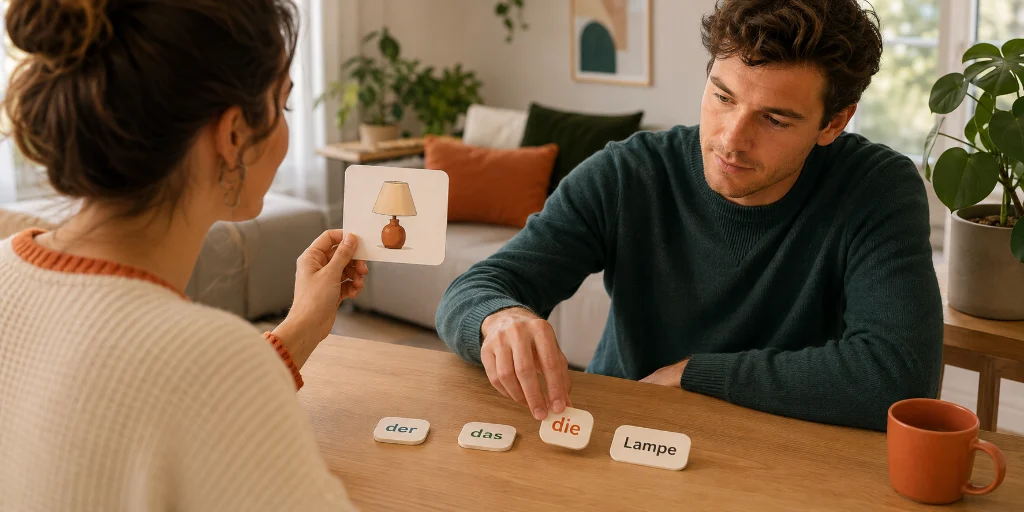
To remember German noun gender, do not learn a noun as a bare word. Learn the article and noun as one vocabulary item: der Tisch, die Lampe, das Fenster. Then practise retrieving the full phrase, not just recognizing the noun when the answer is already visible.
This simple change matters because German gender is not decoration. The article affects later choices in sentences, and a learner who memorizes only Tisch has stored incomplete information. Flashcards can fix that problem, but only when the card is designed to make the article part of every recall attempt.
Why German noun gender is easy to recognize and hard to produce
Many learners can look at der Tisch and think, “Yes, that looks right.” The difficulty appears a few seconds later when they need to say “the table” without seeing the answer. Recognition feels familiar, but speaking requires retrieval.
This is why reading lists of nouns grouped under der, die, and das often creates false confidence. The list gives you the answer before your memory has to produce it. A useful flashcard should create a small gap between the prompt and the answer so that you must retrieve the article yourself.
Do not treat gender as information attached to the noun. Treat the article and noun as one stored expression.
That means your memory target is not Haus. It is das Haus. It is not Zeit. It is die Zeit. The article should feel as inseparable from the noun as the first syllable.
Build the card around the complete noun phrase
The front of a German noun card should show the full target item whenever the German side is visible. Write der Beruf, not just Beruf. Write die Frage, not just Frage. Write das Problem, not just Problem.
In My Lingua Cards, a card can include the word, translation, description, example sentence, pronunciation support, audio, and an image. For a personal German noun card, those elements can work together like this:
- Word: die Entscheidung
- Translation: decision
- Description: feminine noun; plural: die Entscheidungen
- Example: Die Entscheidung war nicht einfach.
- Audio: listen to the word and example when available, then repeat them aloud
The crucial part is the word field. If the stored item is only Entscheidung, your reviews may strengthen the meaning while leaving the gender weak. If the stored item is die Entscheidung, every encounter reinforces the article with the noun.
Use examples to make the article meaningful
A noun and article pair is easier to remember when it appears in a short sentence. The sentence should be simple enough that the noun remains the focus:
- Der Schlüssel liegt auf dem Tisch.
- Die Rechnung kommt morgen.
- Das Hotel ist in der Nähe.
You do not need a complicated grammar explanation on every card. The goal is to see and hear the noun in natural use. A clear sentence gives the article a role rather than presenting it as an isolated label.
This also helps you notice that the article may change inside a sentence. For a beginner, that can be confusing. Keep the dictionary form visible in the card’s main word field, and use the example to show real usage. The main memory target remains der Schlüssel, die Rechnung, or das Hotel.
For more on why this works better than disconnected lists, see Example Sentences vs Word Lists: What Actually Helps You Speak Faster.
Practise in both directions
Forward practice is useful, but it is not enough. When you see das Fenster and recall “window,” the German article is already on the screen. You have recognized it, but you have not produced it.
Reverse practice is where noun gender becomes active. When the prompt gives you “window,” your answer should be the complete German item: das Fenster. When you see “experience,” retrieve die Erfahrung, not just Erfahrung.
My Lingua Cards separates forward cards from reverse practice. This gives you two useful memory checks:
- German to your language: Can you understand the noun and notice the correct article?
- Your language to German: Can you retrieve both the noun and its article without seeing either one?
The second direction is the stronger test for speaking and writing. It exposes a common weakness immediately: you may know the noun but hesitate between der, die, and das.
That hesitation is useful feedback. Do not remove the article from your answer to make the card easier. The article is part of what you are learning. The same meaning-first direction is what helps you stop translating in your head when you speak.
A practical My Lingua Cards workflow
You do not need a special gender-only course. A focused card routine is enough when every noun is stored and reviewed correctly.
- Choose one focused word set or theme. Start with a practical area such as home, food, work, travel, or daily objects. A small connected group is easier to review than a random collection.
- Check how each noun is written. Learn the noun with its definite article. If you add a personal card, put the article directly in the word field.
- Use the description for supporting information. Add a short gender note or plural form when it helps, but keep the card readable.
- Read and listen to the example. Notice the noun in context and repeat the phrase aloud when audio is available.
- Continue the learning session regularly. The session mixes familiar nouns that are due for repetition with new ones chosen by the app, so you do not have to decide what to review first.
- Add reverse practice. It runs as a separate session from the translation to the word. Retrieve the article and noun together before revealing the answer.
- Continue the same started word set. Repeated contact with one focused group is usually more productive than opening several unrelated sets.
- Use the Daily Quiz as extra practice. It is built from words you are currently studying and can add variety, but it should support rather than replace the main learning session.
The main page keeps this simple: its main action is to continue the learning session, and it shows how many cards are ready now and how many become ready in the next 8 hours. Reverse practice can appear there as an extra button. This keeps the routine focused on retrieval instead of making you decide from scratch what to study each day.
Do not rely on gender rules alone
German does have useful patterns. Certain endings often point toward a particular gender, and some semantic groups are more predictable than others. These patterns can help you make a better first guess.
They should not replace learning the complete noun phrase. A rule is useful when it reduces confusion, but it is dangerous when it makes you assume that every noun will behave the same way. Exceptions are common enough that the safest practical habit is still to store the article with the noun.
Use a rule as a clue, then use repeated recall to remember the actual item. For example, noticing a familiar ending may help you predict die Entscheidung, but the flashcard should still teach die Entscheidung as a unit.
Common flashcard mistakes with German nouns
Saving the noun without the article
This is the biggest mistake. A card for Stuhl may teach the meaning “chair” while leaving you unsure whether to say der, die, or das. Save der Stuhl instead.
Looking at the answer too quickly
Give yourself a brief, honest attempt before revealing the card. The effort to retrieve the article is the training. Immediate checking turns practice into reading.
Using forward cards only
Seeing the German phrase makes the gender feel easier than it is. Reverse practice is necessary if you want to produce the noun in conversation.
Adding too many nouns at once
Gender errors multiply when you collect a large batch and review it poorly. Learn a manageable set, complete due reviews, and add more when the earlier items are becoming stable.
Writing examples that are too complicated
A dense sentence introduces extra grammar and vocabulary. Use a short example where the noun is easy to notice. Other habits that quietly weaken cards are covered in flashcard mistakes that make you forget new words.
Memorizing a color without recalling the article
Some learners use colors as a private mnemonic. That can help, but the final answer still needs to be der, die, or das. A visual cue should support retrieval, not replace it.
A seven-day starter routine
Use this simple plan with one small set of German nouns:
- Day 1: Add or choose 8 to 10 useful nouns. Check that every noun includes its article.
- Day 2: Complete the due forward reviews. Read each article and noun aloud as one phrase.
- Day 3: Review again and pay attention to the example sentences.
- Day 4: Use reverse practice. Require yourself to recall the article before revealing the answer.
- Day 5: Continue due reviews. Mark your three weakest noun phrases for extra attention.
- Day 6: Say one new sentence aloud for each weak noun, while keeping the article correct.
- Day 7: Test the set from your language into German. Add new nouns only after completing the due work.
This routine is deliberately small. The objective is not to cover German gender in one week. It is to build the habit of storing complete noun phrases and retrieving them accurately.
What progress should look like
Do not measure success by how many gender rules you can explain. Measure it by what happens when you need a noun.
You are improving when:
- the article appears together with the noun instead of after a long pause;
- you notice immediately when a noun card is missing its article;
- reverse practice feels less like guessing;
- you can say short noun phrases and examples without checking a list;
- older nouns remain available while you add new ones.
German noun gender becomes manageable when it stops being a separate fact you try to attach later. Store the article and noun together, support them with a clear example and audio, and practise both recognition and retrieval.
My Lingua Cards gives you the card fields, focused word sets, due reviews, and reverse practice needed for that workflow. Start with one small German theme, make every noun complete, and do not accept a recalled noun without its article. You can begin with one month free and 300 cards.