.png)
Many language learners grow their vocabulary by scanning word lists, color-highlighting textbooks or flipping through silent flashcards. It seems productive, but it hides a flaw: you learn words you can spot in print, yet stall when they show up in conversation.
If your aim is to speak with ease and follow native speech in real time, sound must come first. In my view, a silent word is an unfinished one.
1. Audio prevents mispronunciations before they fossilize
When you learn a word purely as letters, your brain sketches a pronunciation using the sound system you already know. This improvised version is often inaccurate, and worse – durable.
Classic mishaps include:
- Saying com-FOR-table instead of KUMF-tər-bəl.
- Reading recipe as if it rhymes with sleep.
- Pronouncing the w in sword, or inventing vowels that aren’t there at all.
Audio fixes this at the gate. Hearing the correct stress, reduction and vowel quality from the outset is like installing quality control into speech itself.
One rule I stand by: if you haven’t heard it, you haven’t learned it.
2. The brain prioritizes sound patterns over written symbols
Spoken language does not unfold in neatly separated letters. It moves fast, compresses syllables and links consonants in ways spelling alone can’t convey.
Native speakers rely on mental storage that pairs sound and meaning first, adding spelling later.
If you only memorize text, you end up building spelling plus translation, not real recall. This leads to:
- recognizing a word instantly in reading,
- needing a pause to catch it in speech,
- and hesitating when you try to pronounce it.
Strong, active vocabulary is created when you link sound ↔ meaning and sound ↔ spelling, turning reviews into rehearsals for speech rather than decoding exercises.
3. Every card with audio is a listening task in disguise
Learners often think listening is a separate skill, practiced later through movies or podcasts. But listening really improves at the level of single words if sound is built in early.
With audio on each flashcard, you train your ear to notice:
- where the main stress lands,
- how vowels blur or shorten in connected speech,
- how certain consonants soften, overlap or drop in natural rhythm,
- and the real tempo of the word, not its imaginary textbook version.
These miniature listening sprints add up quickly. With consistent audio-first learning, your ear sharpens without scheduling “listening time” at all.
4. Audio strengthens the memory trace
Multisensory learning is not just theory – it is leverage.
When you hear a word, read it, then say it aloud within the same moment, your brain creates several recall cues at once:
- an auditory imprint,
- a visual structure,
- and motor memory for articulation.
With spaced repetition, these cues compound: a word you have heard and said aloud tends to stick better at every review.
If efficiency matters to you, audio is one of the lowest-effort, highest-return improvements available.
5. Speech confidence hinges on rhythm, not isolated syllables
Without audio, learners unknowingly assemble a personal, unofficial version of the language. It might work with other learners, but native speakers hear it differently.
Issues usually sound like:
- stress on the wrong beat,
- rigid, unreduced vowels,
- clipped rhythm between consonants,
- or sentence melody that mimics another language entirely.
Audio keeps your internal sound system aligned with the real one. Over time, this is the difference between:
“You have an accent, but your speech is clear” and
“Sorry, can you say that again?”
6. Audio nudges speaking practice into every five-second review
Silent flashcards allow passive skimming. Audio encourages immediate repetition – called shadowing, echoing, or simply practicing aloud.
Even a few seconds per word builds:
- muscle memory for unfamiliar sounds,
- quick self-correction,
- steadier articulation at speed,
- and a more natural rhythm in full sentences later.
This micro-speaking layer is often missing from vocabulary routines, yet it noticeably improves your speaking when it is added early.
7. A practical audio-first vocabulary routine
A single audio button is not enough. Order and method matter. Use it like this:
- Play audio before spelling – let sound introduce the word.
- Repeat immediately – copy stress and syllable flow, not just the sounds.
- Check spelling after listening – this locks the sound to the written form, not the other way around.
- Use audio every time you review – make pronunciation correction a habit, not an occasional fix.
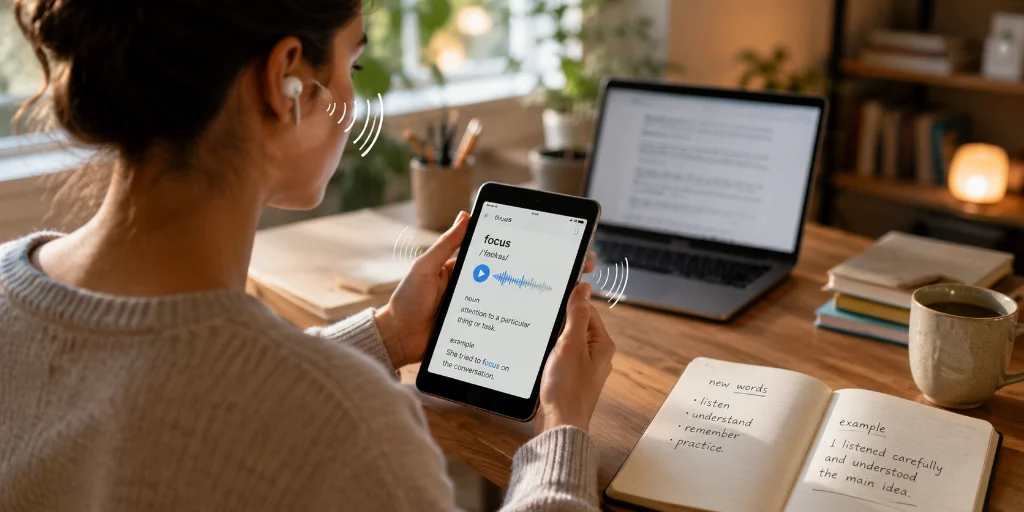
- Use sentence audio too – short examples show how the word sounds inside real speech, not only on its own.
8. How My Lingua Cards builds audio into learning
With My Lingua Cards, sound is not decoration – it is part of the workflow:
- Every word card has clear audio, so you hear the correct pronunciation from day one.
- Spaced repetition reviews bring listening and saying the word into every session.
- Replays and example sentences let you hear and see the word in context, not only in isolation.
- The result is vocabulary you can catch, pronounce and recall at speed, not only recognize when reading.
Conclusion
Learning words without sound builds recognition, but language is spoken before it is spelled. If speaking with confidence is your goal, audio is not optional; it is the track you run on.