You can improve listening comprehension through vocabulary practice, but only if you train words as sounds rather than as text alone. Many learners know enough vocabulary to understand a transcript and still miss the same words in conversation. The problem is usually not a complete lack of knowledge. It is slow or incomplete recognition of the spoken form.
The practical solution is to connect each useful word with its pronunciation, meaning, spelling, and context, then review it until recognition becomes quick. Listening gets easier when common sound patterns stop feeling new every time you hear them.
You do not improve listening by hearing more noise. You improve it by making important sound patterns easier to recognize.
Why familiar words disappear in spoken language
A word can feel familiar on a page and still be difficult to catch by ear. Written language gives you clean boundaries, stable spelling, and as much time as you need. Spoken language gives you none of those advantages.
In real speech, words may be shortened, linked to neighboring words, stressed differently, or surrounded by unfamiliar sounds. Even a simple sentence can feel fast because your brain is trying to identify several words at once while also following the meaning.
Consider a learner who knows the word probably. In writing, it is obvious. In speech, it may sound closer to “probly,” especially in a quick sentence. The learner does not necessarily need a bigger vocabulary. They need a stronger connection between the word they know visually and the form they actually hear.
This creates a common gap:
- You recognize the word after seeing subtitles.
- You understand it when someone repeats the sentence slowly.
- You miss it during normal speech.
- You remember it only after the conversation has already moved on.
Vocabulary practice can close this gap when it trains recognition speed instead of only testing translation.
Build each word as a complete listening unit
For listening, a vocabulary item is not just spelling plus meaning. It is a small package that should include several connected cues.
- Sound: what the word actually sounds like.
- Stress: which syllable carries the main emphasis.
- Spelling: how the sound maps to the written word.
- Meaning: what the word contributes in context.
- Example: how it behaves inside a natural sentence.
When one of these parts is missing, recognition becomes fragile. You may know the translation but not the pronunciation. You may pronounce the word correctly in isolation but fail to recognize it inside a sentence. You may understand the sentence after reading it but not while listening.
This is why silent word lists have limited value for listening comprehension. They help you notice vocabulary in reading, but they do not give your ear enough information to identify the same vocabulary at speed. For a deeper explanation of this foundation, see Why You Should Learn Vocabulary with Audio, Not Just Text.
Use a listen-first vocabulary routine
The order of practice matters. If you always read the word before hearing it, your brain can rely on spelling and treat the audio as confirmation. To train listening, sometimes reverse that order and let sound carry the first attempt.
1. Hear the word before you reveal it
Play the audio and pause. Try to identify the word or at least its main sound shape before looking at the answer. You do not need to guess perfectly. The goal is to make your ear work before your eyes take over.
Ask yourself:
- How many syllables did I hear?
- Where was the stress?
- Which sounds were clear?
- Did I recognize the word immediately or only after seeing it?
2. Check spelling, transcription, and meaning
After the attempt, reveal the word and compare it with what you heard. IPA or another transcription can help when spelling is misleading. The translation and description confirm meaning, while the written form connects the sound to reading.
Do not spend a minute analyzing every symbol. Focus on the feature that caused the miss. It may be an unexpected vowel, a silent letter, stress on a different syllable, or a sound that does not exist in your native language.
3. Replay and repeat once
Listen again and repeat the word aloud. Copy the whole rhythm rather than pronouncing one letter at a time. A single careful repetition is usually more useful than five distracted ones.
This is not pronunciation grading. It is a simple way to make the sound more memorable and to notice where your own version differs from the model.
4. Read the example sentence for context
An example sentence shows which meaning is active and what tends to appear around the word. This matters because listening rarely involves isolated vocabulary. Context helps you predict what is likely to come next, reducing the amount of sound you must decode from zero.
For example, learning available together with “Is this room available tonight?” prepares you for a hotel conversation much better than memorizing the translation alone.
How to practice listening vocabulary in My Lingua Cards
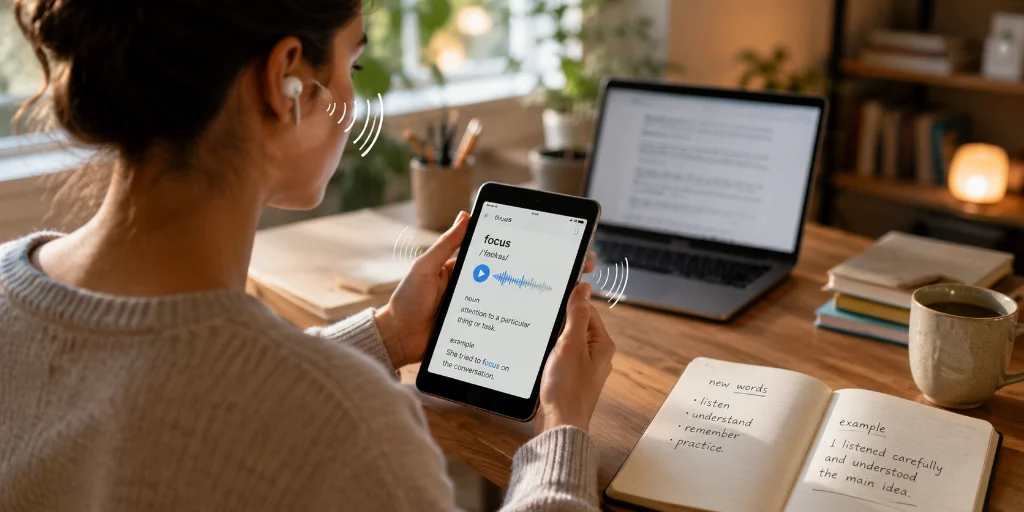
My Lingua Cards can support this workflow without turning every session into a separate listening lesson. A card can show the word, IPA or transcription, audio playback, translation, description, example sentence, and image. Use those elements in a deliberate sequence rather than revealing everything immediately.
- Continue your learning session. Returning to existing words is more important than constantly adding new ones. The session mixes familiar words that are due for repetition with new words chosen by the app, so you do not have to decide what to review first.
- Use audio before reading when possible. Make a listening attempt, then reveal the written information and check the mismatch.
- Use the example sentence to anchor meaning. Notice the nearby words and the situation in which the item appears.
- Continue with reverse practice when it is available. Producing the target word from the local translation strengthens access from another direction. It is not a listening test, but it helps prevent the word from remaining purely passive.
- Keep related vocabulary in word sets or themes. Grouping words by a real situation makes context more predictable and useful.
The main page keeps one main action in front of you: continue the learning session. Because the app decides which due and new words come next, it is harder to skip weak vocabulary and simply collect more words instead.
Choose vocabulary that will actually improve your listening
Not every unknown word deserves a card. If you save everything from a podcast or video, you create a large review burden without necessarily improving comprehension of the material you usually hear.
Prioritize vocabulary that meets at least one of these conditions:
- It appears repeatedly in the content you consume.
- It belongs to a situation you expect to face soon.
- You know it in writing but repeatedly miss it in speech.
- It carries important meaning in a sentence.
- Its pronunciation is difficult to predict from spelling.
Common verbs, connectors, everyday adjectives, and short functional phrases often improve listening more than rare nouns. Words such as actually, instead, unless, supposed to, and at least can change the meaning of a sentence, yet learners often hear them as background noise.
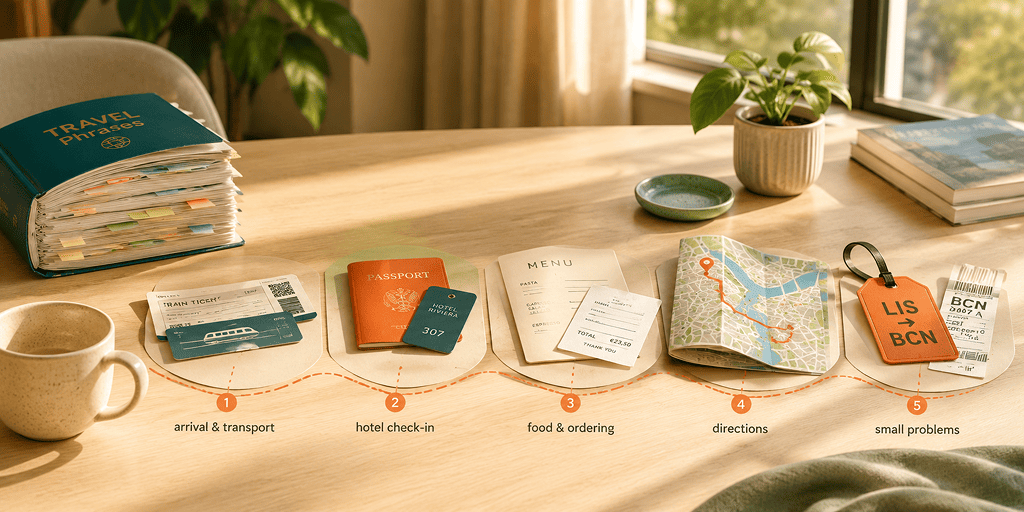
Situation-based sets are also useful. A small set for meetings, medical appointments, travel problems, or casual conversation gives you a realistic cluster of sounds and meanings. You begin to anticipate the vocabulary before it arrives, which is part of fluent listening.
A 15-minute listening vocabulary session
You do not need a long podcast session every day. A short, focused routine can strengthen the vocabulary layer that supports broader listening.
- Five minutes of due reviews: listen first on selected cards, then reveal and check.
- Four minutes of correction: replay words you missed, inspect transcription, and repeat each one once.
- Three minutes of context: read example sentences and identify the clue that makes the meaning clear.
- Three minutes of reverse practice or a started word set: strengthen access to the same vocabulary from another direction or continue a focused topic.
This routine is intentionally small. Listening recognition improves through repeated accurate encounters, not through one exhausting session followed by several days of avoidance.
For the review order behind this routine, see Daily Vocabulary Review: Should You Learn New Words or Do Repetitions First?.
Common mistakes that slow listening progress
Always reading while the audio plays
Text makes speech easier to understand, but it can hide weak listening. Use subtitles or spelling to check your answer, not automatically as the first step every time.
Treating background exposure as focused practice
Music, videos, and podcasts can increase familiarity, but passive exposure does not guarantee that you are identifying individual words. A few minutes of deliberate recognition practice can reveal what your ear is actually missing.
Adding too many new words
A large vocabulary list feels productive, but listening depends on speed and stability. Ten words you can recognize quickly are more useful than fifty words that still require translation and visual support.
Ignoring small words and short phrases
Learners often collect impressive nouns while missing the connectors and functional phrases that organize real speech. These smaller items are frequent, reduced, and easy to overlook, so they deserve focused attention.
Expecting single-word practice to solve everything
Vocabulary practice supports listening, but it is not the entire skill. You still need real sentences, different speakers, varied speed, and extended material. The purpose of vocabulary work is to reduce the number of unknown or slowly recognized elements so that broader listening practice becomes manageable.
How to tell whether the method is working
Do not judge progress only by whether you understand an entire film or podcast. That test is too broad and depends on topic, accent, speed, background noise, and grammar.
Look for smaller signs:
- You recognize reviewed words before seeing subtitles.
- You need fewer repetitions of a sentence.
- You can separate familiar words more clearly.
- You notice reductions or stress patterns that previously sounded random.
- You follow the main idea without translating every word.
These changes show that recognition is becoming faster. Over time, the mental effort previously spent decoding individual words becomes available for understanding the message.
Turn known vocabulary into language you can hear
Improving listening comprehension does not always require learning thousands of new words. Often, the fastest progress comes from rebuilding familiar vocabulary in its spoken form.
Hear the word before reading it. Check the exact sound. Connect it to meaning and context. Review it when it is due. Keep the number of new items manageable. Then use broader listening material to test whether those patterns are becoming easier to catch.
My Lingua Cards gives you the practical pieces for this routine: audio-enabled vocabulary cards, transcription, examples, due review, reverse practice, and organized word sets. Start with the words you already know on paper but regularly miss in speech, and turn each review into a small act of listening.
.png)