Travel vocabulary looks simple until you need it. Before a trip, opening a phrasebook feels responsible: airport phrases, hotel phrases, restaurant phrases, a polite sentence for every possible situation.
Then the trip starts, someone asks you a normal question, and the perfect phrasebook sentence is nowhere to be found.
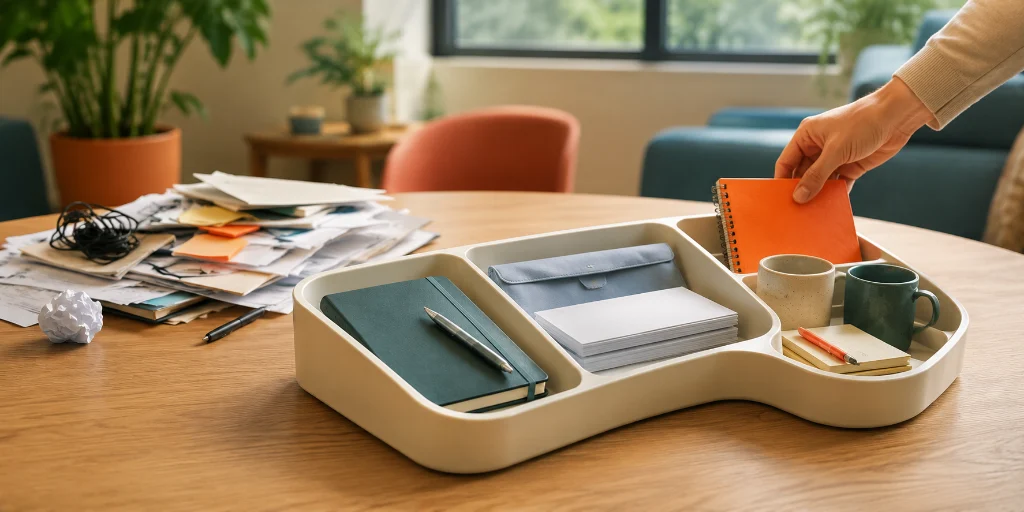
Phrasebooks are not useless. They work as quick reference. The trouble starts when you try to memorize one as if travel were a single giant topic. It is too broad, too passive and too far from what you will actually do.
A better way to learn travel vocabulary is to build small decks around situations. You do not need every word for travel. You need the words and phrases that carry you through predictable moments: airport, transport, hotel, food, directions, payment and small problems.
The short answer: learn travel moments, not travel lists
Travel is not one situation. It is a chain of small ones.
You check in for a flight. You find the right platform. You ask whether breakfast is included. You order something simple. You explain that the key card does not work.
Each moment has its own small vocabulary, and words are easier to remember when they belong to a scene. Compare two approaches:
- Weak: memorize 200 random travel words before the trip.
- Better: learn 20 useful words and phrases for the first day of the trip, then review them with audio and examples.
The second approach is smaller and far more useful. Your memory does not have to search a giant travel drawer. It knows where the word lives.
For travel, useful vocabulary is not the biggest list. It is the smallest set that helps you solve a real situation.
Why phrasebooks are hard to remember
Phrasebooks are built for looking things up, not for memory. They help when you search for a line and fail when you try to turn every line into active vocabulary.
They give you too much at once
A phrasebook may have dozens of sentences for restaurants alone. Some are useful, some are rare, some are too formal, and some you would never say even in your native language. When everything looks important, you read a lot and remember very little.
They hide the core words
Many travel situations run on a few flexible words: need, want, have, can, where, when, ticket, room, card, cash, problem, help, today, tomorrow, left, right. If you learn only full sentences, you miss these building blocks, and they are exactly what lets you adapt when the conversation leaves the script.
They train recognition more than recall
Reading a phrase and thinking yes, I understand that is not the same as saying it while you are tired, carrying luggage and looking for the right exit.
Travel needs active recall. You start with a meaning and need the words. That is why practice from meaning to the target language matters. The useful skill is not recognizing How much does it cost? but producing it when you need it.
Start with your actual trip
Before choosing words, picture your first 24 hours of travel. Not the ideal version, the real one.
Ask:
- Will I fly, take a train, drive, or arrive by bus?
- Will I need to check in at a hotel or apartment?
- Will I order food on the first day?
- Will I use public transport?
- Will I need to ask for directions?
- What small problems are realistic?
The answers give you a better plan than a generic list. A weekend in Paris needs cafe, metro, hotel, payment and directions language. A rental car in Portugal needs road, parking, fuel and insurance words. A conference needs badge, schedule, meeting point and small talk.
Travel vocabulary works best when it follows your itinerary.
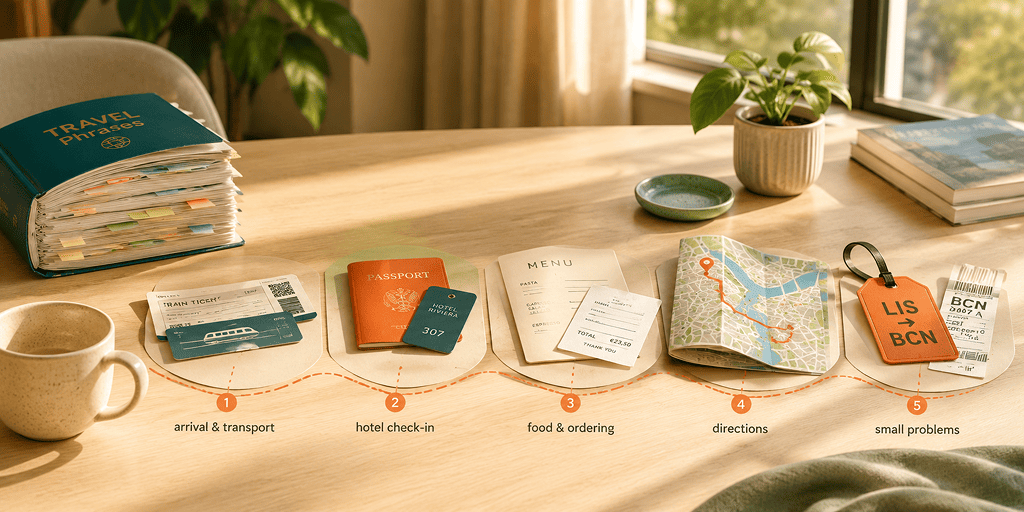
Build five small travel decks
Skip the one huge deck called Travel. Build several small decks, each with one clear job. This is the same idea as topic-based vocabulary learning, narrowed down to one trip.
1. Arrival and transport
This deck gets you from the airport, station or bus terminal to where you are staying:
- arrival
- departure
- ticket
- platform
- gate
- exit
- bus stop
- taxi rank
- one-way ticket
- return ticket
- Where is the train station?
- Does this bus go to the city center?
- How long does it take?
Notice the mix of nouns and short questions. Travel communication is not made of labels only.
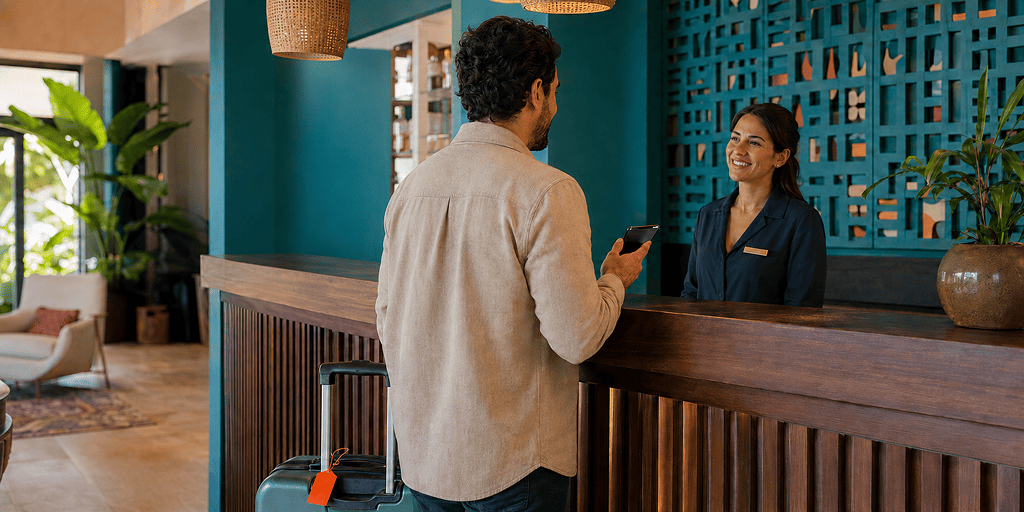
2. Hotel or apartment check-in
This deck covers the moment you arrive tired and need the room, the key, Wi-Fi and breakfast:
- reservation
- booking number
- passport
- room
- key card
- breakfast
- check-in
- check-out
- included
- I have a reservation.
- What time is check-out?
- Is breakfast included?
- The key card does not work.
It focuses on the conversation you are likely to have, which beats 50 random hotel words.
3. Food and ordering
Food vocabulary is endless, so do not learn every ingredient. Start with what helps you order, ask and avoid obvious problems:
- menu
- bill
- table
- water
- without
- with
- spicy
- vegetarian
- allergy
- I would like...
- Can I have...?
- Could we have the bill?
- Does this contain nuts?
If you have dietary needs, put those words first. Gluten-free may matter more to you than ten kinds of dessert.
4. Directions and places
Map apps help, but you may still need to ask where something is or check that you are in the right place:
- left
- right
- straight ahead
- near
- far
- corner
- street
- square
- entrance
- next to
- opposite
- Where is the nearest pharmacy?
- Is it far from here?
- Can you show me on the map?
Here audio matters most. You may know a word on a card and still miss it when someone says it quickly in the street.
5. Small problems
This is the deck people forget and then badly need. Skip dramatic emergency vocabulary at first and start with ordinary trouble:
- lost
- broken
- late
- cancelled
- delayed
- wrong
- receipt
- refund
- help
- I cannot find...
- Something is wrong.
- My bag is missing.
- The room is too noisy.
- Could you help me?
These words reduce panic because they give you language for the moment the plan stops being clean.
Use a simple formula for each card
A travel card needs more than a translation. It should show the word inside a realistic sentence:
- word or phrase
- clear meaning
- short example sentence
- audio or pronunciation support
- reverse practice from meaning to target language
Do not learn only included = part of the price. Learn it inside a travel sentence: Is breakfast included? Now the word has a home, and you are preparing for a real question.
The same works for delayed in The flight is delayed. and for receipt in Can I have a receipt? Short normal sentences beat beautiful complicated ones, because you will need them under pressure.
Do not learn only polite full sentences
Polite phrases are useful, but one unexpected answer can break a memorized sentence. I would like to buy a ticket to the city center. is fine. You also want the smaller pieces:
- ticket
- to the city center
- one-way
- return
- today
- tomorrow
- how much
- which platform
These pieces keep you going when the sentence changes. You say less, but you still communicate, and that is the real goal of beginner travel vocabulary.
Practice in the direction you will need
When you travel, the prompt in your head is a need in your own language: ask for the bill, find the station, explain a problem. Your practice should start there too:
- Ask where the bus stop is.
- Say that you have a reservation.
- Ask whether the train is delayed.
- Ask for the bill.
- Say that the key card does not work.
- Ask someone to show you on the map.
Answer in the language you are learning. This is much closer to a real trip than reading target-language phrases and checking the translation. It is also how you start reducing mental translation: not by thinking in the language all day, but by building a faster path from a need to a usable phrase.
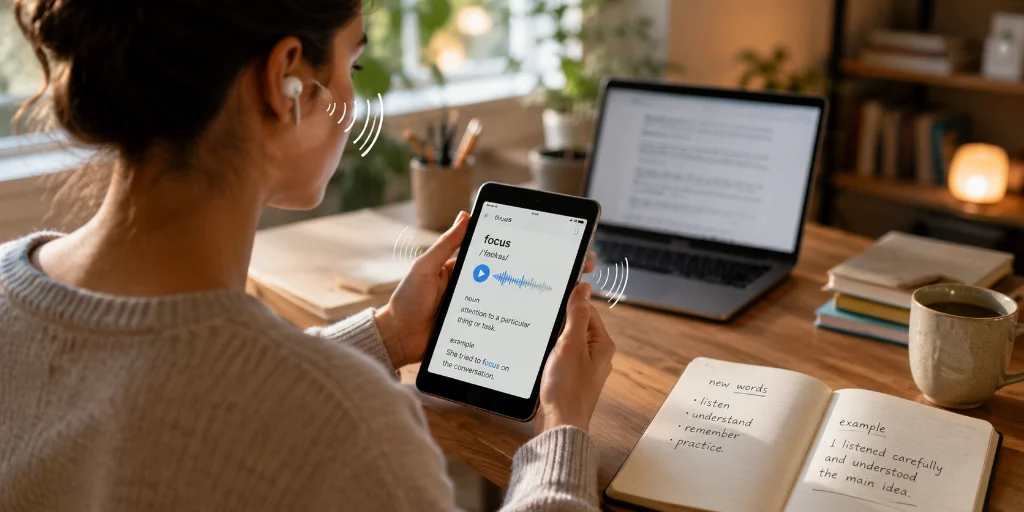
Add audio before the trip, not at the airport
Airports, stations, restaurants and busy streets are hard places to listen. If you know a word only as text, you may freeze when you hear it. For every deck, listen to the audio and repeat key phrases out loud, especially:
- directions
- numbers
- times
- transport words
- food words you must understand
- problem phrases
You are not trying to sound perfect. You want the words familiar enough that they do not sound new in the real situation. If listening is your weak spot, see how vocabulary practice improves listening comprehension.
How many words should you learn before a trip?
For a normal short trip, 80 to 150 well-chosen words and phrases are usually worth more than 500 half-known items. A practical split:
- 20 to 30 items for arrival and transport
- 15 to 25 items for hotel or apartment check-in
- 20 to 30 items for food and ordering
- 15 to 25 items for directions
- 15 to 25 items for small problems
Adjust the mix to your trip. A hiking trip needs weather, trail and distance words. A work trip needs meeting, schedule and invoice phrases. A family trip may need stroller, toilet and pharmacy. Do not chase an impressive number. Chase the situations you will actually meet.
A seven-day travel vocabulary plan
If your trip is soon, use a simple one-week routine.
Day 1: choose the situations
Write down the first five situations you expect and keep them narrow: airport arrival, hotel check-in, lunch, a transport ticket, directions.
Day 2: add the first 30 items
Choose the most useful words and phrases with short examples. The deck should feel light enough to review.
Day 3: review and say answers out loud
Start with due reviews. Pause before revealing answers, listen to the audio and repeat each phrase once.
Day 4: add problem phrases
Add language for delays, missing items, wrong orders, broken key cards, payment trouble and asking for help.
Day 5: practice reverse prompts
Start from meaning: ask for the bill, say the room is noisy, ask where the station is. Produce the phrase before you look.
Day 6: do mini roleplay
Take one situation and say five short lines: arrive at the hotel, mention the reservation, ask about breakfast and check-out, report that the key card does not work.
Day 7: review only
Do not add a pile of new words the night before the trip. Make the items you already chose easier to reach.
The plan is modest on purpose. You will not be fluent in a week, but you can remove a lot of avoidable helplessness.
How My Lingua Cards can help
My Lingua Cards fits this kind of preparation because it treats vocabulary as memory you come back to, not a page you read once.
Word sets and themes let you organize travel vocabulary by situation instead of one giant mixed list. A card shows the word or phrase with its IPA transcription, audio, translation, description, example sentence and image, which gives each travel item more than one route into memory.
The spaced repetition schedule brings words back before they fade. Reverse practice is a separate session that runs from the translation to the word, the harder direction you need when you start from ask for directions and must produce the phrase. The main page keeps one main action – continue the learning session, which mixes words due for repetition with new words chosen by the app – so you do not spend the session deciding what to do.
For travel, that structure matters. You are not admiring a long list. You are making a small group of phrases available at the exact moment you need them.
Common mistakes to avoid
Learning rare tourist words too early
Itinerary, souvenir and landmark can be useful, but they are rarely more urgent than ticket, room, left, right, help and how much.
Ignoring numbers and times
Travel runs on numbers: platform 4, room 217, 8:30, 15 minutes, two tickets, third floor. Review them with audio.
Only learning nouns
Nouns label the world. Verbs and phrases let you act in it. Add need, want, go, take, pay, change, wait and short question patterns.
Adding too much the night before
Last-minute cramming feels productive but builds fragile memory. The night before a trip is for review.
Skipping the problem deck
The most valuable phrases are often the boring ones: something is wrong, I cannot find it, the card does not work, could you help me?
Final thought: travel vocabulary should make the trip easier
You do not need to memorize a phrasebook to travel with more confidence. You need a small set of words and phrases that match the trip in front of you.
Build decks around real moments. Keep them small. Add examples and audio. Practice from meaning to the target language. Review before adding more. Then the useful phrases show up quietly when you need them. You can start in My Lingua Cards with one month free and 300 cards.