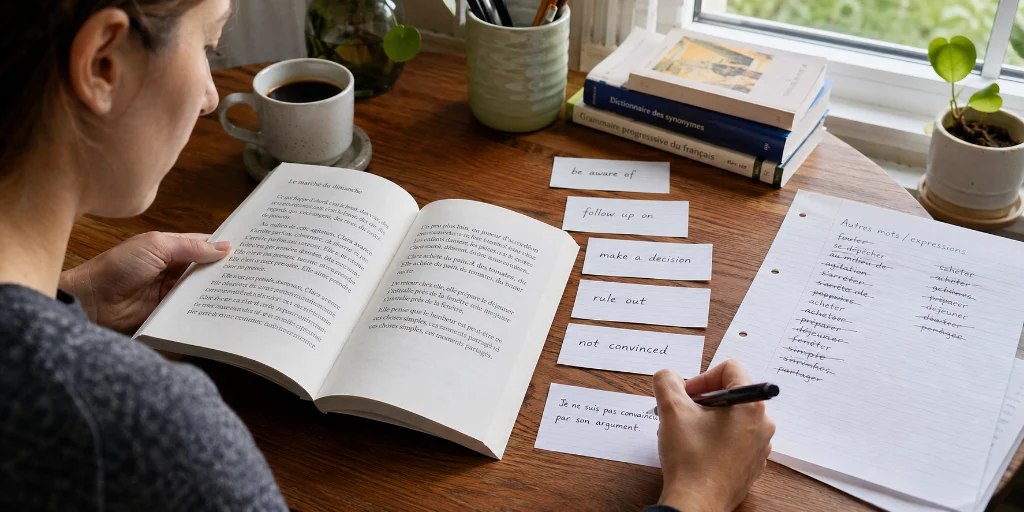
Reading is one of the best ways to grow your vocabulary, but saving every unfamiliar word is usually the fastest way to make the process exhausting. A better method is to read for meaning first, notice which words matter, and keep only a small number that are useful enough to review later.
The goal is not to turn every article, book chapter, or graded reader into a giant vocabulary list. The goal is to identify words and phrases that are likely to appear again, help you understand more, or give you something you genuinely want to say. Those are the items worth turning into active study material.
A word earns a place in your review routine because it is useful, repeated, or personally relevant, not simply because it is new.
Why reading helps vocabulary grow
Reading gives words something isolated lists cannot provide: context. You see who uses the word, what usually comes before and after it, whether it sounds formal or casual, and what kind of situation makes it useful.
That context helps in several ways:
- You can often infer the approximate meaning before checking a translation.
- You notice common word combinations instead of learning a word as a disconnected label.
- You meet grammar and vocabulary together in a natural sentence.
- You see the same useful items return across different texts.
Repeated encounters are especially valuable. The first time you see a word, it may feel vague. The second time, you recognize its shape. By the third or fourth encounter, you may understand it without stopping. Reading creates these encounters naturally.
However, exposure alone does not guarantee reliable recall. You may recognize a phrase in a story and still be unable to produce it in conversation. Reading is excellent for discovery and reinforcement, but selected vocabulary still benefits from deliberate review.
Why saving every unknown word backfires
Many learners begin with a strict rule: if a word is unknown, it must be saved. That sounds thorough, but it creates several problems.
You interrupt comprehension too often
If you stop every two lines, reading becomes dictionary work. You lose the argument, plot, tone, and rhythm of the text. The individual words become clearer, but the text as a whole becomes harder to follow.
Your review list fills with low-value vocabulary
A novel may contain rare plants, historical objects, surnames, descriptive verbs, and one-off expressions. Some are interesting, but many will not help with your next conversation, work email, or everyday task. Saving all of them gives rare items the same priority as high-frequency language.
Card creation replaces actual learning
Collecting vocabulary can feel productive because it produces a visible result. You finish with forty highlighted words and a long list. But those words still need repeated recall. If you regularly collect more than you can review, the backlog grows while retention falls.
You train recognition without deciding what you need to use
Reading naturally develops recognition. Speaking and writing require production. When every unfamiliar item goes into the same pile, you never distinguish between words you only need to understand and phrases you want to retrieve actively.
Use five filters before saving a word
You do not need a complicated scoring system. A word or phrase is usually worth saving when it passes at least two of the following filters.
1. It appears more than once
Repetition is a strong signal. If an item appears several times in one text, across a series of articles, or in different books on the same topic, it is probably important for that domain.
2. It blocks understanding
Some words are decorative. Others carry the main action, conclusion, or relationship between ideas. Save the items that prevent you from understanding what is happening, especially when they are central verbs, connectors, or recurring topic words.
3. You can imagine using it soon
Personal relevance matters. A phrase such as “follow up on,” “reschedule,” or “I am not convinced” may deserve attention because it fits your work or daily life. A rare literary adjective may not, even if it is memorable.
4. It belongs to a reusable phrase
Useful vocabulary is often larger than one word. Instead of saving “decision,” you may get more value from “make a decision.” Instead of saving “aware,” keep “be aware of.” Phrases reduce the amount of grammar you must assemble under pressure.
5. It is learnable at your current level
A word can be useful and still be premature. If its explanation requires several other unknown concepts, leave it for later. Choose material you can understand with one clear translation, a short description, and a natural example.
Interesting is not the same as useful. Your review queue should represent the language you want available, not every curiosity you have encountered.
A practical reading-to-vocabulary workflow
This process works with news articles, blog posts, graded readers, nonfiction, subtitles, and novels. The proportions can change, but the logic stays the same.
Step 1: read a meaningful section without stopping
Read one paragraph, page, or short scene for overall meaning. Do not look up every unfamiliar item immediately. Mark a word only when it seems important or appears repeatedly.
Step 2: check only what you need for comprehension
After the section, look up the few items that block understanding. Confirm the meaning that fits the sentence rather than copying the first dictionary definition.
Step 3: choose three to seven items
Apply the five filters. For a normal reading session, three to seven new words or phrases is usually enough. A difficult specialist text may produce more candidates, but you do not need to study them all immediately.
Step 4: turn the best items into useful cards
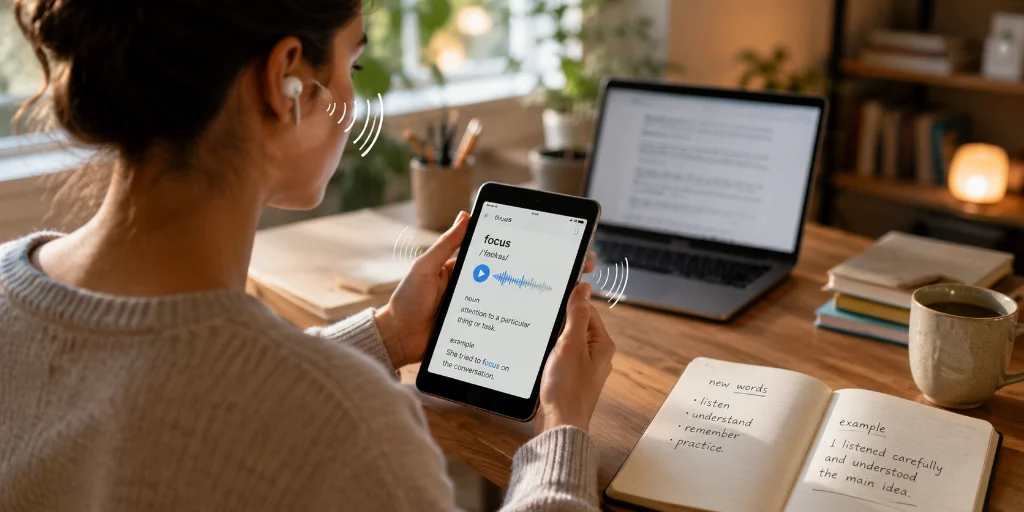
A reading-derived card should preserve enough context to make the meaning clear. In My Lingua Cards, a card can include the word, translation, description, example sentence, pronunciation or transcription, audio, and an image when it genuinely helps.
Do not copy a long paragraph into the card. Create one short example that reflects the meaning you met. This keeps the card quick to review and reduces dependence on the original text.
Step 5: review before adding another large batch
New vocabulary only becomes durable when it returns. In My Lingua Cards the session mixes words that are due for repetition with new words chosen by the app, so existing material is not buried under constant collection. For more on that order, see Daily Vocabulary Review: Should You Learn New Words or Do Repetitions First?. Once words become eligible and have a local translation, reverse practice can help you move from recognizing them to producing them.
This matters because reading gives you the target-language form first. Reverse practice adds the missing production question: can you retrieve the word or phrase from the meaning you want to express?
What a good card from reading looks like
Imagine you meet the phrase “rule out” in a health article. The sentence makes it clear that doctors are checking whether a possible cause is not responsible.
A weak card contains only:
- rule out = exclude
A stronger card contains:
- Phrase: rule out
- Meaning: to decide that something is not possible after checking it
- Example: The doctor ruled out an infection.
- Audio: the phrase and example in natural pronunciation
The stronger card is still compact, but it gives you meaning, grammar, and a reusable pattern. You can understand “rule out” in another article and also use it in your own sentence.
For nouns, include the article or classifier when the language requires one. For verbs, keep the form that helps you recognize and use the word correctly. For expressions, save the complete chunk rather than cutting it into pieces.
Common mistakes when learning vocabulary from reading
- Looking up words before trying to infer them. A brief guess forces you to process the surrounding sentence.
- Saving only single words. Keep collocations and short phrases when that is how the language is normally used.
- Copying complicated dictionary definitions. Use a short explanation that matches the meaning in the text.
- Adding twenty or thirty items after every session. Select less and review more.
- Ignoring audio. A word learned only from print may remain difficult to recognize in speech, which is why it helps to learn vocabulary with audio from the start.
- Never practicing from meaning to target language. Recognition supports reading, but reverse recall supports speaking and writing.
- Keeping every card forever. If an item was a one-off curiosity and never proves useful, it does not need permanent attention.
A simple 25-minute routine
Here is a realistic routine for learners who read several times a week:
- Spend five minutes completing due vocabulary reviews.
- Read for fifteen minutes without turning every unknown word into a task.
- Mark only repeated or meaning-blocking items.
- Choose up to five useful words or phrases after reading.
- Create concise cards and place related items into a practical theme or word set.
The next time you open My Lingua Cards, follow the priority shown for your current learning state rather than immediately adding more material. Continue due review, use reverse practice when available, and expand the set only when the current words are manageable.
This creates a healthy division of labor. Reading supplies real context and new candidates. Cards preserve the best candidates. Review turns them into knowledge you can access later.
Read widely, collect narrowly
You do not need to capture every unknown word to learn vocabulary from reading. In fact, selective collection usually produces better results because it protects comprehension and keeps your review load realistic.
Read for the message first. Notice repetition. Choose words that unlock meaning or match your real life. Save phrases in usable form, add clear context and audio, then review them in both directions when they are ready.
My Lingua Cards can support that workflow with personal cards, word sets, due review, and reverse practice. Start with one short text and keep only five items that clearly deserve another encounter. That small selection is more likely to become usable vocabulary than a list of fifty words you never review.
.png)