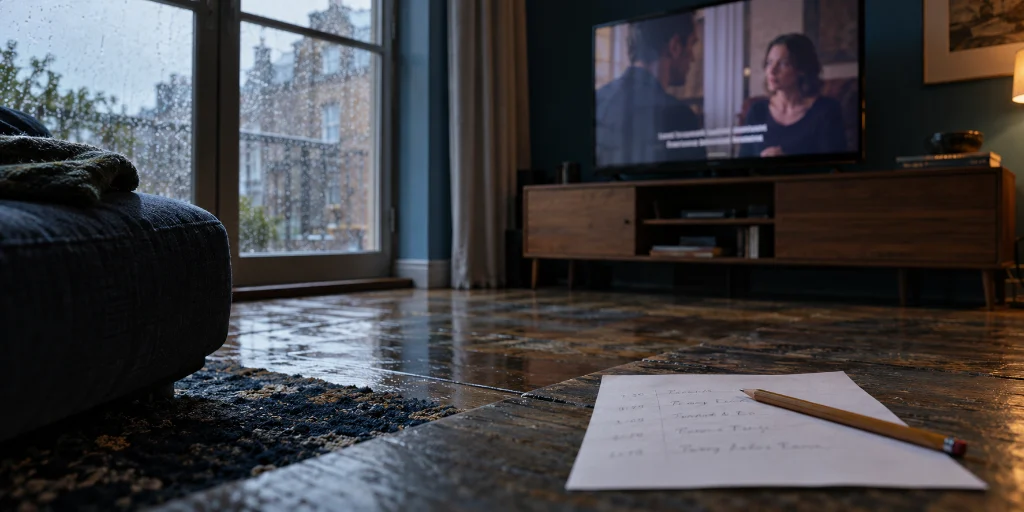
Subtitles become vocabulary practice when you stop treating them as a dictionary that runs under the picture. Watch the scene for the story, with subtitles in the language you are learning, and collect words only afterwards: the phrases that came back two or three times, the line you understood only because of the text. Five or six items from an episode is plenty. Then you review them with audio, not with a screenshot, because the point is to recognize the phrase the next time an actor throws it away in half a second. The rest of this article is the routine: which subtitles to switch on, when to pause and when not to, what is worth keeping from a show, and how to turn one scene into cards you will actually review.
Which subtitles to switch on
Subtitles in the language you are learning. Not in your own language, and not both at once, except in two cases I describe below.
The reason is simple. When the subtitles are in your native language, your eyes read, your brain understands, and the sound of the dialogue passes by as background noise. You finish the episode with the plot and nothing else. With subtitles in the target language, the text and the sound carry the same words, so every line is one more chance to connect what you hear with how it is written. That connection is what listening comprehension is made of, and it is what most learners are missing when they say they "know the word but never catch it in speech". If that is your case, How to Improve Listening Comprehension with Vocabulary Practice goes deeper into the problem.
The two exceptions:
- You are at the very beginning, and target-language subtitles are a wall of unknown words. Watch the first episode of a show with native subtitles to learn who is who and what the story is about. From the second episode, switch. The plot is now familiar, which frees attention for the language.
- The show is far above your level and you still want to watch it. Keep native subtitles and accept that this is entertainment, not study. Pick a second, easier show for the routine below.
Dual subtitles, both languages on screen at once, look like the best of both worlds and usually are not. The native line wins every time your attention is divided, and it is divided all the time. Use them only to check one line you could not work out, then switch back.
Watch first, collect later
The habit that kills this method is pausing on every unknown line. Twenty minutes of show stretch to an hour, you lose the thread of the scene, and you end up with forty words, most of which you will never meet again. It feels thorough. It is mostly dictionary work with a TV on.
Split the two activities instead:
- Watch a scene through, without pausing. A scene is a natural unit: one place, one conversation, two to five minutes. Let the lines go by. If a word is unknown, let it be unknown for now.
- Note a phrase only when it repeats or when it blocks the scene. A character has said the same thing three times, or you missed why everybody laughed. Write down the time, nothing more, and keep watching.
- After the scene, go back to your notes. Replay those few moments, read the subtitle line, work out the meaning from the situation, and check it only if the situation does not tell you.
Rewinding a line twice is fine. Rewinding every line is the problem.
Pause after the scene, not during it. The scene gives you the meaning; a dictionary only confirms it.
What is worth keeping from a show
Scripted dialogue is a very good source of exactly the language textbooks leave out: short reactions, small talk, the things people say while doing something else. It is also full of items that are useless to you. The filters from How to Use Reading to Grow Your Vocabulary Without Saving Every Word apply here too: keep what repeats, what blocks understanding and what you can imagine saying soon. For subtitles I would add a few specific habits.
Keep short phrases, not single words. From a Spanish series you might come away with ¡Qué va! (no way, not at all), Ya veremos (we'll see) and Me da igual (I don't mind). Each is two or three words, each is a complete thing you can say, and each appears in almost every episode of almost every show. A single word pulled out of one of them teaches you much less. Example Sentences vs Word Lists: What Actually Helps You Speak Faster explains why the phrase beats the word.
Keep reactions and connectors. The small words that open and close turns: well, anyway, I mean, exactly, come on. They are impossible to learn from a word list, because their meaning is in how they are used, and a show gives you that use for free, dozens of times an hour.
Keep the line you understood only because of the text. If you read it and thought "oh, so that is what that sounds like", that phrase is the most valuable item of the evening. You already knew it in writing; the subtitle just connected it to its sound. Make sure it comes back in review with audio.
Skip character names, place names and plot-specific words. The name of the fictional company, the medical term from one episode, the murder weapon. Interesting, perhaps; useful, no.
Be careful with slang and swearing. You will understand it after a few episodes anyway, from sheer repetition. Saving it means studying words you may never want to say out loud, in a register you cannot judge yet. Leave them in the show.
From one scene to cards in My Lingua Cards
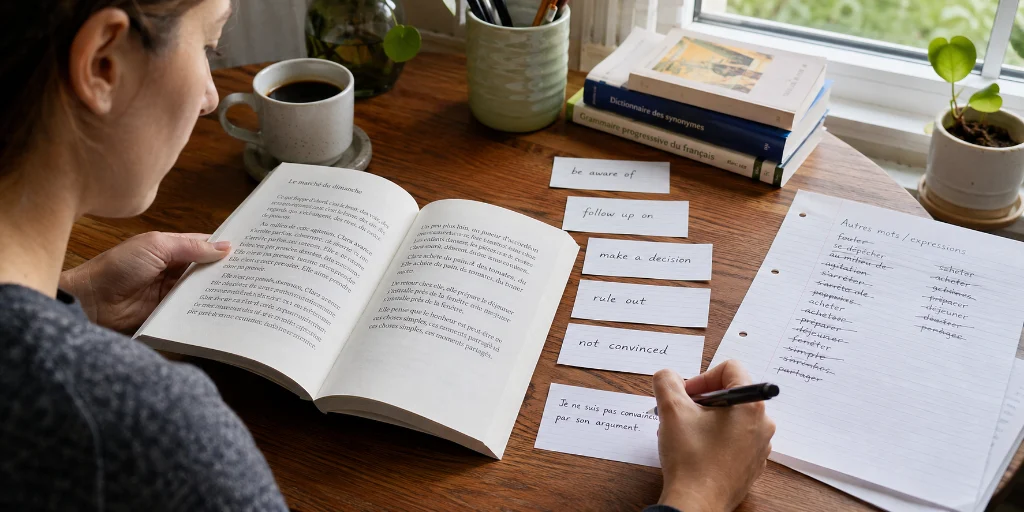
Once the scene is over and your handful of phrases is on paper, the fastest way to make them studyable is to type them into Learning now, the personal list in My Lingua Cards where you keep words that come from your own life rather than from a ready-made set. One entry per line, a word or a short phrase of up to three words, which is exactly the size of Ya veremos or Me da igual. If you have the subtitle text itself, from a subtitle file or a player that lets you copy it, you can also paste a passage of up to 2,000 characters and the app will pull the individual words out of it in their dictionary form. Paste one scene, not the episode; a scene is roughly the right size, and it keeps the list tied to a situation you remember. The phrases you still type yourself, because that is where the value is.
The app adds the translation for each entry. Words that are not in its dictionary yet are marked as being prepared and become ready later. On the free plan you can add up to 30 of your own words this way, which is several weeks of one-scene-a-week before you get anywhere near it.
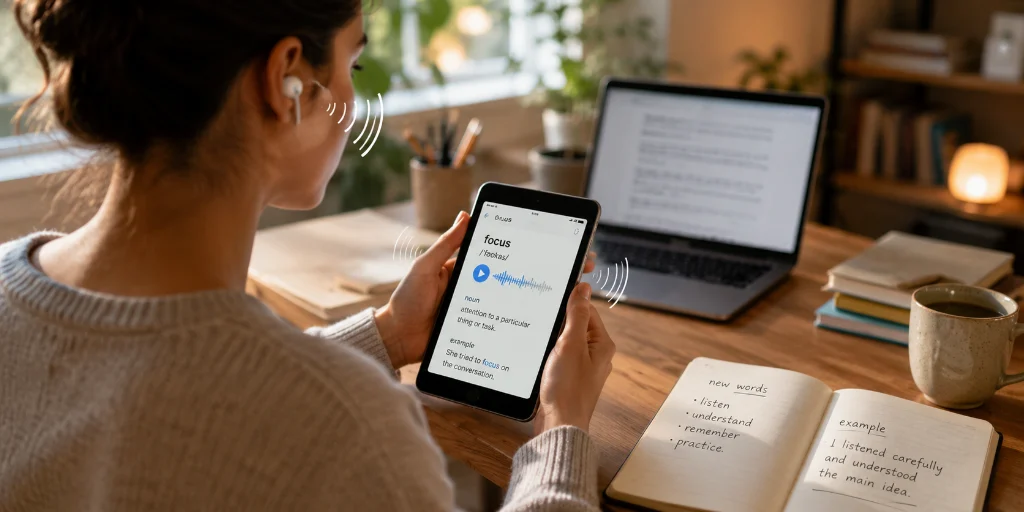
The list is studied from the main page whenever you want, as often as you want, on the same cards as the rest of your vocabulary, and the progress you make on them counts the same way. Each card has audio, and that audio matters more here than anywhere else: an actor says the line fast, half-swallowed, over music. The card gives you the same phrase spoken clearly, and after a few repetitions the fast version in the next episode starts to sound like a word you know rather than a noise. Reverse practice, where you see the translation and have to produce the word, is the step after that: it turns "I understand it when they say it" into "I can say it myself".
If you want to go one step further, take the situation of the scene into Skill Boosts. A practice can start from a topic you set yourself, so "two colleagues argue about who forgot to send the report" is a perfectly good one. You will find yourself reaching for the phrases you just collected, which is the whole point of collecting them.
Mistakes that make subtitles useless
- Native-language subtitles as the default. Comfortable, and the language goes straight past you. Switch, and accept two or three slower episodes.
- Pausing every line. Covered above. If you cannot stop yourself, watch with the remote in another room and take notes on paper.
- Collecting from a whole episode at once. Thirty candidates, none of them reviewed. One scene, five phrases, every time.
- Saving the written line and never hearing it again. A phrase learned from text alone stays a reading word. Review it with audio, and replay the original moment once more at the end of the week.
- Choosing a show for its reputation rather than its level. A slow family drama with everyday dialogue teaches more than an acclaimed series about lawyers. Fast, specialized speech is for later.
- Never rewatching. The second viewing of a scene, a week later and without subtitles, is where you find out what stuck. It is also the most satisfying part of the whole method, so do not skip it.
A one-episode week
The routine fits around one episode a week, which is about what a working adult can sustain alongside everything else. Say the episode is forty minutes.
- Day 1. Watch the whole episode with target-language subtitles, no pausing, a pencil nearby. Mark the time of two or three moments that repeated or that you missed. Enjoy the show; that is allowed.
- Day 2. Pick one scene from your marks and watch it again, this time pausing after it. Read the lines you marked, settle on five or six phrases, and add them to Learning now.
- Days 3 to 6. Nothing special. Run the Learning now list once from the main page of My Lingua Cards, then do your normal session. Ten minutes a day covers both.
- Day 7. Watch the same scene once more, subtitles off. Notice which of the five phrases you now hear without effort. Then start the next episode.
Over a season of ten episodes that is fifty or sixty phrases, every one of them attached to a face, a room and a moment you remember. That is a far better fifty than a frequency list gives you, and you watched a season you wanted to watch anyway.
Start with one scene
You do not need a system, a subtitle file or a special extension. Tonight, watch one episode with the subtitles switched to the language you are learning, and write down the time of three moments that stood out. Tomorrow, go back to one of them, pick your five phrases, and add them to Learning now in My Lingua Cards. By the end of the week you will have heard each of them a dozen times, clearly on the cards and fast on the screen, and those are exactly the two ways you need to know them.
.png)