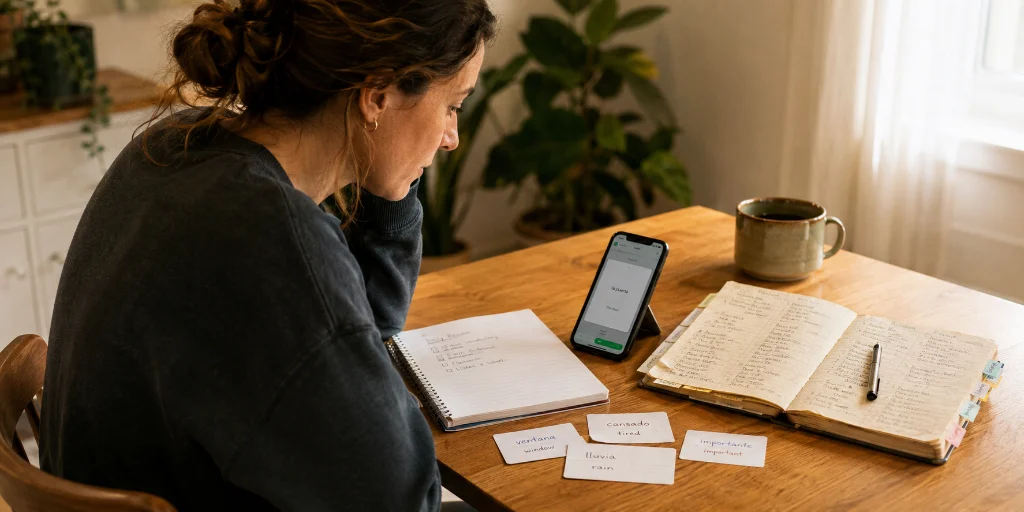
To track language learning progress without overplanning, measure three things: what you can recall, how consistently you return to practice, and where you can use the language in real situations. You do not need a complex spreadsheet, a daily score for every skill, or a detailed forecast of how many words you will know in six months.
A useful tracking system should answer one practical question: Is the language becoming easier to retrieve and use? Review that question once a week, keep only a few signals, and let your daily study remain focused on learning rather than administration.
Track evidence of easier language use, not evidence that you spent time organizing your learning.
Why language progress is difficult to measure
Language learning does not improve in a straight line. You may understand a podcast better one day and struggle the next. A word can feel easy on a card but disappear during a conversation. You may study for ten hours in one week and make less progress than during three focused hours the week before.
This is why simple activity numbers can be misleading. Hours studied, lessons completed, pages read, and words added all describe effort. They do not automatically describe stronger memory or better communication.
The problem becomes worse when tracking takes too much attention. A learner creates categories, charts, color codes, monthly targets, and separate systems for reading, listening, speaking, grammar, and vocabulary. Soon the plan becomes harder to maintain than the study routine itself.
Good tracking is lighter. It uses a small number of indicators that connect directly to the result you want.
Use three progress signals instead of one big score
No single metric can represent an entire language. A quiz score can improve while speaking remains difficult. A long study streak can continue while vocabulary recall becomes shallow. The most reliable picture comes from combining three different signals.
1. Retrieval: Can you remember the language without help?
Retrieval is the clearest signal for vocabulary progress. Recognition is useful, but active recall tells you whether a word is becoming available for speaking and writing.
Look for changes such as:
- you remember the meaning before revealing the answer;
- you can produce the target-language word from its translation;
- you need less time to answer;
- you can remember a word inside an example, not only as an isolated definition;
- you recover a previously forgotten word after fewer repetitions.
You do not need to record every answer. Instead, notice the overall direction. Are more words becoming quick and stable? Are fewer familiar words feeling completely blank? Is reverse recall becoming less uncomfortable?
This is more useful than counting how many cards you have seen, because seeing a card is an activity. Retrieving the answer is the learning result.
2. Consistency: Can you maintain the routine?
Consistency does not mean perfect attendance. It means your learning system survives normal life.
A sustainable routine has several signs:
- you return after a missed day without abandoning the week;
- due review does not grow into an intimidating backlog;
- you can complete a short session even when energy is low;
- you continue a useful topic instead of repeatedly starting new ones;
- the routine needs little daily planning.
A streak can be motivating, but it is not the only measure. A learner who studies on five realistic days every week may progress more reliably than someone who protects a streak with rushed, low-quality sessions.
For a practical routine, see The 15 Minute Flashcard Routine: the My Lingua Cards Method That Sticks. The important point is not the exact number of minutes. It is having a repeatable session that keeps review moving.
3. Transfer: Does the language appear outside practice?
Transfer is the strongest evidence that learning is becoming useful. It happens when vocabulary leaves the card and appears in reading, listening, writing, or conversation.
Small real-use moments count:
- you recognize a recently reviewed word in a video;
- you understand a sign, menu, message, or instruction faster;
- you use a phrase in an email without checking a translator;
- you recall the right word during a conversation;
- you notice and correct your own wording;
- you can explain a familiar topic with less hesitation.
These moments are easy to forget, so keep a very short weekly record. One or two examples are enough. A note such as “used reschedule correctly in a work message” is more meaningful than “studied business English for 42 minutes.”
What to track each week
A weekly review should take about five minutes. Use four questions and keep the answers short.
- What became easier to recall? Name a few words, phrases, or situations.
- Where did I use or recognize the language? Record one real example.
- What repeatedly caused difficulty? Identify one pattern, not a long failure list.
- What is the next useful focus? Choose one small adjustment for the coming week.
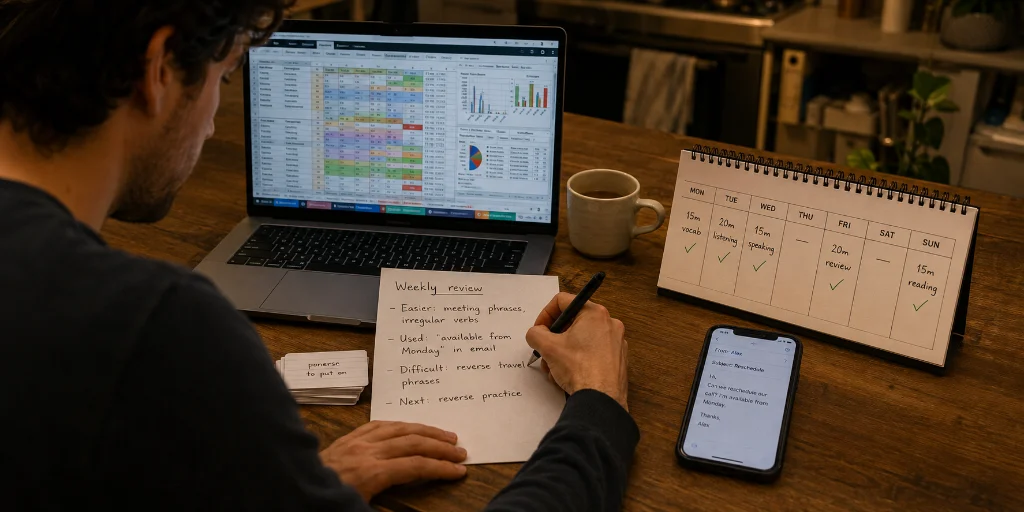
Your weekly note might look like this:
- Easier: meeting phrases and three irregular verbs now come back quickly.
- Used: understood “available from Monday” in an email without translating.
- Difficult: I recognize travel phrases but cannot produce them in reverse.
- Next focus: keep the same travel word set and prioritize reverse practice.
This is enough information to guide the next week. There is no need to estimate a percentage for your entire language level.
How My Lingua Cards supports useful progress tracking
My Lingua Cards is designed to keep the daily decision simple. After learning has started, the main page shows one main action: continue the learning session. The session mixes familiar words that are due for repetition with new words chosen by the app. Reverse practice runs as a separate companion session, difficult words can be reviewed as a separate run, and the Daily Quiz adds a short extra check rather than replacing core review.
This helps because daily progress does not require a new plan. You can continue the session and use your weekly review for reflection.
The different flows also provide different kinds of evidence:
- Forward cards show whether you can recognize and understand the word.
- Reverse practice tests whether you can retrieve the target-language word from the meaning you want to express.
- Started word sets help you see whether you are staying with a useful topic long enough for it to become familiar.
- Daily Quiz gives a short check with words you are currently studying. Use it as an occasional checkpoint, not as the only definition of progress.
The app does not need to become a complete life dashboard. Its main job is to organize the next useful practice action. Your short weekly note adds the part that an app cannot fully measure: where the language became useful in your real life.
Choose metrics that match your current goal
Tracking becomes confusing when every learner uses the same metrics. The right signals depend on what you are trying to improve now.
If your goal is speaking
Track reverse recall, short real conversations, and moments when a phrase comes without translating word by word. Do not make total words seen your main number.
If your goal is listening
Track words you can recognize from sound, sections of familiar audio that require fewer replays, and phrases you catch without reading subtitles. A higher reading vocabulary alone does not prove better listening.
If your goal is reading
Track how often you can continue without stopping, repeated words that have become automatic, and whether you can understand the sentence before checking every unknown item.
If your goal is exam preparation
Track performance by task type, repeated vocabulary errors, and whether high-value words appear correctly in speaking or writing. Do not treat every new word as equally important.
Choose one primary goal for a four-week period. You can still practice other skills, but one main goal makes progress easier to interpret.
Common tracking mistakes
Counting new words instead of retained words
Adding 200 words feels productive, but it creates no guarantee that those words can be recalled later. Keep new material under control and give more attention to words that survive review and become usable.
Using study time as the main success metric
Time is useful for planning, but it does not measure learning quality. Thirty focused minutes with active recall can be more valuable than two distracted hours.
Changing the system every week
A new app, notebook, template, or method can create the feeling of progress before any learning has happened. Keep one tracking format for at least four weeks unless it is clearly unusable.
Recording everything
Detailed logs often collapse because they demand too much effort. Record patterns and examples, not every click, mistake, or minute.
Expecting visible progress every day
Daily performance changes with sleep, stress, topic, and context. Look for a weekly or monthly direction. One difficult session does not mean the method has stopped working.
Ignoring real-use evidence
Learners often dismiss small wins because they are not formal test results. Recognizing one phrase in a conversation or writing one sentence without help is genuine transfer. Record it.
A four-week progress check without a spreadsheet
Use the same lightweight review for four weeks.
Every day: complete the next useful learning action. Prioritize due review, use reverse practice when available, and continue focused word sets instead of collecting unrelated material.
Once a week: answer the four short questions about easier recall, real use, repeated difficulty, and next focus.
At the end of four weeks: compare the first and last notes. Ask:
- Are answers faster?
- Can I retrieve more words in the harder direction?
- Am I using or recognizing the language more often?
- Is the routine easier to maintain?
- Which difficulty keeps repeating?
Then make only one adjustment. You might reduce new words, continue one theme longer, spend more time on reverse practice, or connect vocabulary to a real task. Avoid rebuilding the entire system.
For help deciding whether to review or add new material, read Daily Vocabulary Review: Should You Learn New Words or Do Repetitions First?.
Progress should reduce uncertainty, not create more work
The purpose of tracking is not to prove that you are disciplined. It is to notice whether the language is becoming more available and to choose the next useful adjustment.
Keep the system small: retrieval, consistency, and real use. Review it weekly. Let daily practice remain practical.
In My Lingua Cards, continue the learning session shown on the main page, avoid expanding too quickly, and use reverse practice to test production. At the end of the week, write down one thing that became easier and one place where the language appeared in real life. That is enough tracking to guide real progress without turning learning into project management.