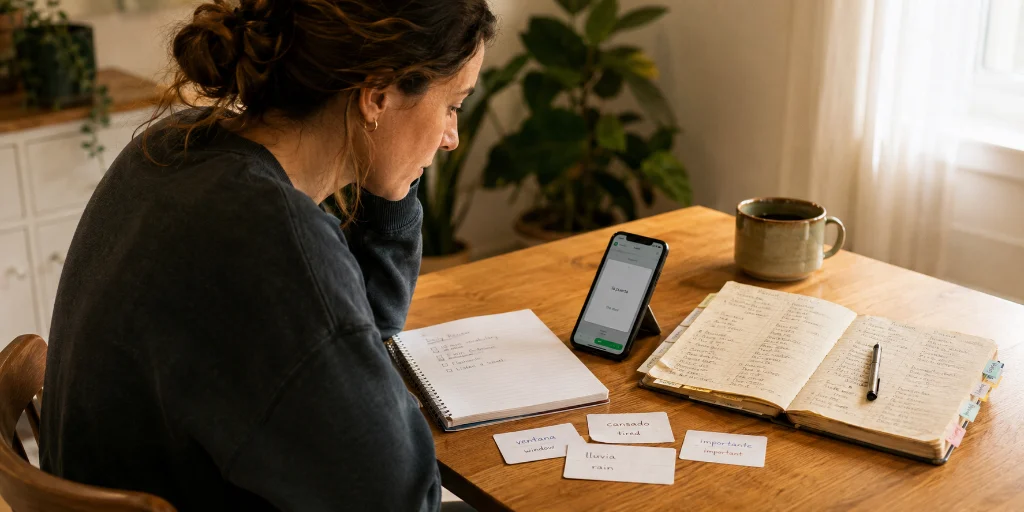
To restart language learning after a long break, do not return to lesson one and do not begin by adding a large amount of new material. First, check what you still recognize, identify the useful words that have become slow or difficult, and rebuild a short review routine around them. Most of your previous learning is not completely gone. It is simply less accessible, especially when you need to speak or write.
A good restart has three stages: recover familiar vocabulary, restore active recall, and only then expand again. This approach is faster, less discouraging, and more relevant than treating yourself like a complete beginner.
You are not starting from zero. You are rebuilding access to knowledge that has become harder to reach.
Why starting from the beginning is usually the wrong move
After several months or years away from a language, your ability will feel uneven. You may understand a sentence but struggle to produce one. You may recognize a word on the page but miss it in speech. Basic grammar may feel familiar, while simple vocabulary refuses to appear when you need it.
This unevenness creates the illusion that everything has been forgotten. In reality, different parts of the language have weakened at different rates. Recognition often survives longer than production, and familiar topics return faster than vocabulary you rarely used.
Restarting from the first beginner unit can therefore waste time. The easiest material may be too familiar to hold your attention, while your real gaps remain untouched. It can also create a false sense of progress because recognizing basic content is much easier than retrieving language independently.
Your first goal is not to prove your old level. It is to find the shortest path back to useful communication.
Run a simple restart audit before building a plan
You do not need a long placement test. A short audit of familiar vocabulary and real-life tasks is usually enough to show where to begin.
Choose three situations that still matter to you. They might be work meetings, travel, conversations with neighbors, reading professional material, school communication, or watching media in the language. For each situation, write down ten to fifteen words or short phrases you remember studying before.
Then sort them into three groups:
- Available: you understand the item quickly and can use it in a sentence.
- Familiar but slow: you recognize it, but recall takes effort or pronunciation is uncertain.
- Unavailable: you cannot retrieve it, confuse it with another word, or no longer understand it reliably.
The middle group is the best place to restart. These words are not completely new, so they can often return quickly. At the same time, they are weak enough to improve your real performance.
Keep the audit practical. A word deserves attention when it helps with a current goal, appears often, or repeatedly blocks you. You do not need to recover every word from an old course simply because you once learned it.
Rebuild vocabulary in three recovery layers
A strong restart plan works from useful and recoverable language toward new material. Think in three layers.
Layer 1: Essential language for your current life
Start with words and phrases connected to situations you are likely to face now. Your priorities may have changed since you first studied the language. Someone who once learned for travel may now need vocabulary for work, healthcare, banking, school, or daily life abroad.
Choose a small core set that lets you complete basic actions: ask, explain, confirm, describe a problem, understand instructions, and respond politely. Relevance makes repeated practice easier to sustain because each word has an obvious purpose.
Layer 2: Partly remembered vocabulary
This is your fastest recovery opportunity. Include words that look familiar but feel slow, words you understand only in one context, and words you can recognize but not produce.
For these items, reconnect the full package: meaning, sound, spelling, one clear example, and the direction in which recall is weak. A word that is easy to recognize may still need reverse practice before it becomes available in speech.
Layer 3: Carefully selected new words
Add new vocabulary only after the first two layers feel manageable. New material can make a restart feel exciting, but too much of it hides the real task, which is restoring access to what you already studied.
At first, use a simple ratio such as four recovered items for every one new item. The exact number is less important than the principle: recovery should dominate until your routine is stable.
Restore recognition first, then rebuild production
When returning after a break, comprehension often comes back before speaking. Use that advantage, but do not stop there.
Begin with forward practice: see the target-language word, hear it when audio is available, and retrieve the meaning. This helps reconnect spelling, pronunciation, and recognition. A card with a word, transcription or IPA, audio, translation, description, example sentence, or image can provide enough context to reactivate a weak memory without turning every review into a long study session.
Once recognition becomes faster, practice in the other direction. Start from the meaning or local-language prompt and retrieve the target-language word. This exposes the gap between “I know it when I see it” and “I can use it when I need it,” the same gap you cross when you move from passive to active vocabulary.
My Lingua Cards separates the two directions. The main learning session mixes familiar words that are due for repetition with new words chosen by the app, while reverse practice runs as a separate companion session in which you produce the word from its translation. That makes the two recovery goals visible: first make the word familiar again, then make it retrievable.
Do not expect every word to return at the same speed. Concrete everyday vocabulary may recover in a few reviews. Abstract verbs, similar synonyms, irregular forms, and words learned only from text may take longer, which is one more reason to learn vocabulary with audio as you rebuild.
Use a two-week language restart plan
The following plan is deliberately modest. Its purpose is to restore rhythm without creating a backlog that makes you quit again.
Days 1 to 3: Audit and reactivate
- Choose one current goal and two or three relevant situations.
- Review a small sample of previously learned vocabulary.
- Focus on familiar but slow items.
- Use audio and examples where pronunciation or context feels weak.
- Do not add a large new set.
Days 4 to 7: Rebuild active recall
- Continue forward review for weak familiar words.
- Add reverse practice for the most useful items.
- Say or write one short sentence with five recovered words.
- Return to a started word set if it still matches your goals.
- Keep sessions short enough that you can repeat them the next day.
Week 2: Expand carefully
- Continue due review before adding new vocabulary.
- Add a few new words from current conversations, reading, work, or daily tasks.
- Organize new material into a narrow word set or theme.
- Use a short speaking or writing task to test whether recovered words are usable.
- Reduce the number of new items if reviews begin to feel heavy.
By the end of two weeks, you are not trying to reach your old level. You are trying to establish a reliable cycle: review, retrieve, use, and add only what you can support.
Let one main action guide the routine
One reason people fail to restart is decision fatigue. Each session begins with the same questions: Should I review? Learn something new? Return to an old topic? Take a quiz? When the answer changes every day, opening the app becomes another planning task.
After learning has started, the My Lingua Cards main page shows one main action: continue the learning session. The session mixes familiar words that are due for repetition with new words chosen by the app, so you do not have to decide what to review first. Reverse practice runs as a separate companion session, and the Daily Quiz adds a short extra check rather than replacing core review.
This is especially useful after a break because the correct next step is often recovery, not expansion. Instead of creating a perfect new plan every day, continue the session and stop while it still feels manageable.
A practical restart session can be as simple as this:
- Complete the due forward review.
- Practice a small number of useful words in reverse.
- Continue one relevant started word set.
- Use two or three recovered words in a sentence.
- Finish without adding more work than tomorrow can support.
Common mistakes when returning to a language
- Trying to recover everything at once: old notebooks and courses contain more material than you currently need.
- Adding only new words: novelty feels productive, but it leaves familiar vocabulary inaccessible.
- Repeating only easy beginner content: comfort does not reveal what is missing from real communication.
- Ignoring reverse recall: recognizing words does not guarantee that you can produce them.
- Changing tools every few days: rebuilding the system can replace actual language practice.
- Chasing a perfect streak: the first goal is a routine you can resume after an imperfect day.
- Using sessions that are too long: an ambitious first week often creates the next long break.
- Measuring progress only by new words: faster recognition and easier retrieval are meaningful progress even when the vocabulary list does not grow.
How to know when you are ready to accelerate
You can increase new material when most recovery sessions feel predictable rather than exhausting. Useful signs include:
- due reviews fit comfortably into your available time;
- familiar words are recognized faster;
- you can retrieve important items in reverse practice;
- you can use recovered vocabulary in short sentences without checking every word;
- one or two word sets clearly match your current goals;
- missing a day no longer makes you abandon the routine.
At that point, add new vocabulary gradually. Keep the same order of priorities: maintain what is due, strengthen production, continue useful sets, and expand only at a pace that preserves the routine.
Restart from what remains, not from what was lost
A long break does not erase all your language learning. It makes some knowledge slower, less reliable, and harder to produce. The most effective restart is therefore selective: audit what remains, recover useful familiar vocabulary, train recognition and production separately, and rebuild a routine small enough to continue.
My Lingua Cards can support that return through a learning session that brings due words back, reverse practice, continued word sets, and the Daily Quiz. Begin with one current situation and a small group of partly remembered words. Recover those first, then let new vocabulary grow from the life you are learning the language for now.
.png)