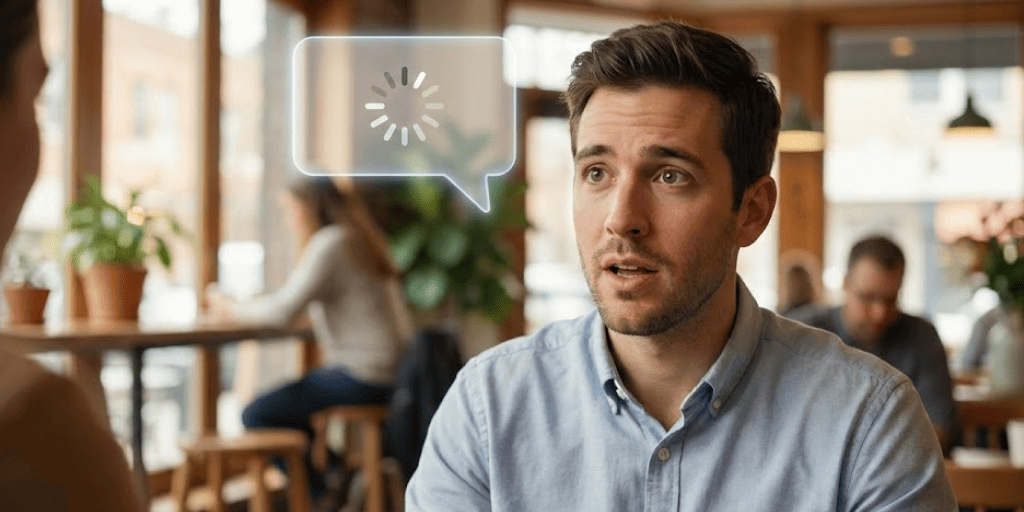
You read a word, you recognize it, you understand the sentence – and then, when you try to speak, nothing comes out. This is the gap between passive and active vocabulary. Passive vocabulary is the words you recognize when you read or listen; active vocabulary is the words you can produce yourself when you speak or write.
You do not need a new textbook to fix this. You need a simple system that works in two directions and is easy to follow:
- Target language – native language. You see the foreign word and understand its meaning.
- Native language – target language. You see the meaning in your language and say the foreign word aloud.
My Lingua Cards is built around this two-way idea and guides you through both stages step by step.
Below are 8 clear points that explain how it works and how you can finally start using the words you “know”.
Passive vs active vocabulary: why the difference matters
Your vocabulary has two parts:
- Passive vocabulary – words you can recognize when you read or listen.
- Active vocabulary – words you can produce yourself when you speak or write.
Most apps and textbooks mainly train one direction:
target language – native language
This is good for understanding, but it is not enough for speaking. To activate words, you must also train the reverse direction on purpose:
native language – target language
For step-by-step exercises, see How to Turn Passive Vocabulary into Active Vocabulary.
My Lingua Cards takes you through both directions in a clear, structured way.
Stage A: build strong understanding (target – native)
The first stage makes each word feel familiar and obvious.
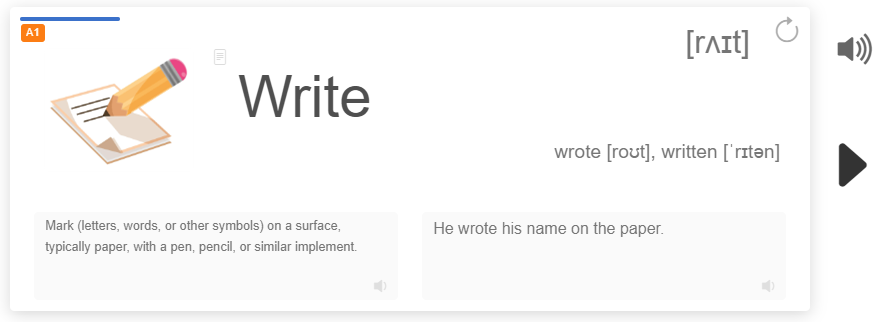
On the target-language page in My Lingua Cards you usually see:
On the front:
- the target word (with audio)
- its level
- transcription
- an image
- Description & Example (with audio)
On the back:
- the translation into your language
- a translation of the example sentence
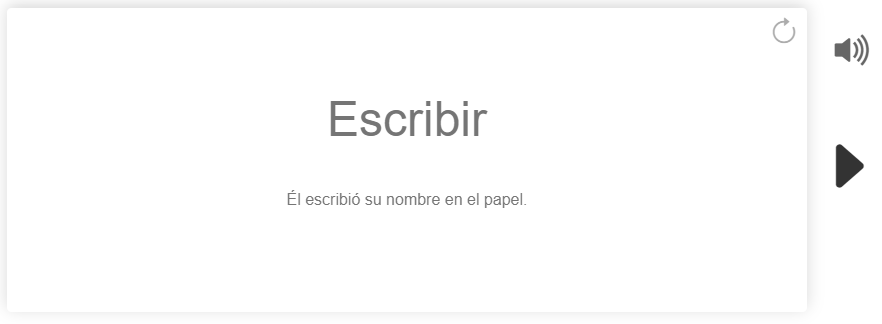
You review these cards with spaced repetition on the target-language page. After some time, your brain starts to recognize them very quickly. This is classic target – native work, and it builds strong passive vocabulary.
The goal of this stage is simple: when you see the foreign word, you understand it at once, without effort.
When Stage B unlocks: once the word feels familiar
You should not start native – target practice too early. If you flip the direction before the word feels familiar, the exercise becomes annoying and demotivating.
My Lingua Cards takes care of this for you:
- On the target-language page, the app first shows each card several times in the normal direction (target – native).
- Only once the word feels familiar does the system unlock the reverse practice on the separate native-language page.
In other words, the app waits until the word is strong enough in your passive vocabulary. Only then does it become available for activation on the native-language page, where you must produce it yourself.
This keeps the process challenging, but not overwhelming.
Stage B: native – target with My Lingua Cards (say it aloud)
When the card is ready, My Lingua Cards also shows it on the native-language page.
Now the direction changes:
- On the front you see the meaning in your native language, again with two audio fields with voiceover: “Description” and “Example”.
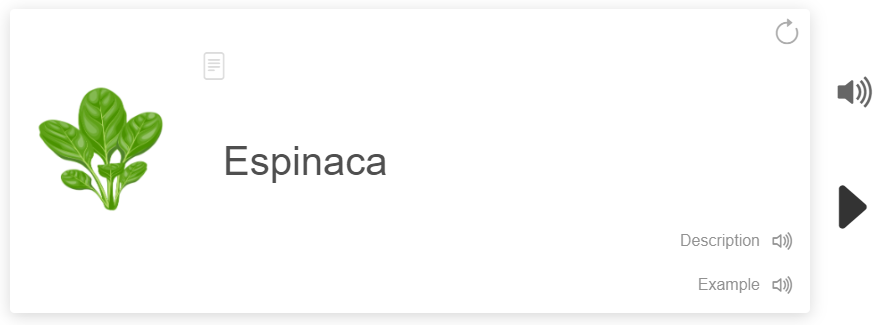

Your steps are:
- Try to recall and say the target word aloud from memory.
- If you cannot, tap to listen to the Description in the target language.
- If it still does not help, listen to the Example sentence in the target language.
- If you still cannot remember, listen to the original target word or flip the card to see the answer.
- Tap to move to the next word.
Each word appears several times in random order during activation on the native-language page.
This is the practical form of the two-way system: first you understand the word, then you train yourself to produce it.
How the two directions look inside My Lingua Cards
You work with two separate pages.
Target – native (for understanding)
On the target-language page, the front of the card is in the target language and the back is in your native language.
This builds your passive vocabulary and your ability to recognize words when you read and listen.
Native – target (for activation)
On the native-language page, the front is in your native language and the back is in the target language, with the same flip behaviour.
Cards only appear here once they have become familiar through repetition on the target-language page.
This is where you move words into your active vocabulary by saying them out loud.
All cards are prepared in advance. My Lingua Cards simply chooses when and how to show them so that both directions are trained.
Use your voice: why saying the word matters
Active vocabulary lives in your mouth, not only in your head.
That is why My Lingua Cards asks you to:
- Look at the word in the target language and its short Description in the target language.
- Pause for a moment.
- Say the word aloud in the target language.
- Flip the card and see the translation of the word and the translation of the example sentence (the example itself stays in the target language).
Ideally, you:
- repeat the audio of the example sentence as closely as possible (shadowing)
- if you wish, also shadow the Description audio
By speaking every time, you train:
- faster recall
- clearer pronunciation
- more confidence when you later use the word in real conversations
Short daily “activation sessions” that fit into real life
You do not need long study marathons.
A simple routine with My Lingua Cards can look like this:
- Open the website once or twice a day.
- Go through your scheduled cards.
- In the learning session on the target-language page (target – native), focus on understanding quickly, say the word aloud, and, ideally, repeat the example sentence.
- In the separate reverse practice on the native-language page (native – target), slow down, say the word aloud, and then check yourself.
Words whose turn has come in the spaced repetition schedule are ready for review on both pages – the target-language page and the native-language page.
Even 20–30 minutes per day are enough to activate more and more of your “known” words.
From “I know it passively” to “I just said it without thinking”
To move vocabulary from passive to active, you need three things:
A clear two-direction system:
- first target – native for understanding
- then native – target for recall
A sensible rule for when to flip the direction:
- only after several successful repetitions, once the word feels familiar (My Lingua Cards takes care of this for you)
Regular, short practice with your voice:
- you say the words aloud instead of only recognizing them on the screen
My Lingua Cards gives you this whole process out of the box:
- ready-made cards with audio, translations and examples
- automatic spaced repetition for long-term memory
- a built-in native – target flow that starts after enough passive repetitions and gives you several rounds of native – target practice for each word
If you already “know” hundreds of words but still cannot use them when you speak, try working with My Lingua Cards for a few days. Pay special attention to the words that appear on the native-language page for native – target practice.
You will start to notice a change: more and more often, the word you once only recognized will suddenly come out of your mouth at the right moment.
That is what active vocabulary really is.