
Spain Spanish and Latin American Spanish are one language. A speaker from Madrid and a speaker from Mexico City understand each other the way a Londoner and a Texan do: at once, with a smile at a few words. What changes is a layer of everyday vocabulary (coche or carro, móvil or celular), one sound (the z of cerveza), and two pieces of grammar a beginner meets in the first month: vosotros and the past tense people use for "today". Which one should you learn? The one spoken where you will use your Spanish. If that is the United States, Mexico or anywhere else in the Americas, learn Latin American Spanish; if it is Spain, learn the Spanish of Spain.
Below are the differences that matter in the first year, with the actual words, and a way to choose that does not take a month of reading comparisons.
How different are they, really?
Less than the question suggests. The grammar is the same grammar, the spelling is the same spelling, and the words you learn first are almost all shared: casa, comer, trabajo and mañana mean the same thing in Seville and in Bogotá.
The differences sit in the things people name every day: food, transport, the phone in your pocket, the apartment you rent. That is why they feel bigger than they are. You notice them at the supermarket and at the bus stop, not in a newspaper.
One correction before the lists. "Latin American Spanish" is a label of convenience for a long list of countries. Mexico says camión for a city bus, Cuba and Puerto Rico say guagua, Argentina says colectivo; Argentina also says vos tenés where Mexico says tú tienes. What the Americas share, and Spain does not, is the layer described below. For a learner in the US, that shared layer is the one to start from.
The words that change
These are the pairs a beginner runs into first. The Spain word comes first, then the word used in most of Latin America.
Everyday things
- coche – carro (auto in Argentina and Chile) – car
- ordenador – computadora – computer
- móvil – celular – cell phone
- zumo – jugo – juice
- patata – papa – potato
- melocotón – durazno – peach
- gafas – lentes – glasses
- piso – apartamento (departamento in Mexico and Argentina) – apartment
- billete – boleto – ticket for a train or a bus
Verbs and small phrases
- conducir – manejar – to drive
- aparcar – estacionar – to park
- coger el autobús – tomar el autobús – to take the bus
- vale – está bien – OK, all right
The third pair deserves a warning. In Spain coger is the plain verb for taking a bus or picking something up. In Mexico, Argentina and several other countries it is a crude word, and people say tomar or agarrar instead. It is the one difference on this list that can embarrass you; the others only show where you learned your Spanish.
None of these words is wrong anywhere. Say ordenador in Lima and you will be understood, the way a British "flat" is understood in Chicago. But you will not hear it back, and a word you never hear around you is hard to keep.
The sound: one letter gives it away
In most of Spain, z and c before e or i are said like the th in the English word "think". Cerveza (beer) is [θeɾˈβeθa] and gracias (thank you) is [ˈɡɾaθjas]. In the Americas the same letters are a plain s: [seɾˈβesa], [ˈɡɾasjas]. So casa (house) and caza (hunt) sound different in Madrid and identical in Mexico City.
Neither is harder to say. But the sound you train your ear on is the sound you will recognize at speed, so the audio you learn with should match the Spanish you expect to hear. I would put this above any word list: a handful of different nouns can be picked up in a week, while an ear tuned to one accent needs real listening time to retune. Why sound belongs on every card from the first day is the subject of Why You Should Learn Vocabulary with Audio, Not Just Text.
The grammar a beginner will notice
Vosotros or ustedes
Spain has two words for "you" when you talk to a group: vosotros for friends and family, ustedes for people you address formally. Each has its own verb ending: ¿Queréis café? to your friends, ¿Quieren café? to clients. Latin America uses ustedes for every group, with one ending. For a learner that is one verb form fewer in every tense, and in the first months you feel the difference.
If you learn Latin American Spanish, you still need to recognize vosotros forms when a series from Spain uses them. Recognizing them is quick. Producing them correctly takes much longer, and you may never need to.
He comido or comí
For something that happened today, Spain reaches for the present perfect: Esta mañana he desayunado tarde (I had breakfast late this morning). Most of Latin America uses the simple past for the same sentence: Esta mañana desayuné tarde. Both tenses exist on both sides of the ocean; what differs is which one comes out first. Learn the one your example sentences use and treat the other as something to understand.
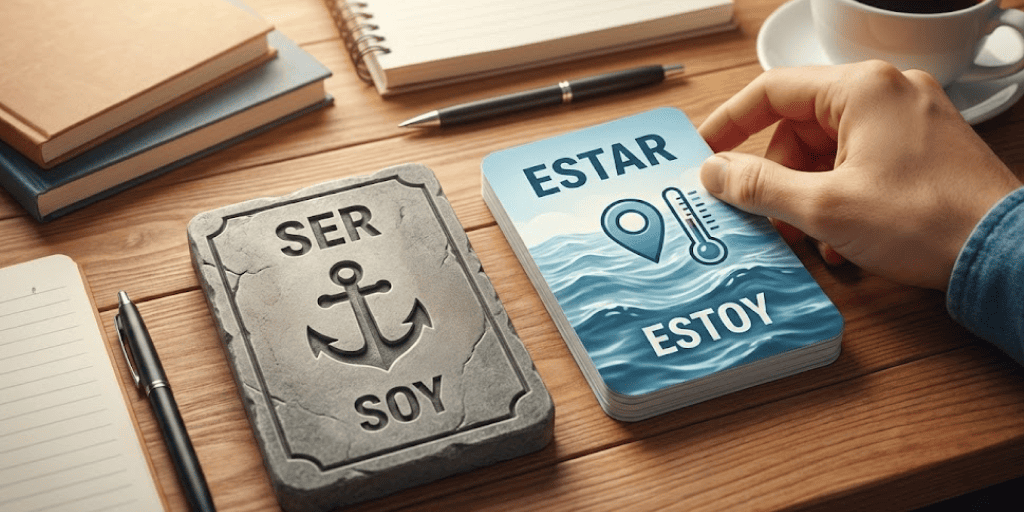
The rest of the verb system, including the two verbs for "to be", works the same way everywhere. If those two are your current problem, Ser vs Estar: A Simple Flashcard Strategy You Will Finally Remember applies to both varieties.
Which one should you learn first?
Choose by place, not by prestige. No variety is the "correct" or the "pure" one. The DELE exams, to take the best-known certificate, accept every variety of Spanish as valid.
- You live in the US, or you learn for work, family or neighbors there – Latin American Spanish.
- You plan to travel in Mexico, Central America or South America – Latin American Spanish.
- You are moving to Spain, studying there or dealing with Spanish paperwork – Spain Spanish, vosotros included.
- Your partner's family, your teacher or your favorite series comes from one side – that side. The Spanish you hear every week beats any general argument.
- You have no plan yet – Latin American Spanish if you live in the Americas, Spain Spanish if you live in Europe. Distance decides whom you will end up talking to.
Pick one variety and stay with it until you can hold a conversation. Understanding the other one comes later and costs little; learning both from day one costs you every word twice.
What you should not do is learn both at once "to be safe". A beginner who memorizes coche and carro, zumo and jugo doubles the load for words that could be added later in a week. Switching is cheap: someone with a solid base in one variety needs a short list of words and some listening to feel at home in the other.
How to learn one variety in My Lingua Cards
My Lingua Cards keeps the two varieties apart as two learning languages, so you choose once, at the start, and everything after that stays consistent. In the track for the US and Latin America the words on the cards are carro, computadora, celular and jugo, the audio and the transcription follow Latin American pronunciation, and the example sentences use tú, usted and ustedes. In the Spain track the cards say coche, ordenador, móvil and zumo, the audio is Castilian, and the examples use tú and vosotros.
After sign-up you choose the learning language and your native language, a level (A1 if you start from zero), up to three goals and one to five starting themes. The app prepares a starter dictionary of 300 words for that level and those themes and activates the first 10, so you begin on the cards at once. Each card shows the word with its transcription, audio, the translation, an example sentence and an image.
When you meet a word from the other side, say a vale in a series from Madrid while you learn Latin American Spanish, add it to Learning now: type it on its own line and the app adds the translation. That is the right size for the other variety at this stage – single words you ran into, not a second vocabulary. If series are where you meet them, How to Turn Subtitles into Vocabulary Practice shows how to collect them without pausing every minute.
Free access is one month and 300 cards. Start with Spanish for the US and Latin America or with Spain Spanish.
Mistakes that cost beginners time
- Postponing the choice. Weeks spent comparing varieties are weeks without words. The choice can be changed later; the weeks cannot be taken back.
- Mixing sources without noticing. A textbook from Spain, an app with Mexican audio and a Colombian series give you three accents and two sets of words before you can tell them apart. Keep your main source in one variety and let the rest be listening practice.
- Treating vosotros as optional in Spain. If you will live there, you need it from the first month: friends will use it with you every day.
- Correcting native speakers. If someone says computadora and your book said ordenador, the book was describing another country.
Today's step is small. Decide where you will use your Spanish, pick the matching variety, and learn your first ten words with audio in that accent. Everything on the other side of the ocean will still be there when you are ready for it.
.png)