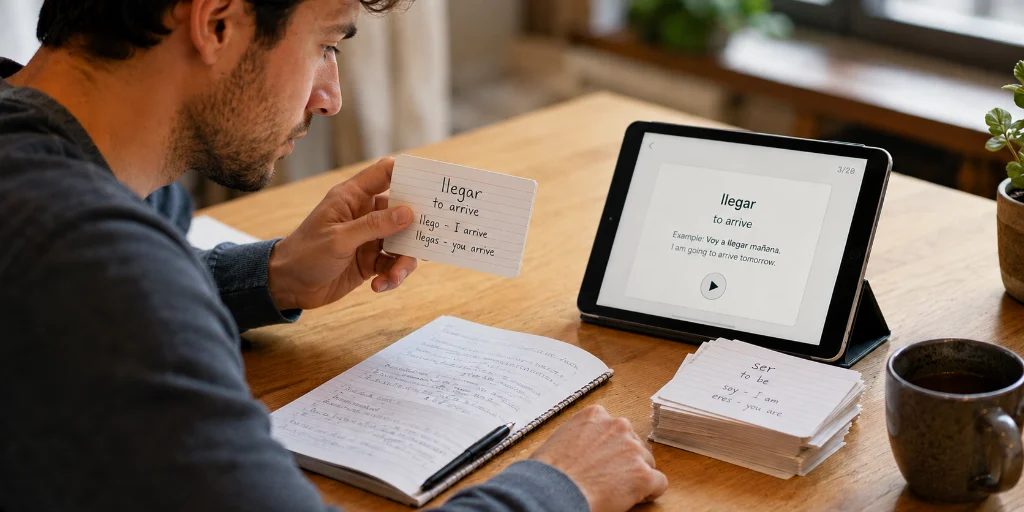
Premade decks and custom flashcards solve different problems. A good premade deck gives you structure, coverage, and a fast start. Custom flashcards give you relevance because they come from your work, conversations, reading, travel, and mistakes. For most language learners, the best answer is not choosing one forever. Start with a curated deck for the essential vocabulary, then add personal cards as your real needs become clearer.
The wrong choice is usually an extreme. Using only premade material can leave you knowing generic words but missing the phrases you need every day. Creating every card yourself can consume so much time that card making replaces learning. A useful system combines the speed of ready-made content with the precision of personal vocabulary.
Use premade decks to build the map. Use custom flashcards to mark the places you actually visit.
Premade decks vs custom flashcards: the practical difference
A premade deck is built before you begin. It may follow a proficiency level, a topic, a course, or a frequency list. Its main advantage is selection: someone has already decided which words belong together and what should come first.
A custom flashcard begins with your own encounter. You hear a phrase in a meeting, notice a word in a book, forget how to ask for something, or make the same mistake twice. You then create a card around that exact need.
Both approaches can support active recall. The difference is where the vocabulary comes from and who does the selection work.
- Premade deck: faster setup, broader coverage, less daily decision-making.
- Custom flashcard: stronger personal relevance, better context, more control over meaning and examples.
The important question is not which type is universally better. It is which type should do each job in your learning system.
Where premade decks are stronger
Premade decks are most useful when you do not yet know what you are missing. Beginners often cannot judge which words are frequent, which meanings matter first, or whether a topic contains a major gap. A well-curated deck reduces that uncertainty.
They help you start without building a curriculum
When learning a new language, creating hundreds of cards from zero is a poor first task. You are still learning how the language works, so your selections may be random, too advanced, or dominated by whatever content you happened to see that week.
A structured deck can give you common verbs, everyday nouns, basic adjectives, and useful phrases in a sensible order. This is the same reason a curated ESL Vocabulary Pack for American English can be more useful than collecting disconnected words from search results.
They expose gaps you would not notice yourself
Personal vocabulary naturally reflects your habits. That is valuable, but it can become narrow. You may collect office words while missing basic language for health, transport, time, or household problems. Premade sets create broader coverage and help prevent a vocabulary collection built entirely around recent interests.
They reduce preparation friction
A ready-made set lets you spend more time recalling and less time formatting. That matters for learners who repeatedly design elaborate systems, add dozens of fields, and stop before completing a week of reviews.
The limitation is quality. A premade deck is useful only when it has a clear audience, sensible scope, accurate meanings, and enough context. A list of thousands of unrelated words is technically premade, but it is not truly curated.
Where custom flashcards are stronger
Custom flashcards become more valuable as your learning becomes more specific. Two learners at the same level may need completely different language. One is preparing for customer calls. Another needs school vocabulary for a child. A third wants to understand cooking videos. A generic deck cannot fully predict those needs.
Personal relevance improves attention
A phrase connected to a real moment has a reason to exist. If you needed “Could you send the revised version?” at work yesterday, the card is not an abstract English sentence. It belongs to a situation you can picture and may face again.
This does not make personal words automatically memorable, but it gives them stronger cues. You know who said the phrase, why it mattered, and how you might use it next time.
You can preserve the exact meaning you need
Many words have several meanings. A premade card may teach the most common one, while your context uses another. A custom card can include the relevant translation, a short description, and an example that removes ambiguity.
For example, the word “issue” may mean a problem, a topic, an edition of a magazine, or the act of providing something officially. A card built from your workplace sentence can focus on the exact sense you need instead of asking you to memorize four meanings at once.
They capture phrases, not just dictionary words
Real communication depends heavily on combinations such as “make a decision,” “run out of,” “as soon as possible,” or “I was wondering if.” Custom cards help you keep expressions that repeatedly appear in your own conversations and content.
That is also why useful topic sets should be built around situations rather than giant categories. The guide to Topic-Based Vocabulary Learning explains how smaller, use-based sets avoid the usual “everything about travel” or “everything about work” problem.
Why using only one type usually fails
An all-premade system often becomes detached from real life. You may complete hundreds of cards but still lack the sentence you need to explain a problem, join a discussion, or handle a recurring task. The deck builds general capacity, but your personal gaps remain invisible.
An all-custom system has the opposite problem. It can be relevant but incomplete. You learn whatever crosses your path, which may produce clusters of advanced vocabulary beside missing basics. It also creates a constant production burden: choosing words, checking meanings, finding examples, and deciding how to organize everything.
There is another trap. Custom creation feels productive because it produces visible output. You can spend an hour making beautiful cards and complete almost no retrieval practice. A card is not learned because it exists.
Premade content protects you from endless setup. Custom content protects you from generic irrelevance. The strongest workflow lets each one correct the weakness of the other.
The best hybrid method for most learners
Use a curated deck as the stable base, then add custom cards in small numbers. The ratio should change as your level and goals change.
- Begin with a core set. Choose vocabulary suited to your level and immediate goals rather than the largest available deck.
- Review before expanding. Give existing words repeated recall attempts before activating another large batch.
- Add personal vocabulary selectively. Save words and phrases that are useful, repeated, or connected to a real communication problem.
- Place personal cards into practical themes. Group them with related vocabulary instead of creating one endless miscellaneous pile.
- Remove low-value material. A word that looked interesting once does not deserve permanent space in your review routine.
A beginner might use 80 to 90 percent curated vocabulary because the priority is building a reliable foundation. An intermediate learner may move closer to an even split. An advanced learner with specialized goals may depend mostly on personal material while still using curated sets to repair gaps.
These numbers are not rules. They are a reminder that the balance should evolve. The more clearly you understand your needs, the more useful customization becomes.
How this works in My Lingua Cards
My Lingua Cards supports a foundation-first workflow. After sign-up, the learner chooses the learning language and native language, then a level, goals, and starting themes. The app uses those answers to prepare a starter dictionary of 300 words and activates ten of them, so learning begins without a full vocabulary plan.
That is the premade side of the system: curated starting material, themes, word sets, and word-set discovery. If you begin a set, it can remain available to continue instead of forcing you to choose new material every day.
The personal side comes from adding cards for vocabulary that matters to your own life and organizing study around useful themes. A card shows the word, IPA transcription, audio, translation, description, example sentence, and image, so a personal item does not have to become a bare word-and-translation pair.
The review flow is more important than the source of the card. The learning session mixes familiar words that are due for repetition with new words chosen by the app, so the learner does not have to decide what to review first. Reverse practice is a separate session, from translation to word, that trains production. The main page shows one main action, continue the learning session, together with how many cards are ready now, the estimated time for them, and how many become ready in the next 8 hours; reverse practice or the difficult-words run can appear there as extra buttons.
This prevents the hybrid method from turning into two separate collections. Curated and personal vocabulary can enter the same learning routine, while the next action is based on what needs practice rather than which deck looked interesting today.
A simple weekly workflow
Here is a practical routine that keeps customization under control.
- During the week: collect only vocabulary that appears repeatedly or solves a real problem. Limit yourself to a few strong candidates per day.
- Before adding a card: check the meaning, choose one clear sense, and add a short natural example.
- During review: complete due cards before expanding the collection.
- At the end of the week: look at the personal cards you added. Remove curiosities that no longer seem useful and place the remaining items into relevant themes or sets.
- When a core area is weak: return to a curated set instead of trying to reconstruct the entire topic yourself.
Suppose you are learning English for work. Your curated set provides common meeting, email, and small-talk vocabulary. During the week, you add “push the deadline back,” “circle back tomorrow,” and “I have one concern about the proposal” because they appeared in your actual work. The base gives you coverage; the custom cards make that coverage fit your job.
Common mistakes when choosing decks
- Choosing the biggest premade deck: size is not the same as usefulness. Prefer a clear level, theme, and learning path.
- Trusting every premade card: check unclear translations and examples instead of memorizing errors.
- Adding every unknown word: unfamiliar does not automatically mean useful.
- Writing cards with several targets: one card should ask for one clear piece of recall.
- Creating without reviewing: card production cannot replace retrieval.
- Keeping duplicate vocabulary: update or improve an existing card instead of creating several versions of the same item.
- Ignoring pronunciation: connect important vocabulary with audio from the beginning.
The format question matters too. Custom does not have to mean paper, and premade does not have to mean digital. The comparison of Digital vs Paper Flashcards for Language Learning covers the separate choice between card source and card format.
Final verdict: premade decks or custom flashcards?
Premade decks are better for starting quickly, building broad coverage, and avoiding curriculum design. Custom flashcards are better for personal relevance, precise context, and the vocabulary your life actually demands.
For most learners, the best system is curated first, personal second, and review throughout. Start with a manageable foundation. Add only the custom words and phrases that earn their place through repeated use or genuine need. Then let recall, not card creation, remain the center of the routine.
With My Lingua Cards, you can begin from starter vocabulary and organized word sets, continue the material you have already started, and add personal vocabulary without abandoning the same review flow. Choose one useful set, continue the learning session, and add one card from real life only when it is worth remembering. The first month is free, with 300 cards.