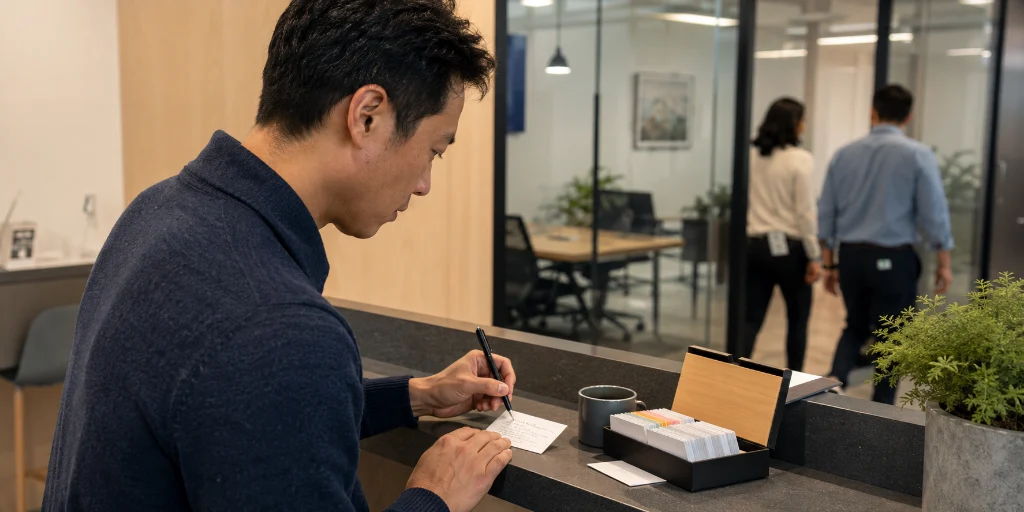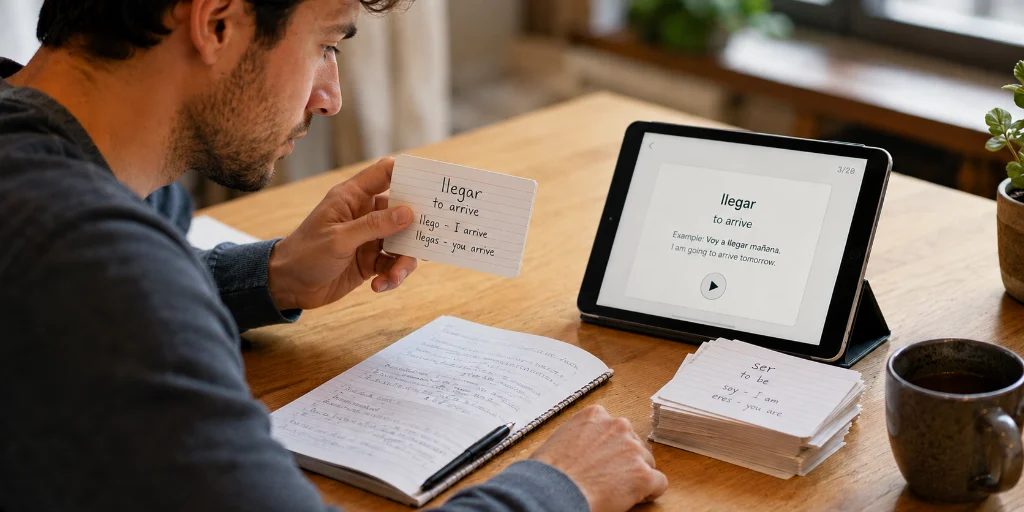
Digital and paper flashcards can both help you learn a language. The better choice depends on what usually breaks your routine. Paper cards are simple, tactile, and easy to personalize. Digital flashcards are stronger when you need audio, a large vocabulary collection, due reviews, and practice in more than one direction. For most adult learners, digital cards are the more practical main system, while paper works best for a small temporary deck or focused handwriting practice.
The format itself is not the real source of progress. A beautiful app cannot rescue weak cards, and a handwritten deck will not work if you only reread it. What matters is whether the system makes you retrieve an answer, check it accurately, return to weak words, and keep the routine manageable.
The best flashcard format is the one that makes active recall easy enough to repeat and difficult enough to teach you something.
Digital vs paper flashcards: the real difference
At first, the comparison seems simple. Paper is physical and digital is convenient. In practice, the important difference is how each format handles the work around the card.
A paper card gives you direct control. You decide what to write, which side to test, where to place the card, and when to review it. That freedom is useful, but it also means you must manage the entire system yourself.
A digital system can reduce that administrative work. It can keep vocabulary organized, surface cards that are ready for review, store audio and examples, and support different practice flows without creating duplicate piles. This matters more as your vocabulary grows.
Imagine learning 30 travel expressions for a weekend trip. A paper deck may be perfect. Now imagine maintaining 2,000 words across daily life, work, and several proficiency levels. The physical deck becomes harder to sort, carry, update, and review consistently. The learning principle has not changed, but the operational burden has.
What makes any flashcard method effective?
Before choosing a format, check whether your cards support the four actions that actually matter.
1. You must retrieve, not just reread
Looking at a word and thinking “yes, I know that” is recognition. Flashcard practice becomes useful when you pause and produce the meaning, target word, pronunciation, or example before revealing the answer.
This is why both paper and digital cards can fail in exactly the same way. Learners often flip too quickly, accept a vague feeling of familiarity, and move on. The problem is not the screen or the paper. It is the absence of a real retrieval attempt.
2. The answer must contain enough information
A weak card may show only a word and one translation. That can be enough for a concrete beginner noun, but many vocabulary items need more context. Pronunciation, a short description, an example sentence, or an image can prevent you from memorizing the wrong meaning.
Digital cards have an obvious advantage here because they can hold audio and richer word data without becoming physically crowded. Paper still works when you deliberately keep the card narrow and add only the most useful cue.
3. Weak words must return
A good review system does not treat every card equally forever. Words that are not stable need another attempt, while familiar words should not consume the same amount of attention.
With paper, you can create piles such as “new,” “learning,” and “known,” or use a box system. It works, but you must move cards honestly and remember when each pile should return. With digital flashcards, this process can be built into the review flow.
4. The routine must stay small enough to continue
A method that is theoretically perfect but unpleasant to maintain will collapse. The more time you spend sorting, rewriting, synchronizing, or deciding what to review, the less attention remains for recall.
This is closely related to the mistakes covered in Flashcard Mistakes That Make You Forget New Words. Too many new cards, vague answers, and passive review damage both digital and paper systems.
Where paper flashcards work better
Paper cards are not an outdated version of an app. They have several genuine advantages when the learning task is small and specific.
- Fast personal creation: you can write a card immediately during a lesson, conversation, or reading session.
- Physical focus: a small deck has no notifications, menus, or competing content.
- Handwriting practice: writing can be useful when the written form itself is part of the skill, especially for unfamiliar scripts or spelling.
- Visible progress: moving cards between piles gives some learners a satisfying sense of control.
- Flexible layout: you can draw, underline, add color, or arrange information exactly as you prefer.
Paper is especially effective for a temporary mission. You may keep 20 phrases beside your passport before a trip, 15 terms for an upcoming presentation, or a handful of difficult spelling patterns on your desk.
The main limitation appears when the deck expands. Cards are easy to lose, hard to search, difficult to duplicate cleanly, and inconvenient for audio. You also need a reliable physical review system. Without one, the newest cards receive attention while older words quietly disappear.
Where digital flashcards work better
Digital flashcards are usually stronger for long-term vocabulary building because they can combine learning content with review management.
- Due review: the system can bring back vocabulary that is ready for another attempt instead of asking you to sort every card manually.
- Audio: you can connect spelling, meaning, and pronunciation on the same card.
- Richer context: translations, descriptions, examples, images, and transcription can stay attached to the word.
- Search and organization: a large vocabulary library can be divided into themes and word sets without creating physical piles.
- Portability: the same collection is available whenever you have access to the service.
- Multiple recall directions: you can practice understanding a target-language word and later practise producing it from your native language.
My Lingua Cards is designed around these advantages. A card shows the word, its IPA transcription, audio, translation, description, example sentence, and image. The learning session on the cards mixes new words with familiar words that are due for repetition, while reverse practice runs as a separate companion session that trains producing the word once it has become familiar.
This matters because understanding and speaking are different retrieval tasks. The article Two-Way Flashcards: Why You Should Practice Both Native–Target and Target–Native explains why a word can feel familiar in one direction but disappear in conversation.
The weakness of digital cards is not the technology. It is the temptation to collect too much. Adding or activating vocabulary can feel productive even when the review queue is already full. A digital library needs the same discipline as a paper deck: useful words, clear answers, and a sustainable number of new items.
Which format is better for pronunciation and listening?
Digital flashcards have the stronger case when pronunciation and listening are part of the goal. Written phonetic support can help, but it cannot replace hearing the word. Audio lets you check stress, rhythm, vowel quality, and the difference between how a word looks and how it sounds.
Paper can still support pronunciation if you use it beside a teacher, recording, dictionary, or lesson. The problem is friction. Each card requires you to find the matching audio somewhere else, so learners often skip that step and memorize a text-only version of the word.
With My Lingua Cards, audio can be part of the same vocabulary card as the written form and translation. That makes listening to the word a normal part of review rather than an optional extra. For a deeper explanation, see Why You Should Learn Vocabulary with Audio, Not Just Text.
Choose based on your learning situation
Use paper as your main format when your deck is small, temporary, highly personal, or strongly connected to handwriting. It is a good choice for a classroom unit, a short exam list, a week of travel preparation, or a difficult group of spellings that you want on your desk.
Use digital flashcards as your main format when you are building vocabulary over months, learning from audio, managing several themes, or trying to turn recognition into active recall. Digital is also more practical when you want the system to show a useful next action instead of planning every review session yourself.
In My Lingua Cards, the main page shows one main action: continue the learning session. The session mixes familiar words that are due for repetition with new words chosen by the app, and the page also shows how many cards are ready now, the estimated time for them, and how many become ready in the next 8 hours. Reverse practice or the difficult-words run can appear there as extra buttons. This reduces the daily decision from “How do I organize everything?” to “Can I complete the next useful step?”
A hybrid method is often the best answer
You do not need to choose one format forever. A hybrid method works well when each tool has a clear job.
- Keep your long-term vocabulary in a digital system. Use it for organized word sets, due reviews, audio, and reverse practice.
- Create a small paper deck for a short-term problem. Limit it to words that need special attention this week.
- Retire paper cards quickly. Once the temporary goal is finished, move important vocabulary into the long-term system or discard the cards.
- Do not duplicate everything. Maintaining the same large deck in two places creates extra work without doubling your memory.
For example, suppose you are preparing for a job interview in another language. You could use a paper deck for ten personal answers that need handwriting and rehearsal. Your broader workplace vocabulary can remain in digital word sets with audio and regular review. Paper handles the immediate performance task; digital maintains the vocabulary after the interview.
A practical digital workflow in My Lingua Cards
A digital system works best when you use its flows in a simple order rather than opening every available activity.
- Start with a relevant word set or starter vocabulary. Choose material connected to your level and current goals.
- Continue the learning session. Try to recall the meaning before revealing the full card, then check pronunciation and context.
- Let the app balance new and familiar words. The session brings back words that are due for repetition together with new ones, so you do not have to decide what to review first.
- Add reverse practice. It is a separate session that runs from the translation to the word. Retrieve the target-language word from the local translation to strengthen speaking recall.
- Use the Daily quiz or practice packs as additional practice. The Daily quiz is a short quiz built from the words you are currently studying; practice packs with situation-based exercises exist for some learning languages. They support the core learning session but do not replace it.
The goal is not to use every feature every day. It is to complete the strongest available learning action and keep the routine light enough to repeat tomorrow.
Common mistakes in both formats
- Making cards for every unfamiliar word: collect vocabulary that is frequent, useful, or personally relevant.
- Putting several answers on one card: keep the retrieval target clear.
- Reviewing by sight only: pause and produce an answer before flipping or tapping.
- Ignoring pronunciation: use audio or another reliable source from the beginning.
- Keeping cards forever because they exist: remove low-value material that clogs the routine.
- Adding new words before reviewing old ones: protect retention before expanding the collection.
Final verdict: digital or paper flashcards?
Paper flashcards are excellent for small, focused, personal tasks. Digital flashcards are better suited to a growing language vocabulary because they reduce organization work, support audio and context, and make repeated review easier to manage.
For most learners, the strongest setup is digital first and paper when useful. Keep your durable vocabulary system in one place, then use a small handwritten deck for temporary goals that benefit from physical attention.
My Lingua Cards gives you a practical digital path: organized word sets, forward cards, due review, reverse practice, and additional focused activities. Start with a useful set, continue the learning session from the main page, and judge the method by one result: can you recall the word when you actually need it? You can start with one month free and 300 cards.