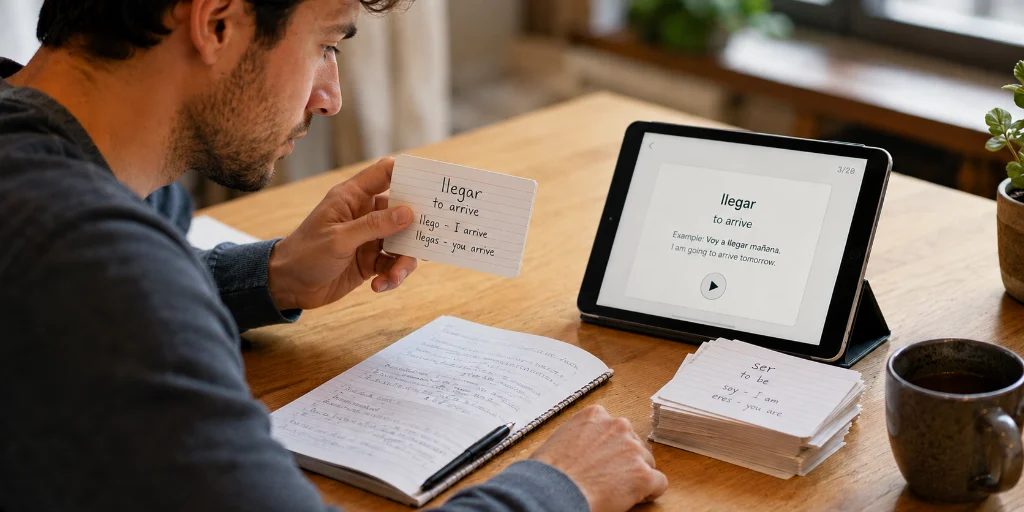
Flashcards are supposed to help you remember words. So when you review every day and still lose the same vocabulary in conversation, it is tempting to blame the method.
Most of the time, though, the problem is not flashcards. It is how the cards are built and how they are reviewed. A weak card can make you feel productive while training the wrong skill: recognition instead of recall.
Here are the most common flashcard mistakes that make learners forget new words, plus a better routine that works with any card system.
The short answer: good flashcards make you retrieve, not just recognize
A useful flashcard creates a small moment of effort. You see a prompt, pause, try to remember the answer, check it, and meet the card again later.
A weak flashcard skips that effort. It gives you too many clues or too much information at once. You look, recognize the answer, feel good and move on. Then, when you need the word while speaking, it is gone.
If you want words to stick, your cards should train three things:
- meaning: you understand what the word or phrase means;
- sound: you recognize it when you hear it and can say it;
- retrieval: you can produce it without looking at the answer first.
That thread runs through every mistake below.
Mistake 1: cards that are too easy to recognize
The easiest card in the world is also one of the least useful:
Front: accommodate
Back: to provide a place to stay
This card helps you recognize the word when reading, which is not useless. But if your goal is to speak or write, it asks for very little recall. You see the word first, and the answer becomes a confirmation exercise.
Recognition feels like knowledge because it is comfortable. Recall is different: you start from an idea and produce the word. A stronger set adds the reverse prompt:
Front: to provide someone with a place to stay
Back: accommodate
Now your brain has to search, and that small search is the useful part. It is also the skill you need to stop translating in your head, as explained in how to stop translating in your head when you speak.
Mistake 2: too much information on one card
A flashcard is not a textbook page. If one card asks you to remember a word, three meanings, four examples, two grammar notes and a list of similar words, your brain has no clear target.
Overloaded cards create fuzzy reviews. You check the answer and think, “I mostly knew that.” But what exactly did you know? The main meaning? The pronunciation? The phrase pattern?
One card should usually test one thing:
- a meaning card: what does this word mean?
- a production card: which word expresses this idea?
- a usage card: which preposition or pattern goes with it?
- a listening card: can you recognize it from audio?
You can still keep explanations and examples on the answer side. Just do not make the question ask five things at once.
Mistake 3: revealing the answer too fast
This one is painfully common. You see the prompt, feel a little uncertainty, reveal the answer immediately and count the card as reviewed.
Revealing immediately trains revealing immediately. It does not train memory.
Give your brain a fair chance first. A simple rule works: wait three seconds and try to say the answer in your head or out loud. If nothing comes, then reveal it and be honest with yourself. That tiny pause turns the card from a reading task into a recall task.
Mistake 4: adding new words faster than you can review them
Adding words feels productive; reviewing old ones feels ordinary. That is why learners add 40 new cards on Sunday and avoid the app by Wednesday.
New cards are not free. Every new word creates future reviews, and if reviews keep piling up, the queue turns into pressure instead of progress. A boring rule works better:
- do today's reviews first;
- add new words only when the review load is manageable;
- take fewer new words on busy days;
- pause new words for a few days if old cards are piling up.
Spaced review works because words come back before they fade completely. Skip the returns, and you remove the part that makes the method work.
Mistake 5: learning silent text instead of real language
A language is not only written symbols. It is sound, rhythm and stress, patterns your ear needs to recognize.
If your cards contain only text and translations, you may remember the spelling and still fail when listening or speaking. The word lives on the screen, not in your mouth.
A strong card for language learning includes audio. This matters most in languages where spelling does not tell the whole story, such as English, French, Chinese, Japanese or Arabic.
When you review, listen once, then repeat the word or phrase out loud. It feels slower, but it builds a stronger memory. How vocabulary practice supports listening is covered in how to improve listening comprehension with vocabulary practice.
Mistake 6: single words without usable context
A single word can be too bare. You may remember that depend means something like “rely” and still forget that English says depend on.
Context shows how the word behaves and gives your brain a small scene where it belongs. Compare:
Weak: depend = rely
Better: depend on someone or something
Example: “It depends on the weather.”
The second version teaches meaning and usage together. You do not need a long, fancy sentence; short, normal examples are usually better.
Mistake 7: marking vague answers as correct
Flashcards depend on honest feedback. If you reveal the answer and think, “Ah yes, I knew that,” you may be fooling yourself.
An answer counts as correct only if you retrieved it before seeing it. Not if it looked familiar afterward, not if you recognized the first letter, and not if you “would have known it with more time”.
You do not need to be harsh with yourself, but be clear about what happened:
- you produced the word correctly: it is correct;
- you produced a close but wrong word: review it again sooner;
- you only recognized the answer after revealing it: that was not recall yet.
Honest marking keeps your practice useful. Gentle self-deception lets difficult words slip away.
Mistake 8: keeping broken cards forever
Some cards fail again and again because the word is hard. Others fail because the card itself is badly designed. If a card keeps coming back and you still miss it, do not just suffer through it. Diagnose it:
- Is the prompt too vague?
- Are there two possible answers?
- Is the example sentence too complex?
- Am I confusing it with a similar word?
- Do I need audio, an image or a clearer usage note?
Then repair the card: add a better example, split one large card into two, or add a note that separates it from a similar word. Good learners do not start with perfect cards; they fix cards when the evidence says something is wrong.
A better flashcard routine
This routine avoids most of the mistakes above and takes about 10 to 15 minutes:
- Review first. Start with due cards before adding anything new.
- Pause before revealing. Give every card a real recall attempt.
- Use audio. Listen and repeat at least once.
- Check context. Make sure useful words have a short example.
- Practice both directions. From the new language for understanding, into it for recall.
- Repair weak cards. If a card fails repeatedly, improve the card.
- Add only a few new words. Stop before future reviews become unrealistic.
None of this is dramatic, and that is why it works: vocabulary grows best when the process is repeatable on normal days. If you are still deciding what kind of cards to use, digital vs paper flashcards compares the options.
Before and after: what a fixed card looks like
Take a weak card:
Front: run
Back: move fast on foot / manage / operate / flow
This card is messy. It mixes several meanings and gives no context, so you may recognize one meaning and count the whole card as known. Better cards separate the meanings:
- run = move fast on foot. Example: “I run in the park every morning.”
- run a business = manage a business. Example: “She runs a small language school.”
- the app is running = the app is working.
Now each card has one clear job. You are no longer learning a vague dictionary cloud but usable language patterns.
How My Lingua Cards helps you avoid these mistakes
In My Lingua Cards, each card shows the word with its transcription, audio, translation, a description, an example sentence and an image, so sound and context are there from the start. Under the card you can open, when the word has them, a full description, synonyms, antonyms and a memory tip, which helps when two similar words keep getting mixed up.
You do not have to decide what to review first: the learning session mixes new words chosen by the app with familiar words that are due. Reverse practice is a separate session that goes from the translation to the word, which trains exactly the recall that easy cards skip. Difficult words can be reviewed as a separate run, and all your words can be searched and edited in the word list.
You can start with one month free and 300 cards.
Final thought: flashcards work when the card asks the right question
If flashcards have not worked for you, do not throw the method away too quickly. Check the cards first.
A good flashcard asks one clear question, makes you retrieve the answer, gives you sound and context and returns at the right time. Fix that, and vocabulary practice starts to feel less like collecting words and more like building language you can actually use.