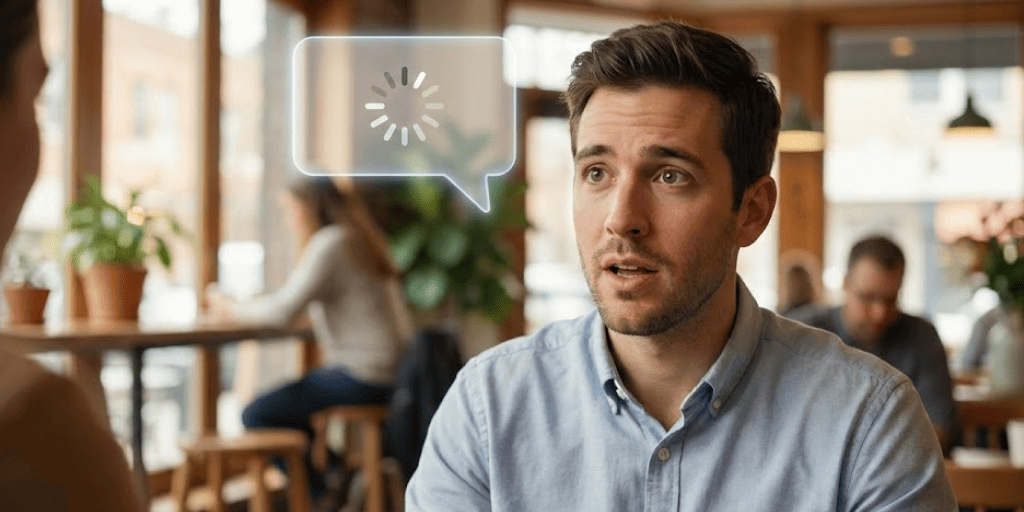
There is a specific kind of language frustration that deserves its own name. You read a sentence and understand it instantly. You hear the word in a podcast and think, yes, I know that one. Then you open your mouth and your brain serves you an empty plate.
That is the passive-to-active gap, and the fix is unglamorous: practice in both directions, on purpose, until recall stops being a search.
If you want the definitions first, start with active and passive vocabulary and come back here for the exercises.
Passive and active, in plain words
Passive vocabulary is what you recognize. Active vocabulary is what you can produce. If your goal is speaking, the second one decides how the conversation goes, not because recognition is useless, but because talking is a speed game. Nobody gives you extra seconds to browse your internal dictionary.
Which leads to the claim this whole article rests on: most learners do not have a speaking problem. They have a direction-of-practice problem.
Why understanding does not turn into saying
Understanding is recognition. Speaking is retrieval. Those are different skills, and only one of them gets trained by reading.
Recognition is seeing a familiar face in the street. Retrieval is remembering the name fast enough to greet the person before the moment turns awkward. You can be excellent at the first and hopeless at the second, and that is exactly what happens when a study routine is built entirely around input.
So when your comprehension feels solid and your speech feels empty, nothing has betrayed you. A piece of training is simply missing.
The two directions that change everything
A working vocabulary needs both directions, and most people run only one of them for months.
From the target language into yours
This is the “I see it, I understand it” direction. It builds fast comprehension and settles the meaning of a word, which is why it should come first.
From your language into the target
This is the “I want to say it, can I?” direction. It is slower, less comfortable, and it is the one that produces speech. If it is missing from your week, speaking will keep feeling like a separate hobby you never practice.
Why reverse cards fix the “I cannot say it” problem
A reverse card is just a card where the prompt is in your own language and the answer is in the language you are learning. It works because it demands the exact move a conversation demands: produce the word from the meaning, now.
Reverse cards also create a useful kind of pressure. Not panic, just a second of effort. That effort is the point. Recognition feels smooth and fast, which is precisely why it fools you into thinking a word is learned; retrieval feels slow and messy, which is precisely why it feels like failure even when it is the right exercise.
My position: if your study never feels a little effortful, you are probably not training recall at all.
When to switch reverse practice on
Not immediately. Flip a brand-new word into reverse mode and you get a guessing game, which is both demotivating and a waste of the repetition.
Build a quick, solid understanding in the forward direction first. Turn on reverse practice once the word is familiar enough that recall is actually possible, even if it is slow. In My Lingua Cards this is the default flow: a word goes through several successful repetitions in the main direction, and the reverse version appears on later steps. That keeps the difficulty in the useful range, hard enough to build recall, not hard enough to make you avoid the app.
How to run a reverse session
The method is simple, and people still manage to make it harder than it needs to be. Look at the prompt in your own language and pause for a second. Say the answer out loud in the target language even if it comes out imperfect. If you are stuck, give yourself a hint rather than the full answer. Then check the card and repeat the correct version aloud once, and move on quickly, because speed is part of the exercise.
The goal is not a perfect score. The goal is to make retrieval a habit and then make it faster.
What makes a word easy to activate
Some words go active in days and others stay slippery for months, and it is rarely random. A word activates faster when it carries more than a translation.
A card in My Lingua Cards can hold the word or phrase, a transcription, a short explanation and a longer one, examples, a memory hint, an image and audio for several fields. That structure is not decoration: every extra piece is another route back to the word when you need it.
If you build your own cards, prioritize the things that give a word context to live in.
- learn phrases rather than lone words wherever a phrase is what people actually say;
- keep at least one example sentence you genuinely understand;
- use audio, so the word exists as a sound and not only as spelling.
Active vocabulary lives in sound and situation. It does not live in a silent list, which is also why learning with audio from the start makes activation so much easier later.
The quiet killer: translating instead of recalling
Plenty of learners run reverse cards like a small assembly line. Read the prompt, translate word by word, glue the pieces together. It is slow, and it produces language that is technically correct and unmistakably foreign.
Treat the prompt as meaning instead of text. If it says “to book a table”, do not translate “book” on its own and then attach “table” to it; recall the whole chunk as one move. This is the main reason cards built around phrases and examples work better than cards built around single words: they teach you what people say, not what a dictionary permits.
Spaced repetition is what makes it stick
Reverse cards start production. Spaced repetition is what makes production reliable. One reverse session gives you a good evening and nothing the following week. The same session repeated at growing intervals turns recall into something automatic.
In My Lingua Cards you do not grade yourself on a scale; you repeat, and the schedule moves. Weak words come back sooner, strong ones drift further out, and once a word is familiar the reverse direction keeps reinforcing active recall. Over a couple of months that adds up to a great deal of retrieval you never had to plan.
The habits that keep words passive
If you are stuck at “I understand it but I cannot say it”, one of these is usually in the way.
Practicing one direction only
Target language into yours, every session, for months. That builds a large passive vocabulary and a confident feeling that collapses the first time you have to speak.
Never making a sound
If the whole routine happens silently in your head, speaking later feels like a different skill, because it is one.
Collecting bare translations
A word with nothing but its translation attached is hard to produce under pressure. There is nothing to grab.
Adding too much new material
When the review load explodes you start skipping days, and spaced repetition without the repetition is just a list.
Treating slow recall as failure
Slow recall is the stage immediately before fast recall. Quitting there is the one mistake that cannot be fixed by a better method.
A short routine that moves words into speech
You do not need a two-hour evening ritual. You need something small enough to repeat on a bad week.
- do the scheduled reviews first, since they protect what you already have;
- add a few new words or phrases, not twenty;
- say each new item out loud once, with the audio;
- run a short reverse pass on the words that are ready for it;
- stop while it still feels manageable, so tomorrow is not intimidating.
Fifteen consistent minutes will outperform occasional heroic marathons, every time.
What to do today
Pick ten words or phrases you recognize easily and never use. Make sure each one has an example sentence and audio. Review them forward until they feel familiar, then do a reverse pass and say every answer out loud. Notice which ones jam, and resist the urge to feel bad about them: those are the best training targets you have.
A week of that usually produces a noticeable shift. Fewer pauses, faster answers, and much less of the “I know it, it is somewhere” feeling.
Where AI helps, and where it does not
AI is genuinely good for practicing output. It will run a roleplay, ask follow-up questions and keep you talking longer than a textbook ever could. What it cannot do is store vocabulary in your head for you. Repeated retrieval over time is still the mechanism, and no conversation partner removes it.
So the split I would recommend: flashcards and spaced repetition to build and stabilize recall, conversation practice to make that recall flexible. In My Lingua Cards the step after remembering is Skill Boosts, short practices where you take familiar words and do something with them: change a sentence, answer a situation, retell a short story, build phrases around a word, speaking or typing your answers. They are worth using once a word has started to activate, because they give it somewhere to go.
Try it
If you want a system that trains both directions instead of one, My Lingua Cards is built around exactly that. You start with cards that carry audio, explanations and example sentences, spaced repetition decides what today looks like, and reverse practice arrives as words get stronger, so you spend your time producing them and not only recognizing them.
You can begin with one month free and 300 cards, and continue with a subscription if you want to go past the first three hundred words.