To learn Japanese vocabulary as a beginner without getting lost, start with a small group of useful words and short expressions, learn how they sound, connect them to their written forms, and review them before adding more. Do not begin with a giant vocabulary list or a catalog of isolated kanji. Your first goal is to build a core of Japanese you can recognize, understand, and retrieve in everyday situations.
Japanese can feel like several subjects at once: new sounds, hiragana, katakana, kanji, unfamiliar sentence patterns, and thousands of words. The solution is not to ignore those layers. It is to introduce them in an order that keeps each new word manageable.
Why Japanese vocabulary feels overwhelming at the beginning
Beginners often try to solve everything at once. They memorize a kana chart, download a list of 1,000 words, start a kanji course, watch grammar videos, and save every unfamiliar expression they encounter. Each activity may be useful on its own, but together they create too many competing priorities.
The result is usually shallow familiarity. You may recognize that you have seen a word before, but you cannot remember its meaning, pronounce it confidently, or use it when speaking. A large collection of half-known words feels like progress while making daily review harder.
Your beginner goal is not to cover Japanese. It is to make a small amount of Japanese reliably available.
A better system gives every word a clear job. Some words help you greet people. Others help you understand time, food, directions, daily actions, or simple questions. When the vocabulary belongs to real situations, you know why you are learning it and where it may appear.
What Japanese words should a beginner learn first?
Start with words and expressions that appear frequently in ordinary communication and that combine easily with other vocabulary. Useful beginner categories include:
- greetings and polite expressions;
- people and family;
- numbers, days, and time;
- food and drinks;
- common places and transport;
- daily actions such as going, coming, eating, seeing, and doing;
- basic descriptions such as big, small, good, new, and busy;
- question words and short practical expressions.
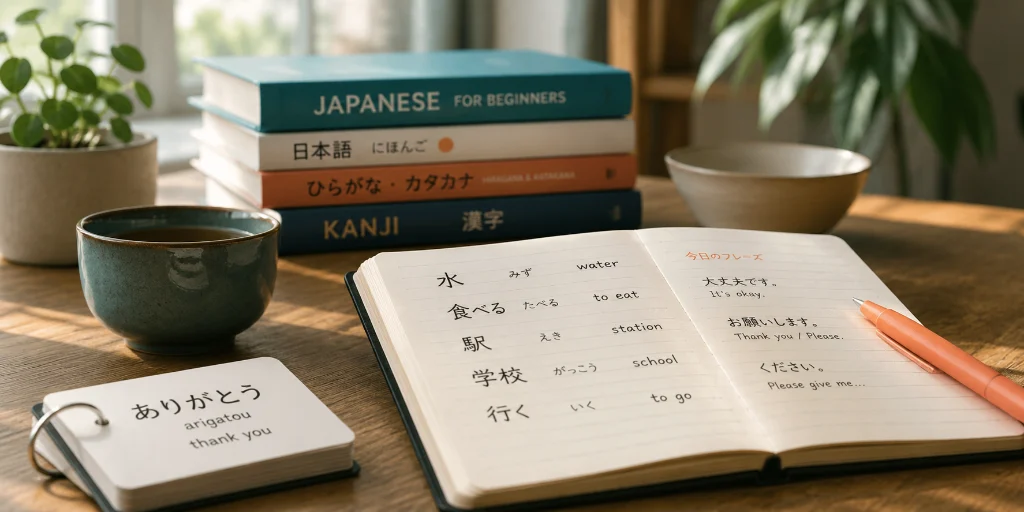
For example, 水 with the reading みず means “water,” 食べる with the reading たべる means “to eat,” and 駅 with the reading えき means “station.” These are more useful starting points than uncommon nouns chosen only because their kanji looks interesting.
Short expressions also deserve space from the beginning. A learner who knows 大丈夫です can communicate that something is okay, while お願いします and ください appear in many practical requests. Learn them as complete expressions rather than trying to assemble every sentence from isolated dictionary entries.
This is the same principle behind topic-based vocabulary learning with useful word sets: a connected group is easier to remember and easier to apply than a random list.
Learn the word, reading, sound, and meaning together
A Japanese vocabulary item has several layers. Beginners get better results when those layers are connected from the start:
- Written form: kana, kanji, or a natural combination of both.
- Reading: the kana reading when kanji is present.
- Sound: audio that lets you hear the word at a natural pace.
- Meaning: a clear translation or explanation.
- Context: a short example that shows how the word behaves.
Consider 学校. Seeing only the English word “school” does not teach you how Japanese represents or pronounces it. Seeing 学校, its reading がっこう, hearing the audio, and meeting it in a short example creates a much stronger memory.
My Lingua Cards can show a word, transcription, audio, translation, description, example sentence, and image on a card. For Japanese, this makes it possible to connect the written form with pronunciation and meaning instead of treating each part as a separate subject.
Audio is especially important because romanization can hide details and encourage English-like pronunciation. Use it as a temporary aid when necessary, but let kana and sound become your main guides. The article Learn Vocabulary with Audio explains why a word known only on the page may still be difficult to recognize in speech.
How to balance hiragana, katakana, kanji, and romaji
Learn hiragana early, but do not pause all vocabulary
Hiragana is foundational, so it deserves focused practice. However, you do not need to wait until every symbol feels automatic before learning useful Japanese words. Vocabulary gives the script a purpose. Reading みず, たべる, and ありがとう turns kana practice into real language practice.
Add katakana through common words
Katakana often appears in loanwords, names, menus, products, and modern everyday language. Learn the system, then reinforce it through words you are likely to meet, such as ホテル for “hotel” or コーヒー for “coffee.”
Meet kanji inside words, not as disconnected drawings
Kanji is easier to retain when it is attached to a word you already understand and can hear. Instead of trying to memorize every possible reading of 食, begin with a useful word such as 食べる. Later, related vocabulary will expand your understanding of the character.
This does not mean that dedicated kanji study is useless. It means that beginner vocabulary should remain the anchor. A character, its reading, and its meaning become easier to organize when they belong to a word you can actually use.
Reduce romaji gradually
Romaji can help during the first few days, but it should not become the permanent front of every card. If you always see taberu before たべる, your eyes will continue choosing the familiar Latin letters. Keep romaji as support, then hide or ignore it as kana becomes more comfortable.
A practical My Lingua Cards workflow for Japanese beginners
A useful beginner workflow should remove decisions rather than create more of them. You need to know what to learn now, what to review, and when to add new material.
- Choose Japanese as your learning language and set your native language. This establishes the direction of the cards and the language of the translations.
- Answer the starter questions after sign-up. My Lingua Cards uses your level, goals, and starting themes to prepare a starter dictionary for Japanese.
- Begin with the first active words, not the whole dictionary. The starter dictionary contains 300 words with images and transcriptions, and 10 of them are activated for immediate learning. That smaller active group is the important part. It gives you a clear first session without presenting hundreds of equal priorities.
- Use the full card information. Look at the Japanese form, check the reading or transcription, listen to the audio, read the translation, and notice the example. Do not spend equal time on every field, but use them to resolve uncertainty.
- Continue the learning session regularly. The session mixes familiar words that are due for repetition with new words chosen by the app, so you do not have to decide what to review first. This recognition practice helps you understand Japanese when you see or hear it.
- Add reverse practice. It is a separate session that runs from the translation to the word: a prompt in your language asks you to retrieve the Japanese word instead of merely recognizing it. This is the direction that exposes whether you can produce the word for speaking or writing.
- Continue a started word set. Staying with one useful theme, such as daily life, food, people, or travel, creates stronger connections than opening several unrelated sets.
- Use the Daily quiz as extra practice. It is built from words you are currently studying and can add variety, but it should support the main learning session rather than replace it.
The My Lingua Cards main page keeps this simple: its main action is to continue the learning session, and it shows how many cards are ready now and how many become ready in the next 8 hours. Reverse practice can appear there as an extra button. For a beginner, this matters because the hardest question is often not “Can I study?” but “What should I do first?”
Build vocabulary in four stages
You do not need to master every stage in the first encounter. Let each word become stronger over several reviews.
- Understand it: see or hear the Japanese word and recall the basic meaning.
- Read it: connect kana or kanji to the correct reading without relying immediately on romaji.
- Retrieve it: see the meaning in your language and produce the Japanese form before revealing the answer.
- Use it: say a short phrase or sentence that contains the word.
For 行く, for example, the stages might be: understand that it means “to go,” read it as いく, retrieve 行く from the meaning, and then say a short example such as 学校に行きます.
Forward and reverse practice should work together. Forward cards support comprehension, while reverse practice develops active recall. For a deeper explanation of this difference, see Two-Way Flashcards: Native-to-Target and Target-to-Native Practice.
Common mistakes that make Japanese vocabulary harder
Starting with a huge frequency list
A frequency list can be useful for choosing material, but it is not a study plan. Learning 300 disconnected entries at once creates more review than most beginners can manage. Start with a small active group and expand after you can retrieve it.
Memorizing isolated kanji before useful words
Characters need context. Learn kanji through practical vocabulary, then study components and additional readings as your word base grows.
Keeping romaji on every card forever
Romaji feels easier, which is exactly why it can block progress. Gradually make kana the form you notice first.
Skipping audio because the reading looks obvious
A correct kana reading does not guarantee natural pronunciation or fast listening recognition. Hear the word, repeat it, and connect the sound to the written form.
Saving every new word you encounter
Not every word deserves immediate review. Prioritize repeated, useful, situation-specific vocabulary. Leave rare words until they become relevant again.
Learning nouns but no verbs or expressions
A vocabulary base made only of objects is difficult to use. Mix nouns with common actions, descriptions, question words, and polite expressions so that you can build simple messages.
Adding new words before completing reviews
New vocabulary feels productive because it is novel. Reviews feel repetitive because the material is familiar. But retrieval of older words is what turns exposure into usable knowledge.
A seven-day Japanese vocabulary starter plan
- Day 1: Learn 10 useful items from one practical theme. Listen to each word and read its kana form.
- Day 2: Complete due reviews before adding anything new. Say each answer aloud after revealing it.
- Day 3: Focus on written recognition. Cover romaji when possible and read the kana or kanji with its reading.
- Day 4: Run a reverse practice session. Try to retrieve the Japanese word from your language before checking.
- Day 5: Continue the same word set. Add only a manageable number of new items after the reviews are complete.
- Day 6: Read the examples and create one very short spoken phrase for your weakest words.
- Day 7: Review the set and identify which layer causes trouble: meaning, reading, sound, or active recall. Use the card information that addresses that specific weakness.
This routine is intentionally modest. Ten words that you can recognize, pronounce, and retrieve are a better foundation than 100 words that merely look familiar.
What beginner progress should look like
Progress in Japanese vocabulary is not only a rising word count. You are moving forward when:
- you can read more words directly in kana without converting every symbol into romaji;
- common kanji begin to look familiar inside known words;
- you recognize a word in audio as well as on the screen;
- you can retrieve basic Japanese from a meaning in your own language;
- you can combine known words into short phrases;
- your earlier vocabulary remains available while you add new material.
Japanese becomes less confusing when vocabulary, writing, and sound support one another. Start with useful words, attach readings and audio, meet kanji inside real vocabulary, and practice both understanding and retrieval.
My Lingua Cards can turn that method into a clear daily sequence through starter words, detailed cards, due reviews, reverse practice, and focused word sets. Begin with the first small group, continue the learning session regularly, and let your Japanese vocabulary grow step by step. You can start with one month free and 300 cards.